
N기출 영어 영역 고난도 독해 Level 2
Part 2.- 3 과학 & 기술 변형문제
전문항 확인 하러가기!
https://themakings.co.kr/408/?idx=1508
최상위 수능 기출문제집 N기출 영어영역 고난도 독해 Level 2 Part 2 - 3. 과학 & 기술(PDF)
최상위 수능 기출문제집 N기출 영어영역 고난도 독해 Level 2 Part 2 - 3. 과학 & 기술(PDF)은 원어민 선생님과 현직 강사가 제작한 수능 영어 변형문제. 실전 감각을 높이는 고퀄리티 문제로 내신·수
themakings.co.kr
다음 지문을 읽고 글의 내용과 다른 문장을 고르세요.
“Survivorship bias” is a common logical fallacy. We’re prone to listen to the success stories from survivors because the others aren’t around to tell the tale. A dramatic example from history is the case of statistician Abraham Wald who, during World War Ⅱ, was hired by the U.S. Air Force to determine how to make their bomber planes safer. The planes that returned tended to have bullet holes along the wings, body, and tail, and commanders wanted to reinforce those areas because they seemed to get hit most often. Wald, however, saw that the important thing was that these bullet holes had not destroyed the planes, and what needed more protection were the areas that were not hit. Those were the parts where, if a plane was struck by a bullet, it would never be seen again. His calculations based on that logic are still in use today, and they have saved many pilots.
① Survivorship bias causes people to focus on success stories while overlooking those who failed.
② The surviving bomber planes displayed no identifiable pattern in where they had been damaged.
③ Wald concluded that the undamaged sections of returning planes were the truly vulnerable areas.
④ Military commanders originally sought to add armor to the areas showing the most bullet damage.
⑤ The analytical methods Wald developed during the war continue to be applied in the present day.
지문 해석
태도(attitude)는 네 가지 주요 구성 요소로 개념화되었다: 정서적(affective) 요소(좋아하거나 싫어하는 감정), 인지적(cognitive) 요소(신념과 그 신념에 대한 평가), 행동 의도(behavioral intention)(특정 상황에서 어떻게 행동할 것인지에 대한 진술), 그리고 행동(behavior). 야생 동물 종과 그 관리에 대한 대중의 태도는 이 구성 요소들의 상호작용을 바탕으로 형성된다. 늑대에 대한 태도를 형성할 때, 사람들은 태도의 정서적 요소를 인지적 요소와 일관되게 유지하려 한다. 예를 들어, 나는 늑대를 싫어할 수 있다. 나는 늑대가 사람을 죽였다고 믿고(인지적 신념), 사람이 죽는 것은 당연히 나쁘다(신념에 대한 평가). 이로 인한 행동 의도는 늑대 통제 프로그램을 지지하는 것이 될 수 있고, 실제 행동은 늑대를 사살한 이력이 될 수 있다. 이 예에서 태도의 모든 측면이 서로 일관되어 늑대에 대한 부정적인 전체 태도를 만들어낸다.
풀이 흐름
이 지문은 태도의 네 가지 구성 요소를 각각 명확히 정의한다. 문제를 풀 때는 각 구성 요소의 정의가 정확히 어떤 요소에 해당하는지 혼동 없이 파악하는 것이 핵심이다.
지문은 네 가지 요소를 다음과 같이 정의한다.
- 정서적(affective): "feelings of liking or disliking" (좋아하거나 싫어하는 감정)
- 행동 의도(behavioral intention): "a statement of how one would behave in a certain situation" (특정 상황에서 어떻게 행동할 것인지)
따라서 정서적 요소가 "특정 상황에서 어떻게 행동할 것인지를 가리킨다"고 서술하는 선지가 있다면, 이는 행동 의도의 정의를 정서적 요소에 잘못 대입한 것이다.
전체 선지 분석
|
선지
|
판정
|
근거
|
|
① Cognitive beliefs include both what a person believes and how they evaluate those beliefs.
|
✅ 일치
|
지문의 "cognitive (beliefs and evaluation of those beliefs)"와 직접 대응. what a person believes = beliefs, how they evaluate = evaluation.
|
|
② The affective component of attitude refers to how one would behave in a given situation.
|
❌ 불일치
|
지문은 정서적 요소를 "feelings of liking or disliking"으로, "how one would behave in a certain situation"은 행동 의도(behavioral intention로 정의. ②는 행동 의도의 정의를 정서적 요소에 잘못 대입했다.
|
|
③ Attitudes toward wildlife are influenced by the interaction of multiple attitude components.
|
✅ 일치
|
지문의 "Public attitudes toward a wildlife species and its management are generated based on the interaction of those components"와 직접 대응.
|
|
④ The example illustrates how different attitude components align to form a unified negative viewpoint.
|
✅ 일치
|
지문의 "all aspects of attitude are consistent with each other, producing a negative overall attitude toward wolves"와 정확히 대응. align = consistent, unified negative viewpoint = negative overall attitude.
|
|
⑤ A history of shooting wolves represents the behavioral component of attitude in the example.
|
✅ 일치
|
지문의 "actual behavior may be a history of shooting wolves"와 직접 대응. behavioral component = behavior.
|
핵심 문장 정리
"affective (feelings of liking or disliking)"
"behavioral intention (a statement of how one would behave in a certain situation)"
이 두 정의가 ②번 선지의 오류를 판별하는 결정적 근거다. 지문은 정서적(affective) 요소를 "좋아하거나 싫어하는 감정"으로 정의하고, "특정 상황에서 어떻게 행동할 것인지"는 행동 의도(behavioral intention)의 정의라고 명시한다. ②번은 행동 의도의 정의를 정서적 요소에 잘못 귀속시켜 두 구성 요소의 정의를 뒤바꿨다.
한 줄 정리
정서적(affective) 요소는 "특정 상황에서 어떻게 행동할 것인지"를 가리키는 것이 아니라 "좋아하거나 싫어하는 감정"을 가리키며, 전자의 정의는 "행동 의도(behavioral intention)"에 해당한다.
The Makings의 Part 2 - 3. 과학 & 기술 변형문제는
총 11개의 유형으로 구성되어 있습니다.
1. 빈칸 채우기(객관식)
2. 글의 내용 일치/불일치(객관식/한글 선택지)
3. 글의 내용 일치/불일치(객관식/영어 선택지)
4. 글 끼어 넣기(객관식)
5. 어법(서술형)
6. 어휘(서술형)
7. 주제문(객관식/영어 선택지)
8. 어휘 빈칸 채우기(서술형)
9. 영작(서술형)
10. 요약문 완성하기(서술형)
11. 문단 재배열 하기(객관식)
더메이킹스(The Makings)가 제작한
최상위 수능 기출문제집 N기출 영어영역 고난도 독해 Level 2
Part 2 - 3. 과학 & 기술(44문항) 변형문제의 지문입니다.
1번 지문
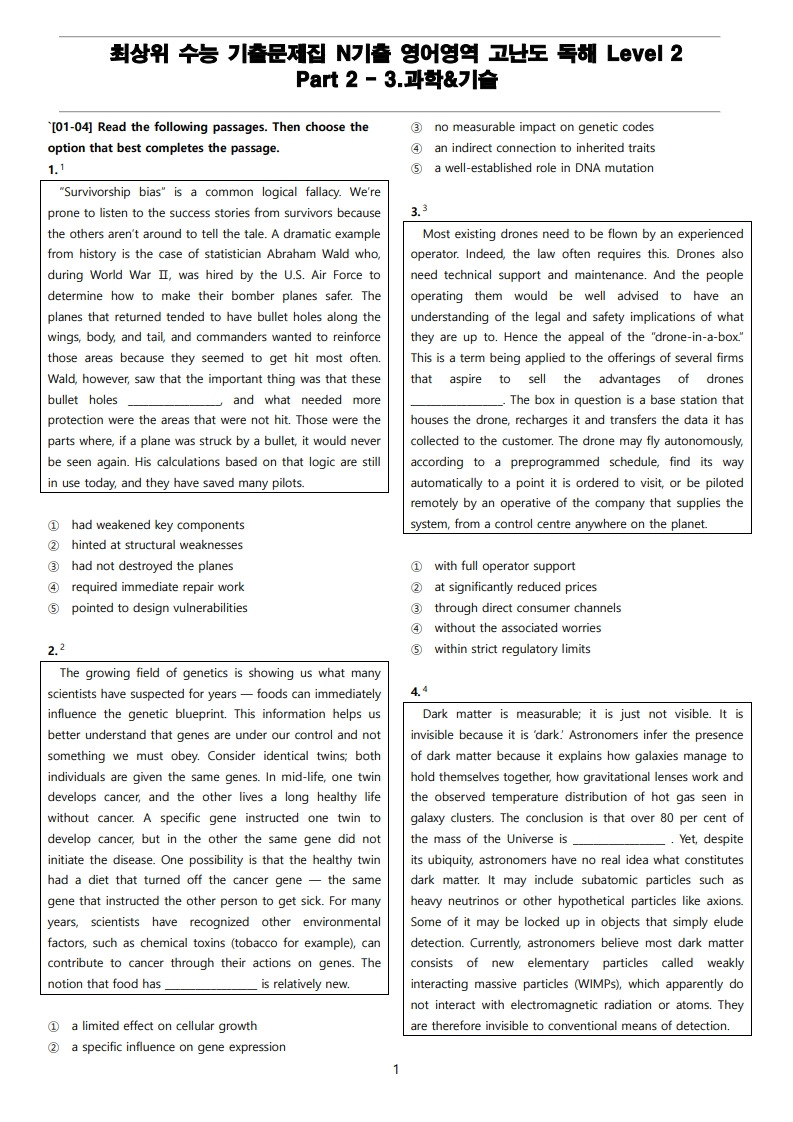
“Survivorship bias” is a common logical fallacy. We’re prone to listen to the success stories from survivors because the others aren’t around to tell the tale. A dramatic example from history is the case of statistician Abraham Wald who, during World War Ⅱ, was hired by the U.S. Air Force to determine how to make their bomber planes safer. The planes that returned tended to have bullet holes along the wings, body, and tail, and commanders wanted to reinforce those areas because they seemed to get hit most often. Wald, however, saw that the important thing was that these bullet holes had not destroyed the planes, and what needed more protection were the areas that were not hit. Those were the parts where, if a plane was struck by a bullet, it would never be seen again. His calculations based on that logic are still in use today, and they have saved many pilots.
2번 지문
The growing field of genetics is showing us what many scientists have suspected for years ― foods can immediately influence the genetic blueprint. This information helps us better understand that genes are under our control and not something we must obey. Consider identical twins; both individuals are given the same genes. In mid-life, one twin develops cancer, and the other lives a long healthy life without cancer. A specific gene instructed one twin to develop cancer, but in the other the same gene did not initiate the disease. One possibility is that the healthy twin had a diet that turned off the cancer gene ― the same gene that instructed the other person to get sick. For many years, scientists have recognized other environmental factors, such as chemical toxins (tobacco for example), can contribute to cancer through their actions on genes. The notion that food has a specific influence on gene expression is relatively new.
3번 지문
Most existing drones need to be flown by an experienced operator. Indeed, the law often requires this. Drones also need technical support and maintenance. And the people operating them would be well advised to have an understanding of the legal and safety implications of what they are up to. Hence the appeal of the “drone-in-a-box.” This is a term being applied to the offerings of several firms that aspire to sell the advantages of drones without the associated worries. The box in question is a base station that houses the drone, recharges it and transfers the data it has collected to the customer. The drone may fly autonomously, according to a preprogrammed schedule, find its way automatically to a point it is ordered to visit, or be piloted remotely by an operative of the company that supplies the system, from a control centre anywhere on the planet.
4번 지문
Dark matter is measurable; it is just not visible. It is invisible because it is ‘dark.’ Astronomers infer the presence of dark matter because it explains how galaxies manage to hold themselves together, how gravitational lenses work and the observed temperature distribution of hot gas seen in galaxy clusters. The conclusion is that over 80 per cent of the mass of the Universe is in a form we simply can’t see. Yet, despite its ubiquity, astronomers have no real idea what constitutes dark matter. It may include subatomic particles such as heavy neutrinos or other hypothetical particles like axions. Some of it may be locked up in objects that simply elude detection. Currently, astronomers believe most dark matter consists of new elementary particles called weakly interacting massive particles (WIMPs), which apparently do not interact with electromagnetic radiation or atoms. They are therefore invisible to conventional means of detection.
'문제집 변형문제 > N기출 영어영역 고난도 독해 Level 2' 카테고리의 다른 글
| N기출 영어 영역 고난도 독해 Level 2 Part 2.- 5 건강 & 의학 변형문제 (0) | 2026.09.21 |
|---|---|
| N기출 영어 영역 고난도 독해 Level 2 Part 2.- 4 경영 & 경제 변형문제 (0) | 2026.09.21 |
| N기출 영어 영역 고난도 독해 Level 2 Part 2.- 2 사회 & 문화 변형문제 (0) | 2026.09.20 |
| N기출 영어 영역 고난도 독해 Level 2 Part 2.- 1 심리 철학 변형 문제 (0) | 2026.09.19 |
| N기출 영어 영역 고난도 독해 Level 2 Part 1.- 7 요약문 완성 변형 문제 (0) | 2026.09.13 |