
N기출 영어 영역 고난도 독해
Level 2 Part 2.- 2 사회 & 문화 변형문제
전문항 확인 하러가기!
https://themakings.co.kr/408/?idx=1506
최상위 수능 기출문제집 N기출 영어영역 고난도 독해 Level 2 Part 2 - 2. 사회 & 문화(PDF)
최상위 수능 기출문제집 N기출 영어영역 고난도 독해 Level 2 Part 2 - 2. 사회 & 문화(PDF)은 원어민 선생님과 현직 강사가 제작한 수능 영어 변형문제. 실전 감각을 높이는 고퀄리티 문제로 내신·수
themakings.co.kr
다음 지문을 읽고 글의 내용과 다른 문장을 고르세요.
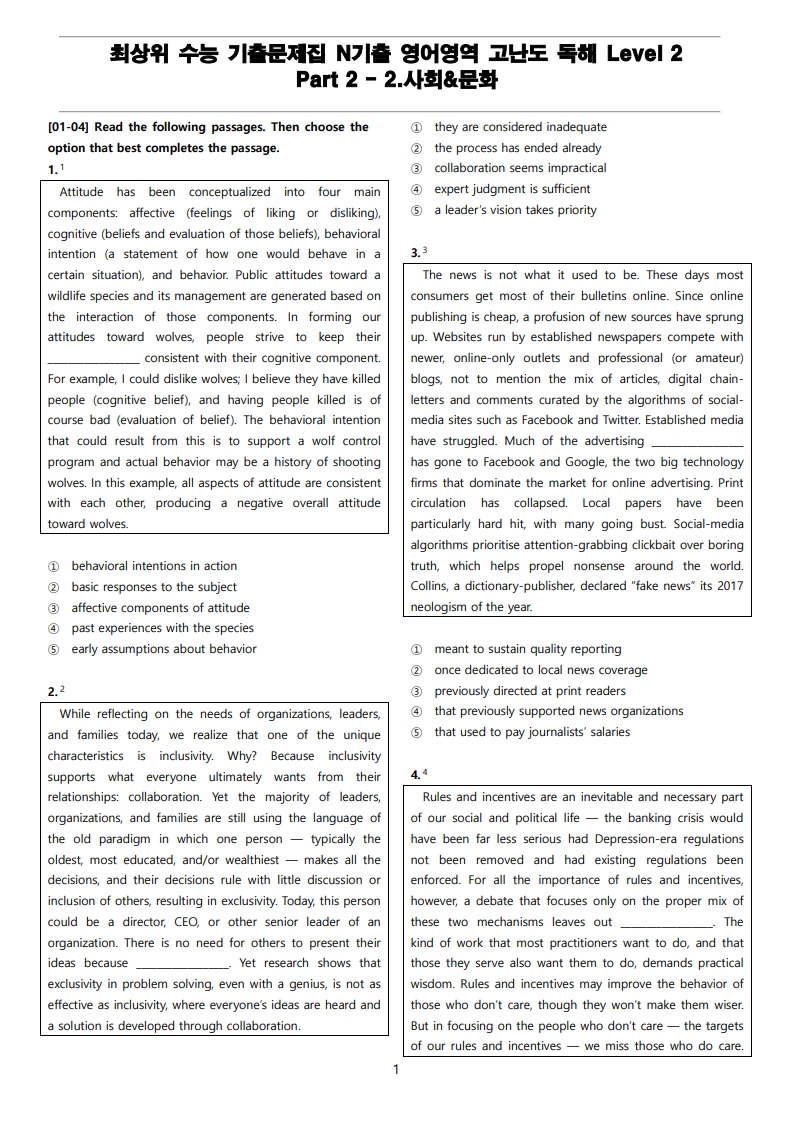
Attitude has been conceptualized into four main components: affective (feelings of liking or disliking), cognitive (beliefs and evaluation of those beliefs), behavioral intention (a statement of how one would behave in a certain situation), and behavior. Public attitudes toward a wildlife species and its management are generated based on the interaction of those components. In forming our attitudes toward wolves, people strive to keep their affective components of attitude consistent with their cognitive component. For example, I could dislike wolves; I believe they have killed people (cognitive belief), and having people killed is of course bad (evaluation of belief). The behavioral intention that could result from this is to support a wolf control program and actual behavior may be a history of shooting wolves. In this example, all aspects of attitude are consistent with each other, producing a negative overall attitude toward wolves.
① Cognitive beliefs include both what a person believes and how they evaluate those beliefs.
② The affective component of attitude refers to how one would behave in a given situation.
③ Attitudes toward wildlife are influenced by the interaction of multiple attitude components.
④ The example illustrates how different attitude components align to form a unified negative viewpoint.
⑤ A history of shooting wolves represents the behavioral component of attitude in the example.
지문 해석
태도(attitude)는 네 가지 주요 구성 요소로 개념화되었다: 정서적(affective) 요소(좋아하거나 싫어하는 감정), 인지적(cognitive) 요소(신념과 그 신념에 대한 평가), 행동 의도(behavioral intention)(특정 상황에서 어떻게 행동할 것인지에 대한 진술), 그리고 행동(behavior). 야생 동물 종과 그 관리에 대한 대중의 태도는 이 구성 요소들의 상호작용을 바탕으로 형성된다. 늑대에 대한 태도를 형성할 때, 사람들은 태도의 정서적 요소를 인지적 요소와 일관되게 유지하려 한다. 예를 들어, 나는 늑대를 싫어할 수 있다. 나는 늑대가 사람을 죽였다고 믿고(인지적 신념), 사람이 죽는 것은 당연히 나쁘다(신념에 대한 평가). 이로 인한 행동 의도는 늑대 통제 프로그램을 지지하는 것이 될 수 있고, 실제 행동은 늑대를 사살한 이력이 될 수 있다. 이 예에서 태도의 모든 측면이 서로 일관되어 늑대에 대한 부정적인 전체 태도를 만들어낸다.
풀이 흐름
이 지문은 태도의 네 가지 구성 요소를 각각 명확히 정의한다. 문제를 풀 때는 각 구성 요소의 정의가 정확히 어떤 요소에 해당하는지 혼동 없이 파악하는 것이 핵심이다.
지문은 네 가지 요소를 다음과 같이 정의한다.
- 정서적(affective): "feelings of liking or disliking" (좋아하거나 싫어하는 감정)
- 행동 의도(behavioral intention): "a statement of how one would behave in a certain situation" (특정 상황에서 어떻게 행동할 것인지)
따라서 정서적 요소가 "특정 상황에서 어떻게 행동할 것인지를 가리킨다"고 서술하는 선지가 있다면, 이는 행동 의도의 정의를 정서적 요소에 잘못 대입한 것이다.
전체 선지 분석
|
선지
|
판정
|
근거
|
|
① Cognitive beliefs include both what a person believes and how they evaluate those beliefs.
|
✅ 일치
|
지문의 "cognitive (beliefs and evaluation of those beliefs)"와 직접 대응. what a person believes = beliefs, how they evaluate = evaluation.
|
|
② The affective component of attitude refers to how one would behave in a given situation.
|
❌ 불일치
|
지문은 정서적 요소를 "feelings of liking or disliking"으로, "how one would behave in a certain situation"은 행동 의도(behavioral intention)로 정의. ②는 행동 의도의 정의를 정서적 요소에 잘못 대입했다.
|
|
③ Attitudes toward wildlife are influenced by the interaction of multiple attitude components.
|
✅ 일치
|
지문의 "Public attitudes toward a wildlife species and its management are generated based on the interaction of those components"와 직접 대응.
|
|
④ The example illustrates how different attitude components align to form a unified negative viewpoint.
|
✅ 일치
|
지문의 "all aspects of attitude are consistent with each other, producing a negative overall attitude toward wolves"와 정확히 대응. align = consistent, unified negative viewpoint = negative overall attitude.
|
|
⑤ A history of shooting wolves represents the behavioral component of attitude in the example.
|
✅ 일치
|
지문의 "actual behavior may be a history of shooting wolves"와 직접 대응. behavioral component = behavior.
|
핵심 문장 정리
"affective (feelings of liking or disliking)"
"behavioral intention (a statement of how one would behave in a certain situation)"
이 두 정의가 ②번 선지의 오류를 판별하는 결정적 근거다. 지문은 정서적(affective) 요소를 "좋아하거나 싫어하는 감정"으로 정의하고, "특정 상황에서 어떻게 행동할 것인지"는 행동 의도(behavioral intention)의 정의라고 명시한다. ②번은 행동 의도의 정의를 정서적 요소에 잘못 귀속시켜 두 구성 요소의 정의를 뒤바꿨다
한 줄 정리
정서적(affective) 요소는 "특정 상황에서 어떻게 행동할 것인지"를 가리키는 것이 아니라 "좋아하거나 싫어하는 감정"을 가리키며, 전자의 정의는 "행동 의도(behavioral intention)"에 해당한다.
The Makings의 Part 2 - 2. 사회 & 문화 변형문제는
총 11개의 유형으로 구성되어 있습니다.
1. 빈칸 채우기(객관식)
2. 글의 내용 일치/불일치(객관식/한글 선택지)
3. 글의 내용 일치/불일치(객관식/영어 선택지)
4. 글 끼어 넣기(객관식)
5. 어법(서술형)
6. 어휘(서술형)
7. 주제문(객관식/영어 선택지)
8. 어휘 빈칸 채우기(서술형)
9. 영작(서술형)
10. 요약문 완성하기(서술형)
11. 문단 재배열 하기(객관식)
더메이킹스(The Makings)가 제작한
최상위 수능 기출문제집 N기출 영어영역 고난도 독해 Level 2
Part 2 - 2. 사회 & 문화(44문항) 변형문제의 지문입니다.
1번 지문
While working as a research fellow at Harvard, B. F. Skinner carried out a series of experiments on rats, using an invention that later became known as a "Skinner box." A rat was placed in one of these boxes, which had a special bar fitted on the inside. Every time the rat pressed this bar, it was presented with food. The rate of bar‑pressing was automatically recorded. Initially, the rat might press the bar accidentally, or simply out of curiosity, and as a consequence receive some food. Over time, the rat learned that food appeared whenever the bar was pressed, and began to press it purposefully in order to be fed. Comparing results from rats given the "positive reinforcement" of food for their bar‑pressing behavior with those that were not, or were presented with food at different rates, it became clear that when food appeared as a consequence of the rat's actions, this influenced its future behavior.
2번 지문
Theseus was a great hero to the people of Athens. When he returned home after a war, the ship that had carried him and his men was so treasured that the townspeople preserved it for years and years, replacing its old, rotten planks with new pieces of wood. The question Plutarch asks philosophers is this: is the repaired ship still the same ship that Theseus had sailed? Removing one plank and replacing it might not make a difference, but can that still be true once all the planks have been replaced? Some philosophers argue that the ship must be the sum of all its parts. But if this is true, then as the ship got pushed around during its journey and lost small pieces, it would already have stopped being the ship of Theseus.
3번 지문
Many people look for safety and security in popular thinking. They figure that if a lot of people are doing something, then it must be right. It must be a good idea. If most people accept it, then it probably represents fairness, equality, compassion, and sensitivity, right? Not necessarily. Popular thinking said the earth was the center of the universe, yet Copernicus studied the stars and planets and proved mathematically that the earth and the other planets in our solar system revolved around the sun. Popular thinking said surgery didn't require clean instruments, yet Joseph Lister studied the high death rates in hospitals and introduced antiseptic practices that immediately saved lives. Popular thinking said that women shouldn't have the right to vote, yet people like Emmeline Pankhurst and Susan B. Anthony fought for and won that right. We must always remember there is a huge difference between acceptance and intelligence. People may say that there's safety in numbers, but that's not always true.
4번 지문
Good reductionism consists not of replacing one field of knowledge with another but of connecting or unifying them. The building blocks used by one field are put under a microscope by another. A geographer might explain why the coastline of Africa fits into the coastline of the Americas by saying that the landmasses were once adjacent but sat on different plates, which drifted apart. The question of why the plates move gets passed on to the geologists, who appeal to an upwelling of magma that pushes them apart. As for how the magma got so hot, they call in the physicists to explain the reactions in the Earth’s core and mantle. None of the scientists is dispensable.
'문제집 변형문제 > N기출 영어영역 고난도 독해 Level 2' 카테고리의 다른 글
| N기출 영어 영역 고난도 독해 Level 2 Part 2.- 4 경영 & 경제 변형문제 (0) | 2026.09.21 |
|---|---|
| N기출 영어 영역 고난도 독해 Level 2 Part 2.- 3 과학 & 기술 변형문제 (0) | 2026.09.20 |
| N기출 영어 영역 고난도 독해 Level 2 Part 2.- 1 심리 철학 변형 문제 (0) | 2026.09.19 |
| N기출 영어 영역 고난도 독해 Level 2 Part 1.- 7 요약문 완성 변형 문제 (0) | 2026.09.13 |
| N기출 영어영역 고난도 독해 Level 2 Part 1.- 6 문장 삽입 변형문제 (0) | 2026.08.26 |