수능실감 영어 독해 5문항 모의고사 300제
Day 31 변형문제

전문항 확인 하러가기!
https://themakings.co.kr/421/?idx=1687
수능실감 영어 독해 5문항 모의고사 300제 DAY 31 변형문제(PDF)
수능실감 영어 독해 5문항 모의고사 300제 DAY 31 변형문제(PDF)은 원어민 선생님과 현직 강사가 제작한 수능 영어 변형문제. 실전 감각을 높이는 고퀄리티 문제로 내신·수능 완벽 대비.
themakings.co.kr
다음 지문을 읽고 글의 내용과 다른 문장을 고르세요.
Some people argue that since the brain hemispheres do have certain proclivities towards creativity versus logic, people should target their learning to cater to these differences. For example, right-brain people are supposed to be more creative, free-minded, and carefree, while left-brain people are supposed to be more logical, analytical, and deliberate. It can certainly be a plausible story to buy into, but it's not as if you learn with just one side and that side should be appealed to exclusively. Both brain hemispheres are involved in almost every single mental process, and studies have demonstrated that people do not have dominant hemispheres whatsoever. What does this mean for you? Just because you're more artistic or more analytical doesn't mean that you should ignore the other parts of life! You can be equally as good at those parts, if not better, so don't let the idea of the dominant hemisphere prevent you from exploring other areas.
① Some people claim that learning should be tailored to the different tendencies of the brain hemispheres toward creativity and logic.
② Right-brain people tend to be more logical and methodical, while left-brain people tend to be more creative and spontaneous.
③ It may be a convincing idea that each hemisphere has its own strengths, but learning does not rely on just one side of the brain.
④ Research has shown that both hemispheres participate in nearly all mental processes, disproving the notion of a dominant hemisphere.
⑤ Being more artistic or analytical does not mean one should neglect other aspects of life, and exploring diverse areas is encouraged.
지문 해석
일부 사람들은 뇌 반구가 창의성 대 논리 쪽으로 특정 성향을 가지고 있으므로, 사람들은 이 차이에 맞추어 학습을 목표화해야 한다고 주장한다. 예를 들어, 우뇌형 사람은 더 창의적이고, 자유로우며, 태평한 것으로 여겨지고, 좌뇌형 사람은 더 논리적이고, 분석적이며, 신중한 것으로 여겨진다. 이것은 분명히 받아들일 만한 그럴듯한 이야기일 수 있지만, 한쪽 면으로만 배우고 그쪽에만 독점적으로 호소해야 하는 것은 아니다. 양쪽 뇌 반구가 거의 모든 단일 정신적 과정에 관여하며, 연구들은 사람들이 지배적 반구를 전혀 가지고 있지 않다는 것을 보여주었다. 이것이 당신에게 무엇을 의미하는가? 당신이 더 예술적이거나 더 분석적이라고 해서 삶의 다른 부분을 무시해야 한다는 뜻이 아니다! 당신은 그 부분들에서도 똑같이 잘할 수 있고, 어쩌면 더 잘할 수도 있으니, 지배적 반구라는 개념이 다른 영역을 탐구하는 것을 막지 않도록 하라.
풀이 흐름
이 지문은 좌뇌/우뇌 이론을 소개하면서 각 반구에 전통적으로 부여되는 특성을 나열한다. 이 특성이 어느 반구에 귀속되는지를 정확히 파악하는 것이 핵심이다.
지문은 ”right-brain people are supposed to be more creative, free-minded, and carefree, while left-brain people are supposed to be more logical, analytical, and deliberate”라고 명시한다. 즉, 우뇌형 = 창의적·자유로운·태평한, 좌뇌형 = 논리적·분석적·신중한이다.
따라서 우뇌형이 ”더 논리적이고 체계적(more logical and methodical)”이고 좌뇌형이 ”더 창의적이고 자발적(more creative and spontaneous)”이라고 서술하는 선지가 있다면, 이는 양쪽 반구의 특성을 완전히 뒤바꾼 것이다.
전체 선지 분석
|
선지
|
판정
|
근거
|
|
① Some people claim that learning should be tailored to the different tendencies of the brain hemispheres toward creativity and logic.
|
✅ 일치
|
지문의 “some people argue that... people should target their learning to cater to these differences”와 직접 대응. tailored = target, tendencies = proclivities.
|
|
② Right-brain people tend to be more logical and methodical, while left-brain people tend to be more creative and spontaneous.
|
❌ 불일치
|
지문은 ”right-brain people are supposed to be more creative, free-minded, and carefree, while left-brain people are supposed to be more logical, analytical, and deliberate”라고 명시. right-brain = logical ↔ creative, left-brain = creative ↔ logical로 양쪽 반구의 특성이 완전히 뒤바뀜.
|
|
③ It may be a convincing idea that each hemisphere has its own strengths, but learning does not rely on just one side of the brain.
|
✅ 일치
|
지문의 “It can certainly be a plausible story to buy into, but it’s not as if you learn with just one side”와 정확히 대응. convincing = plausible.
|
|
④ Research has shown that both hemispheres participate in nearly all mental processes, disproving the notion of a dominant hemisphere.
|
✅ 일치
|
지문의 “Both brain hemispheres are involved in almost every single mental process, and studies have demonstrated that people do not have dominant hemispheres whatsoever”와 직접 대응.
|
|
⑤ Being more artistic or analytical does not mean one should neglect other aspects of life, and exploring diverse areas is encouraged.
|
✅ 일치
|
지문의 “Just because you’re more artistic or more analytical doesn’t mean that you should ignore the other parts of life” + “don’t let... prevent you from exploring other areas”와 정확히 대응.
|
핵심 문장 정리
“Right-brain people are supposed to be more creative, free-minded, and carefree, while left-brain people are supposed to be more logical, analytical, and deliberate.”
이 문장이 ②번 선지의 오류를 판별하는 결정적 근거다. 지문은 우뇌형이 ”창의적(creative)”이고 좌뇌형이 ”논리적(logical)”이라고 서술하는 반면, ②번은 우뇌형이 ”논리적이고 체계적(logical and methodical)”이고 좌뇌형이 ”창의적이고 자발적(creative and spontaneous)”이라고 양쪽 반구에 귀속되는 특성을 완전히 뒤바꿔 서술했다.
한 줄 정리
우뇌형은 "논리적이고 체계적인" 것이 아니라 "창의적이고 자유로운" 것으로, 좌뇌형은 "창의적이고 자발적인" 것이 아니라 "논리적이고 분석적인" 것으로 여겨진다.
The Makings의 DAY 31 변형문제는
총 11개의 유형으로 구성되어 있습니다.
1. 빈칸 채우기(객관식)
2. 글의 내용 일치/불일치(객관식/한글 선택지)
3. 글의 내용 일치/불일치(객관식/영어 선택지)
4. 글 끼어 넣기(객관식)
5. 어법(서술형)
6. 어휘(서술형)
7. 주제문(객관식/영어 선택지)
8. 어휘 빈칸 채우기(서술형)
9. 영작(서술형)
10. 요약문 완성하기(서술형)
11. 문단 재배열 하기(객관식)
더메이킹스(The Makings)가 제작한 수능실감 영어 독해 5문항 모의고사 300제
DAY 31(55문항) 변형문제의 지문입니다.
1번 지문
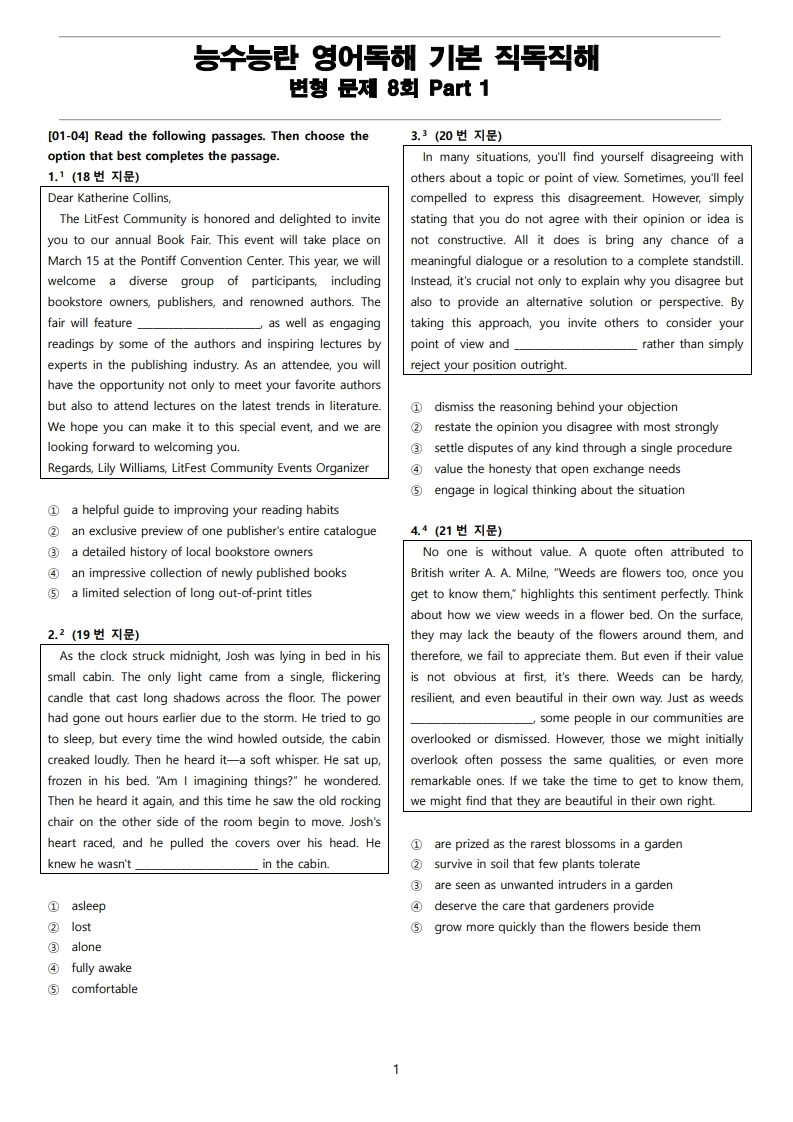
Some people argue that since the brain hemispheres do have certain proclivities towards creativity versus logic, people should target their learning to cater to these differences. For example, right-brain people are supposed to be more creative, free-minded, and carefree, while left-brain people are supposed to be more logical, analytical, and deliberate. It can certainly be a plausible story to buy into, but it's not as if you learn with just one side and that side should be appealed to exclusively. Both brain hemispheres are involved in almost every single mental process, and studies have demonstrated that people do not have dominant hemispheres whatsoever. What does this mean for you? Just because you're more artistic or more analytical doesn't mean that you should ignore the other parts of life! You can be equally as good at those parts, if not better, so don't let the idea of the dominant hemisphere prevent you from exploring other areas.
2번 지문
We often think we slow down and stop during athletic training because we run out of physiological energy ─ that it is the strength of our muscles or the oxygen in our blood that caps our maximum expenditure. Yet research finds that when individuals feel they've reached their physical limits, they actually have the capacity to go on for much longer. It isn't your body that shuts things down, it's your mind. The brain exercises a miserly control over the body's life-sustaining resources; it monitors the environment within and without, and when it feels there's a risk of your getting too fatigued and run-down, it puts the brakes on your efforts, throwing the switch far from the actual point at which you would become dangerously exhausted. But, when an unusual necessity compels you beyond this premature barrier ─ such as the pressures of competition ─ a surprising thing occurs: The power of the brain relents, allowing you to experience a second wind.
3번 지문
Harvard psychologist Felix Warneken had adults show elementary-aged children two pictures they drew ─ one pretty good, one terrible. If the adult didn't show any particular pride in the picture, the kids were truthful in saying whether it was good or bad. If the grown-up acted sad about being a bad artist, most of the kids would rush to reassure her that it wasn't too awful. In other words, they told a white lie; the older they were, the more likely the kids were to say a bad drawing was good. There were no negative consequences for telling the truth to these bad artists; the kids just wanted these strangers to feel better about themselves. In other words, says Warneken, it's a feeling of empathic connection that drives children to tell white lies. In fact, children are trying to resolve two conflicting norms ─ honesty vs. kindness ─ and by about age seven, his studies suggest, they start consistently coming down on the side of kindness.
4번 지문
The electromagnetic force works between any two things that have electric charge. The more the charge, the stronger the force. And, like gravity, the force depends on the separation between the objects. The further they are apart, the weaker the force. But unlike gravity, electromagnetism can be both attractive and repulsive; it can pull things together and push them apart. Opposite charges, one positive the other negative, attract. Like charges, both positive or both negative, repel. This means that a composite object that has an equal amount of positive and negative charge will push and pull in equal amounts and consequently experience and exert no electromagnetic force at all. This balance, the result of charge neutrality, can never happen with gravity. There being no negative mass, there is no possibility of a mass-neutral object. You can't neutralize gravity as you can the electromagnetic force.
5번 지문
At Purdue University Library, a librarian goes about her business, checking out people's books. She is playing a role in an experiment in unnoticeable physical contact, and knows that half the time she is to do nothing special, the other half to touch students as lightly as possible. She brushes a student's hand gently as she returns a library card. Then the student is followed outside and asked to complete a questionnaire about the library that day. Among other questions, the student is asked if the librarian smiled, and if she touched him. In fact, the librarian had not smiled, but the student reports that she did, although he says she did not touch him. This experiment goes on all day, and soon a pattern emerges: those students who have been subtly touched report much more satisfaction with the library and life overall.
'문제집 변형문제 > 수능 실감 영어 독해 5문항 300제' 카테고리의 다른 글
| 수능실감 영어 독해 5문항 모의고사 300제 Day 30 변형문제 (0) | 2026.10.09 |
|---|---|
| 수능실감 영어 독해 5문항 모의고사 300제 Day 29 변형문제 (0) | 2026.10.09 |
| 수능실감 영어 독해 5문항 모의고사 300제 Day 28 변형문제 (0) | 2026.10.08 |
| 수능실감 영어 독해 5문항 모의고사 300제 Day 27 변형문제 (0) | 2026.10.08 |
| 수능실감 영어 독해 5문항 모의고사 300제 Day 24 변형문제 (0) | 2026.10.06 |