
N기출 영어영역 고난도 독해 Level 2
Part 1.- 5 빈칸 추론 변형문제
전문항 확인 하러가기!
https://themakings.co.kr/408/?idx=1497
최상위 수능 기출문제집 N기출 영어영역 고난도 독해 Level 2 Part 1 - 5. 글의 순서(PDF)
최상위 수능 기출문제집 N기출 영어영역 고난도 독해 Level 2 Part 1 - 5. 글의 순서(PDF)은 원어민 선생님과 현직 강사가 제작한 수능 영어 변형문제. 실전 감각을 높이는 고퀄리티 문제로 내신·수능
themakings.co.kr
다음 지문을 읽고 글의 내용과 다른 문장을 고르세요.
Stabilizing selection refers to selection against both extremes of a trait's range in values. Individuals with extreme high or low values of a trait are less likely to survive and reproduce, and those with values closer to the average are more likely to survive and reproduce. The effect of stabilizing selection is to maintain the population at the same average value over time. Extreme values are selected against each generation, but the average value in the population does not change. Human birth weight is a good example of stabilizing selection. The weight of a newborn child is the result of a number of environmental factors, such as mother's age and weight, among many others. There is also a genetic component to birth weight. Newborns who are very small (less than 2.5 kg) are less likely to survive than newborns who are heavier. Very small ones are more prone to disease and have weaker systems, making their survival more difficult. Newborns who are too large are also likely to be selected against, because a very large child may create complications during childbirth and both mother and child may die. Thus, there is selection against both extremes, small and large.
① Individuals with extreme trait values face lower survival chances under stabilizing selection.
② Birth weight in humans is shaped by environmental factors along with a genetic component.
③ Very small newborns tend to develop stronger resistance to disease than their heavier peers.
④ Large newborns may cause serious complications during childbirth, endangering mother and child.
⑤ Under stabilizing selection, extreme trait values are eliminated across successive generations.
지문 해석
안정화 선택(stabilizing selection)이란 어떤 형질의 값 범위에서 양쪽 극단 모두에 대한 선택을 의미한다. 극단적으로 높거나 낮은 형질 값을 가진 개체는 생존하고 번식할 가능성이 낮으며, 평균에 가까운 값을 가진 개체가 생존하고 번식할 가능성이 높다. 안정화 선택의 효과는 시간이 지나도 집단의 평균값을 동일하게 유지하는 것이다. 극단적인 값은 매 세대 도태되지만 집단의 평균값은 변하지 않는다. 인간의 출생 체중이 안정화 선택의 좋은 예이다. 신생아의 체중은 어머니의 나이와 체중 등 여러 환경적 요인의 결과이다. 출생 체중에는 유전적 요소도 있다. 매우 작은 신생아(2.5kg 미만)는 더 무거운 신생아보다 생존할 가능성이 낮다. 매우 작은 아이들은 질병에 더 취약하고 체계가 약해 생존이 더 어렵다. 매우 큰 신생아도 도태될 가능성이 있는데, 매우 큰 아이는 출산 중 합병증을 일으킬 수 있으며 모자 모두 사망할 수 있기 때문이다. 따라서 작은 쪽과 큰 쪽, 양쪽 극단 모두에 대한 선택이 존재한다.
풀이 흐름
이 지문은 안정화 선택의 개념을 설명하면서 인간 출생 체중을 구체적 사례로 제시한다. 특히 매우 작은 신생아의 생존 불리함을 설명하는 부분에 주목해야 한다. 지문은 매우 작은 신생아에 대해 "more prone to disease and have weaker systems"라고 명시한다. 즉, 질병에 더 취약하고 체계가 더 약하다는 것이다. 따라서 매우 작은 신생아가 더 무거운 또래보다 질병에 대한 "더 강한 저항력(stronger resistance)"을 발달시킨다고 서술하는 선지가 있다면, 이는 지문과 정면으로 모순된다.
전체 선지 분석
|
선지
|
판정
|
근거
|
|
① Individuals with extreme trait values face lower survival chances under stabilizing selection.
|
✅ 일치
|
지문의 "Individuals with extreme high or low values of a trait are less likely to survive and reproduce"와 직접 대응. lower survival chances = less likely to survive.
|
|
② Birth weight in humans is shaped by environmental factors along with a genetic component.
|
✅ 일치
|
지문의 "the result of a number of environmental factors" + "There is also a genetic component to birth weight"와 정확히 대응.
|
|
③ Very small newborns tend to develop stronger resistance to disease than their heavier peers.
|
❌ 불일치
|
지문은 "Very small ones are more prone to disease and have weaker systems"라고 명시. stronger resistance ↔ more prone to disease / weaker systems로 정반대.
|
|
④ Large newborns may cause serious complications during childbirth, endangering mother and child.
|
✅ 일치
|
지문의 "a very large child may create complications during childbirth and both mother and child may die"와 직접 대응. endangering = may die.
|
|
⑤ Under stabilizing selection, extreme trait values are eliminated across successive generations.
|
✅ 일치
|
지문의 "Extreme values are selected against each generation"과 일치. eliminated = selected against, successive generations = each generation.
|
핵심 문장 정리
"Very small ones are more prone to disease and have weaker systems, making their survival more difficult."
이 문장이 ③번 선지의 오류를 판별하는 결정적 근거다. 지문은 매우 작은 신생아가 질병에 "더 취약하고(more prone)" 체계가 "더 약하다(weaker)"고 서술하는 반면, ③번은 "더 강한 저항력을 발달시킨다(develop stronger resistance)"고 정반대로 서술했다.
한 줄 정리
매우 작은 신생아는 더 무거운 또래보다 질병에 대한 "더 강한 저항력"을 가지는 것이 아니라 오히려 "질병에 더 취약하고 체계가 약하다."
The Makings의 Part 1 - 5. 글의 순서 변형문제는
총 11개의 유형으로 구성되어 있습니다.
1. 빈칸 채우기(객관식)
2. 글의 내용 일치/불일치(객관식/한글 선택지)
3. 글의 내용 일치/불일치(객관식/영어 선택지)
4. 글 끼어 넣기(객관식)
5. 어법(서술형)
6. 어휘(서술형)
7. 주제문(객관식/영어 선택지)
8. 어휘 빈칸 채우기(서술형)
9. 영작(서술형)
10. 요약문 완성하기(서술형)
11. 문단 재배열 하기(객관식)
더메이킹스(The Makings)가 제작한
최상위 수능 기출문제집 N기출 영어영역 고난도 독해 Level 2
Part 1 - 5. 글의 순서(55문항) 변형문제의 지문입니다.
1번 지문
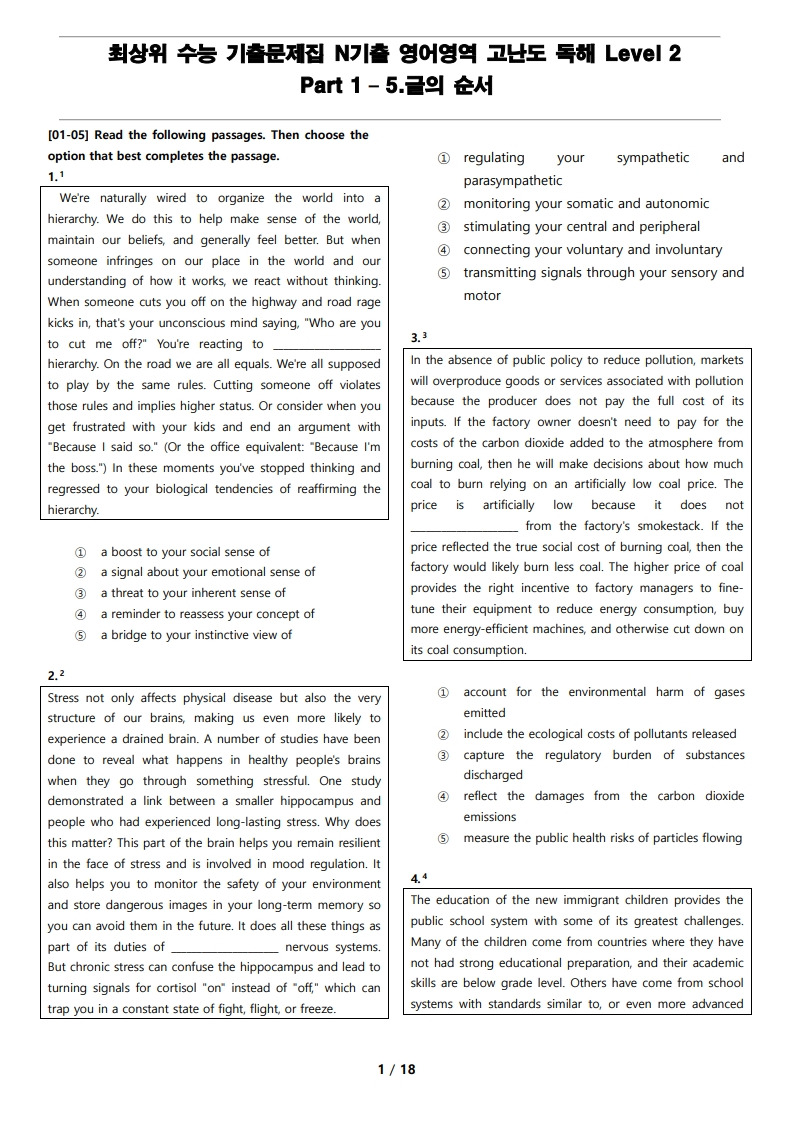
We're naturally wired to organize the world into a hierarchy. We do this to help make sense of the world, maintain our beliefs, and generally feel better. But when someone infringes on our place in the world and our understanding of how it works, we react without thinking. When someone cuts you off on the highway and road rage kicks in, that's your unconscious mind saying, "Who are you to cut me off?" You're reacting to a threat to your inherent sense of hierarchy. On the road we are all equals. We're all supposed to play by the same rules. Cutting someone off violates those rules and implies higher status. Or consider when you get frustrated with your kids and end an argument with "Because I said so." (Or the office equivalent: "Because I'm the boss.") In these moments you've stopped thinking and regressed to your biological tendencies of reaffirming the hierarchy.
2번 지문
Stress not only affects physical disease but also the very structure of our brains, making us even more likely to experience a drained brain. A number of studies have been done to reveal what happens in healthy people's brains when they go through something stressful. One study demonstrated a link between a smaller hippocampus and people who had experienced long-lasting stress. Why does this matter? This part of the brain helps you remain resilient in the face of stress and is involved in mood regulation. It also helps you to monitor the safety of your environment and store dangerous images in your long-term memory so you can avoid them in the future. It does all these things as part of its duties of regulating your sympathetic and parasympathetic nervous systems. But chronic stress can confuse the hippocampus and lead to turning signals for cortisol "on" instead of "off," which can trap you in a constant state of fight, flight, or freeze.
3번 지문
In the absence of public policy to reduce pollution, markets will overproduce goods or services associated with pollution because the producer does not pay the full cost of its inputs. If the factory owner doesn't need to pay for the costs of the carbon dioxide added to the atmosphere from burning coal, then he will make decisions about how much coal to burn relying on an artificially low coal price. The price is artificially low because it does not reflect the damages from the carbon dioxide emissions flowing from the factory's smokestack. If the price reflected the true social cost of burning coal, then the factory would likely burn less coal. The higher price of coal provides the right incentive to factory managers to fine-tune their equipment to reduce energy consumption, buy more energy-efficient machines, and otherwise cut down on its coal consumption.
4번 지문
The education of the new immigrant children provides the public school system with some of its greatest challenges. Many of the children come from countries where they have not had strong educational preparation, and their academic skills are below grade level. Others have come from school systems with standards similar to, or even more advanced than, the American schools, and their academic adjustment is much easier. However, all these children must learn English. This means that they are trying to learn new concepts at the same time that they are struggling to learn a new language. There are some bilingual programs in areas where there is a large concentration of one language group, particularly Spanish speakers. However, there are more than 400 languages spoken in the United States, and some school districts report that 100 or more different languages are spoken by children in their schools. It is not uncommon for five or six different native languages to be spoken by the students in one classroom.
5번 지문
Stabilizing selection refers to selection against both extremes of a trait's range in values. Individuals with extreme high or low values of a trait are less likely to survive and reproduce, and those with values closer to the average are more likely to survive and reproduce. The effect of stabilizing selection is to maintain the population at the same average value over time. Extreme values are selected against each generation, but the average value in the population does not change. Human birth weight is a good example of stabilizing selection. The weight of a newborn child is the result of a number of environmental factors, such as mother's age and weight, among many others. There is also a genetic component to birth weight. Newborns who are very small (less than 2.5 kg) are less likely to survive than newborns who are heavier. Very small ones are more prone to disease and have weaker systems, making their survival more difficult. Newborns who are too large are also likely to be selected against, because a very large child may create complications during childbirth and both mother and child may die. Thus, there is selection against both extremes, small and large.
'문제집 변형문제 > N기출 영어영역 고난도 독해 Level 2' 카테고리의 다른 글
| N기출 영어 영역 고난도 독해 Level 2 Part 1.- 7 요약문 완성 변형 문제 (0) | 2026.09.13 |
|---|---|
| N기출 영어영역 고난도 독해 Level 2 Part 1.- 6 문장 삽입 변형문제 (0) | 2026.08.26 |
| N기출 영어영역 고난도 독해 Level 2 Part 1.-4 빈칸 추론 변형문제 (0) | 2026.08.24 |
| N기출 영어영역 고난도 독해 Level 2 Part 1.-3 어휘 변형문제 (0) | 2026.08.23 |
| N기출 영어영역 고난도 독해 Level 2 Part 1.-2 어법 변형문제 (0) | 2026.08.22 |