
N기출 영어영역 고난도 독해 Level 2
Part 1.- 4 빈칸 추론 변형문제
전문항 확인 하러가기
https://themakings.co.kr/408/?idx=1476
최상위 수능 기출문제집 N기출 영어영역 고난도 독해 Level 2 Part 1 - 4. 빈칸 추론(PDF)
최상위 수능 기출문제집 N기출 영어영역 고난도 독해 Level 2 Part 1 - 4. 빈칸 추론(PDF)은 원어민 선생님과 현직 강사가 제작한 수능 영어 변형문제. 실전 감각을 높이는 고퀄리티 문제로 내신·수능
themakings.co.kr
다음 지문을 읽고 글의 내용과 다른 문장을 고르세요.
Many students hear stories of what college is like from friends and family, but some of these tales contain misinformation that can actually hurt their college performance. For example, Andrew, one of our students, recently missed class because he was running late and heard from his brother that you shouldn’t bother to even go to class if you will be more than ten minutes late. He told Andrew that professors don’t let anyone in when they are so late. Although this may be true for some classes, it was not for ours, and Andrew missed some very important information (and was not able to turn in an assignment due that day, so he also lost some points). The moral of this story is to find out your professors’ rules for attendance and follow them ― don’t take it for granted that the rules are the same in all cases, and don’t rely on another student’s “expertise”. Go to the source of the information you want.
① Many students receive stories about college that may contain misleading information.
② Andrew missed class because his brother told him it was pointless to arrive very late.
③ The brother’s advice might apply in some classes but was not true for the authors’ class.
④ Andrew intentionally chose not to attend class despite having enough time to arrive.
⑤ The passage advises students to verify attendance policies directly with their professors.
지문 해석
많은 학생들은 친구와 가족으로부터 대학 생활이 어떤지에 대한 이야기를 듣지만, 이러한 이야기들 중 일부는 실제로 대학 성적에 해가 될 수 있는 잘못된 정보를 포함하고 있다. 예를 들어, 우리 학생 중 한 명인 Andrew는 최근 늦고 있었기 때문에 수업에 결석했는데, 그의 형에게 10분 이상 늦으면 수업에 가봤자 소용이 없다는 말을 들었기 때문이다. 형은 교수들이 그렇게 늦으면 아무도 들여보내지 않는다고 Andrew에게 말했다. 이것이 일부 수업에서는 사실일 수 있지만, 우리 수업에서는 그렇지 않았고, Andrew는 매우 중요한 정보를 놓쳤다(그날 제출해야 할 과제도 내지 못해 점수도 잃었다). 이 이야기의 교훈은 교수들의 출석 규정을 직접 확인하고 따르라는 것이다 — 모든 경우에 규칙이 동일하다고 당연하게 여기지 말고, 다른 학생의 "전문 지식"에 의존하지 마라. 원하는 정보의 출처로 직접 가라.
풀이 흐름
이 지문에서 Andrew가 수업에 결석한 원인과 상황을 정확히 파악하는 것이 핵심이다.
지문은 Andrew의 상황을 "he was running late(늦고 있었다)"라고 명시한다. 즉, Andrew는 제시간에 도착할 충분한 시간이 없었기 때문에 늦고 있었고, 형의 조언에 따라 아예 수업에 가지 않기로 한 것이다.
따라서 Andrew가 "충분한 시간이 있었음에도 불구하고(despite having enough time)" "의도적으로 출석하지 않기로 선택했다(intentionally chose not to attend)"고 서술하는 선지가 있다면, 이는 Andrew의 실제 상황과 정면으로 모순된다.
전체 선지 분석
|
선지
|
판정
|
근거
|
|
① Many students receive stories about college that may contain misleading information.
|
✅ 일치
|
지문의 "Many students hear stories... some of these tales contain misinformation"과 직접 대응. misleading = misinformation.
|
|
② Andrew missed class because his brother told him it was pointless to arrive very late.
|
✅ 일치
|
지문의 "missed class because he was running late and heard from his brother that you shouldn't bother to even go to class if you will be more than ten minutes late"와 정확히 대응. pointless = shouldn't bother.
|
|
③ The brother's advice might apply in some classes but was not true for the authors' class.
|
✅ 일치
|
지문의 "Although this may be true for some classes, it was not for ours"와 직접 대응. might apply = may be true.
|
|
④ Andrew intentionally chose not to attend class despite having enough time to arrive.
|
❌ 불일치
|
지문은 **"he was running late"**라고 명시. Andrew는 제시간에 도착할 시간이 부족했기 때문에 늦고 있었으며, 형의 조언에 따라 가지 않은 것이다. despite having enough time ↔ was running late로 정반대.
|
|
⑤ The passage advises students to verify attendance policies directly with their professors.
|
✅ 일치
|
지문의 "find out your professors' rules for attendance" + "Go to the source of the information you want"와 일치. verify directly = go to the source.
|
핵심 문장 정리
"Andrew... recently missed class because he was running late and heard from his brother that you shouldn't bother to even go to class if you will be more than ten minutes late."
이 문장이 ④번 선지의 오류를 판별하는 결정적 근거다. 지문은 Andrew가 "늦고 있었기 때문에(was running late)" 형의 조언에 따라 결석했다고 서술하는 반면, ④번은 "충분한 시간이 있었음에도 불구하고(despite having enough time)" 의도적으로 결석했다고 서술하여, Andrew의 상황을 정반대로 왜곡했다.
한 줄 정리
Andrew는 "충분한 시간이 있었음에도" 의도적으로 결석한 것이 아니라, "늦고 있었기 때문에" 형의 잘못된 조언을 따라 수업에 가지 않은 것이다.
The Makings의 Part 1 - 3. 빈칸 추론 변형문제는
총 11개의 유형으로 구성되어 있습니다.
1. 빈칸 채우기(객관식)
2. 글의 내용 일치/불일치(객관식/한글 선택지)
3. 글의 내용 일치/불일치(객관식/영어 선택지)
4. 글 끼어 넣기(객관식)
5. 어법(서술형)
6. 어휘(서술형)
7. 주제문(객관식/영어 선택지)
8. 어휘 빈칸 채우기(서술형)
9. 영작(서술형)
10. 요약문 완성하기(서술형)
11. 문단 재배열 하기(객관식)
더메이킹스(The Makings)가 제작한
최상위 수능 기출문제집 N기출 영어영역 고난도 독해 Level 2
Part 1 - 4. 빈칸 추론(55문항) 변형문제의 지문입니다.
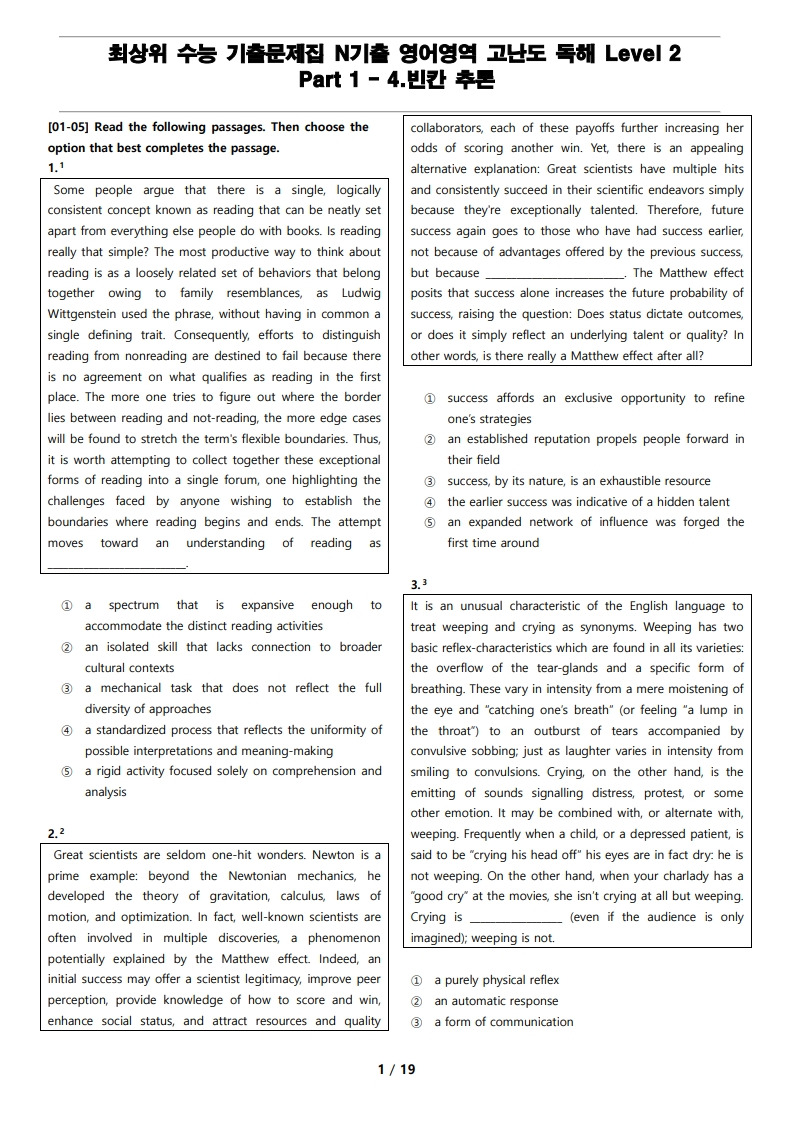
1번 지문
Some people argue that there is a single, logically consistent concept known as reading that can be neatly set apart from everything else people do with books. Is reading really that simple? The most productive way to think about reading is as a loosely related set of behaviors that belong together owing to family resemblances, as Ludwig Wittgenstein used the phrase, without having in common a single defining trait. Consequently, efforts to distinguish reading from nonreading are destined to fail because there is no agreement on what qualifies as reading in the first place. The more one tries to figure out where the border lies between reading and not-reading, the more edge cases will be found to stretch the term's flexible boundaries. Thus, it is worth attempting to collect together these exceptional forms of reading into a single forum, one highlighting the challenges faced by anyone wishing to establish the boundaries where reading begins and ends. The attempt moves toward an understanding of reading as a spectrum that is expansive enough to accommodate the distinct reading activities.
2번 지문
Great scientists are seldom one-hit wonders. Newton is a prime example: beyond the Newtonian mechanics, he developed the theory of gravitation, calculus, laws of motion, and optimization. In fact, well-known scientists are often involved in multiple discoveries, a phenomenon potentially explained by the Matthew effect. Indeed, an initial success may offer a scientist legitimacy, improve peer perception, provide knowledge of how to score and win, enhance social status, and attract resources and quality collaborators, each of these payoffs further increasing her odds of scoring another win. Yet, there is an appealing alternative explanation: Great scientists have multiple hits and consistently succeed in their scientific endeavors simply because they're exceptionally talented. Therefore, future success again goes to those who have had success earlier, not because of advantages offered by the previous success, but because the earlier success was indicative of a hidden talent. The Matthew effect posits that success alone increases the future probability of success, raising the question: Does status dictate outcomes, or does it simply reflect an underlying talent or quality? In other words, is there really a Matthew effect after all?
3번 지문
It is an unusual characteristic of the English language to treat weeping and crying as synonyms. Weeping has two basic reflex-characteristics which are found in all its varieties: the overflow of the tear-glands and a specific form of breathing. These vary in intensity from a mere moistening of the eye and “catching one’s breath” (or feeling “a lump in the throat”) to an outburst of tears accompanied by convulsive sobbing; just as laughter varies in intensity from smiling to convulsions. Crying, on the other hand, is the emitting of sounds signalling distress, protest, or some other emotion. It may be combined with, or alternate with, weeping. Frequently when a child, or a depressed patient, is said to be “crying his head off” his eyes are in fact dry: he is not weeping. On the other hand, when your charlady has a “good cry” at the movies, she isn’t crying at all but weeping. Crying is a form of communication (even if the audience is only imagined); weeping is not.
4번 지문
Imagine an invitation to cooperate with someone, which would bring a common income of $100. Will you accept the invitation, given you get $40? Many would agree: there is a lot of cooperation in the world, but much less equality. Realists would warn states against such a decision. What matters for them is not that you get $40, but what your partner gets $60, thus gaining a $20 advantage. Consequently, states seek relative advantages in their relations with each other. For them it is important to be stronger than their potential rivals; absolute gains are secondary. Guided by seeking relative advantages and not trusting one another, states usually do not engage into longterm partnerships. Integration is assessed by realists through the lenses of coalition theory, as they cannot fully account for states’ voluntary renunciation of sovereignty, supposed to be a sacred priority. In general, relations among states are dominated by distrust, suspicion and anticipation of the worst.
5번 지문
Many students hear stories of what college is like from friends and family, but some of these tales contain misinformation that can actually hurt their college performance. For example, Andrew, one of our students, recently missed class because he was running late and heard from his brother that you shouldn’t bother to even go to class if you will be more than ten minutes late. He told Andrew that professors don’t let anyone in when they are so late. Although this may be true for some classes, it was not for ours, and Andrew missed some very important information (and was not able to turn in an assignment due that day, so he also lost some points). The moral of this story is to find out your professors’ rules for attendance and follow them ― don’t take it for granted that the rules are the same in all cases, and don’t rely on another student’s “expertise”. Go to the source of the information you want.
'문제집 변형문제 > N기출 영어영역 고난도 독해 Level 2' 카테고리의 다른 글
| N기출 영어영역 고난도 독해 Level 2 Part 1.- 6 문장 삽입 변형문제 (0) | 2026.08.26 |
|---|---|
| N기출 영어영역 고난도 독해 Level 2 Part 1.- 5 글의 순서 변형문제 (0) | 2026.08.25 |
| N기출 영어영역 고난도 독해 Level 2 Part 1.-3 어휘 변형문제 (0) | 2026.08.23 |
| N기출 영어영역 고난도 독해 Level 2 Part 1.-2 어법 변형문제 (0) | 2026.08.22 |
| N기출 영어영역 고난도 독해 Level 2 Part 1.1 함축 의미 추론 변형문제 (0) | 2026.08.03 |