
2025년 10월 고3 영어 모의고사
변형문제 지문[22,23,24,26]
전문항 확인 하러가기!
https://themakings.co.kr/226/?idx=1191
2025년 고1 10월 전국 연합 모의고사 변형 문제 Part 2
2025년 고1 10월 전국 연합 모의고사 변형 문제, 내신대비, 영어내신자료,고등영어자료, 모의고사 변형문제,전국 연합모의고사 변형자료, 모의고사 영어 서술형 대비, 대치동 고등 영어자료, 대치
themakings.co.kr
다음 지문을 읽고 글의 내용과 다른 문장을 보르세요.
Our yearning for belonging is so hardwired that we often try to acquire it by any means possible, including trying to fit in and working hard for approval and acceptance. Not only are these efforts hollow substitutes for belonging, but they are the greatest barriers to belonging. When we work to fit in and be accepted, our “belonging” is unstable. If we do or say something that’s true to who we are but outside the expectations or rules of the group, we risk everything. If people don’t really know who we are and what we believe or think, there’s no true belonging. Because we can feel belonging only if we have the courage to share our most authentic selves with people, our sense of belonging can never be greater than our level of self-acceptance. We can never truly belong if we are betraying ourselves, our ideals, or our values in the process. That is why it’s a mistake to think that belonging is passive and simply about joining or “going along” with others. It’s not.
① People often try to gain a sense of belonging through fitting in and seeking approval from others.
② True belonging requires the courage to reveal one’s authentic self to those around them.
③ Belonging becomes stable and secure when individuals prioritize group expectations over personal values.
④ Betraying one’s own ideals and values in pursuit of acceptance makes true belonging impossible.
⑤ The author argues that belonging is not a passive process of simply going along with the group.
지문 해석
소속감에 대한 우리의 갈망은 너무 깊이 내재되어 있어서, 우리는 어울리려 하고 인정과 수용을 위해 열심히 노력하는 것을 포함해 가능한 모든 수단으로 그것을 얻으려 한다. 이런 노력들은 소속감의 공허한 대체물일 뿐 아니라, 소속감에 대한 가장 큰 장벽이다. 어울리고 받아들여지기 위해 노력할 때, 우리의 "소속감"은 불안정하다. 만약 우리가 자신에게 진실하지만 그룹의 기대나 규칙을 벗어나는 말이나 행동을 하면, 우리는 모든 것을 잃을 위험에 처한다. 사람들이 우리가 진정 누구인지, 무엇을 믿고 생각하는지 모른다면, 진정한 소속감은 없다. 가장 진정한 자아를 다른 사람들과 나눌 용기가 있을 때만 소속감을 느낄 수 있기에, 우리의 소속감은 자기 수용의 수준을 결코 넘어설 수 없다. 그 과정에서 자기 자신, 이상, 가치를 배신한다면 결코 진정으로 소속될 수 없다. 그래서 소속감을 수동적이고 단순히 남들과 합류하거나 "동조하는 것"이라 생각하는 것은 실수다. 소속감은 그런 것이 아니다.
풀이 흐름
이 지문은 하나의 핵심 역설을 중심으로 전개된다.
소속감을 얻기 위해 집단에 맞추려 하면 할수록, 진정한 소속감에서 멀어진다.
저자는 fitting in(맞추기)과 true belonging(진정한 소속)을 철저히 구분한다. 어울리려는 노력은 소속감의 "hollow substitutes(공허한 대체물)"이자 "greatest barriers(가장 큰 장벽)"라는 것이다. 그렇다면 진정한 소속감은 어디서 오는가? 저자의 답은 명확하다 — 자기 자신을 있는 그대로 드러낼 용기, 즉 자기 수용(self-acceptance)이 소속감의 상한선이다. 따라서 선지를 검토할 때, "집단 기대를 우선시하면 소속감이 안정된다"는 주장이 있다면 지문의 논리와 정면 충돌한다.
전체 선지 분석
|
선지
|
판정
|
근거
|
|
① People often try to gain a sense of belonging through fitting in and seeking approval from others.
|
✅ 일치
|
"we often try to acquire it by any means possible, including trying to fit in and working hard for approval and acceptance"와 정확히 대응
|
|
② True belonging requires the courage to reveal one's authentic self to those around them.
|
✅ 일치
|
"we can feel belonging only if we have the courage to share our most authentic selves with people"와 정확히 대응
|
|
③ Belonging becomes stable and secure when individuals prioritize group expectations over personal values.
|
❌ 불일치
|
원문은 "When we work to fit in and be accepted, our 'belonging' is unstable"이다. 집단 기대에 맞추면 소속감이 안정되는 게 아니라 불안정해진다. "stable and secure"는 "unstable"과 정반대.
|
|
④ Betraying one's own ideals and values in pursuit of acceptance makes true belonging impossible.
|
✅ 일치
|
"We can never truly belong if we are betraying ourselves, our ideals, or our values in the process"와 정확히 대응
|
|
⑤ The author argues that belonging is not a passive process of simply going along with the group.
|
✅ 일치
|
"it's a mistake to think that belonging is passive and simply about joining or 'going along' with others"와 정확히 대응
|
핵심 구문 정리
"When we work to fit in and be accepted, our 'belonging' is unstable." 어울리려고 노력할 때 소속감은 불안정하다 → ③번이 "stable and secure"라고 한 것과 정면 충돌
"our sense of belonging can never be greater than our level of self-acceptance." 소속감은 자기 수용의 수준을 절대 넘을 수 없다 → 소속감의 열쇠는 집단 기대가 아니라 자기 수용
"Not only are these efforts hollow substitutes for belonging, but they are the greatest barriers to belonging." 맞추려는 노력은 소속감의 대체물이 아니라 가장 큰 장벽 → 집단에 맞추는 것이 소속감을 강화한다는 ③번의 논리를 근본부터 부정
한 줄 요약
집단 기대에 맞추면 소속감이 "unstable(불안정)"해진다고 했는데, ③번은 이를 "stable and secure(안정적이고 확고한)"로 완전히 뒤집었다. 핵심 형용사를 반전시킨 전형적인 불일치 선지다.
The Makings의 2025년 고3 10월 전국 연합 모의고사 변형 문제는
총 11개의 유형으로 구성되어 있습니다.
1. 빈칸 채우기(객관식)
2. 글의 내용 일치/불일치(객관식/한글 선택지)
3. 글의 내용 일치/불일치(객관식/영어 선택지)
4. 글 끼어 넣기(객관식)
5. 어법(서술형)
6. 어휘(서술형)
7. 주제문(객관식/영어 선택지)
8. 어휘 빈칸 채우기(서술형)
9. 영작(서술형)
10. 요약문 완성하기(서술형)
11. 문단 재배열 하기(객관식)
더메이킹스(The Makings)가 제작한
2025년 고3 10월 전국 연합 모의고사 변형 문제 Part 2의 지문입니다.
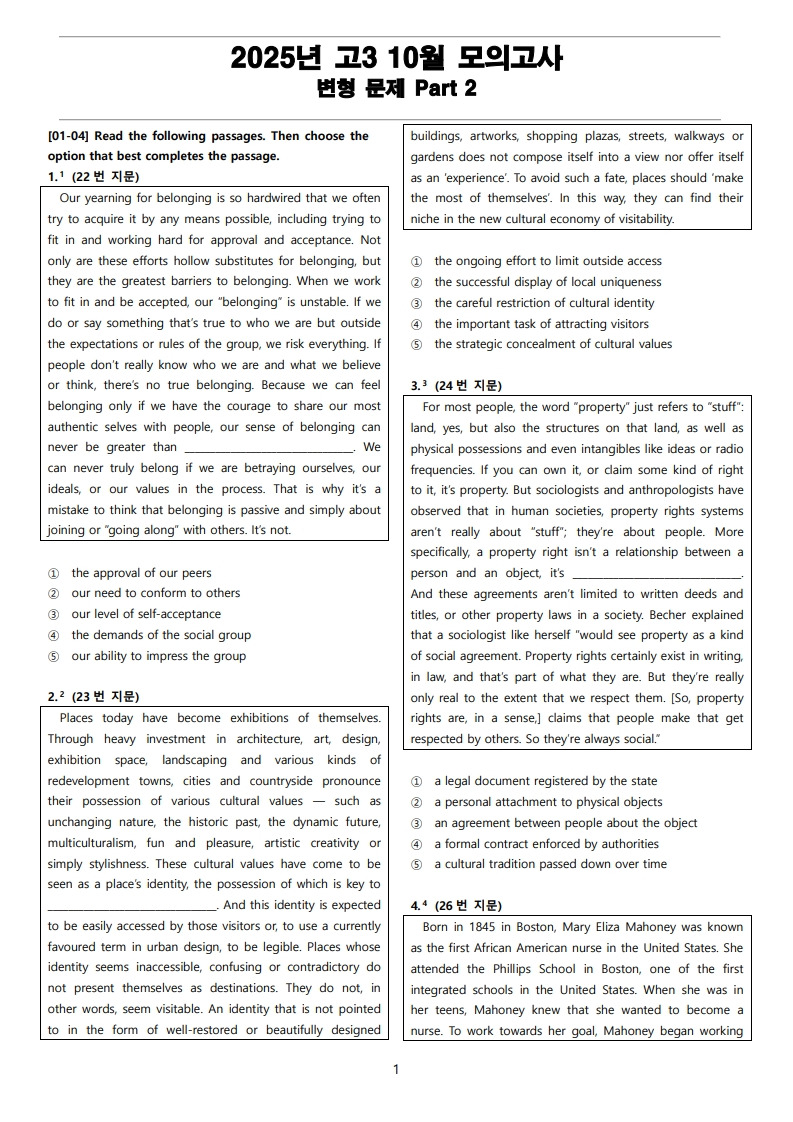
1번 지문(문항 번호 22번)
Our yearning for belonging is so hardwired that we often try to acquire it by any means possible, including trying to fit in and working hard for approval and acceptance. Not only are these efforts hollow substitutes for belonging, but they are the greatest barriers to belonging. When we work to fit in and be accepted, our "belonging" is unstable. If we do or say something that's true to who we are but outside the expectations or rules of the group, we risk everything. If people don't really know who we are and what we believe or think, there's no true belonging. Because we can feel belonging only if we have the courage to share our most authentic selves with people, our sense of belonging can never be greater than our level of self-acceptance. We can never truly belong if we are betraying ourselves, our ideals, or our values in the process. That is why it's a mistake to think that belonging is passive and simply about joining or "going along" with others. It's not.
2번 지문(문항 번호 23번)
Places today have become exhibitions of themselves. Through heavy investment in architecture, art, design, exhibition space, landscaping and various kinds of redevelopment towns, cities and countryside pronounce their possession of various cultural values ─ such as unchanging nature, the historic past, the dynamic future, multiculturalism, fun and pleasure, artistic creativity or simply stylishness. These cultural values have come to be seen as a place's identity, the possession of which is key to the important task of attracting visitors. And this identity is expected to be easily accessed by those visitors or, to use a currently favoured term in urban design, to be legible. Places whose identity seems inaccessible, confusing or contradictory do not present themselves as destinations. They do not, in other words, seem visitable. An identity that is not pointed to in the form of well-restored or beautifully designed buildings, artworks, shopping plazas, streets, walkways or gardens does not compose itself into a view nor offer itself as an 'experience'. To avoid such a fate, places should 'make the most of themselves'. In this way, they can find their niche in the new cultural economy of visitability.
3번 지문(문항 번호 24번)
For most people, the word "property" just refers to "stuff": land, yes, but also the structures on that land, as well as physical possessions and even intangibles like ideas or radio frequencies. If you can own it, or claim some kind of right to it, it's property. But sociologists and anthropologists have observed that in human societies, property rights systems aren't really about "stuff"; they're about people. More specifically, a property right isn't a relationship between a person and an object, it's an agreement between people about the object. And these agreements aren't limited to written deeds and titles, or other property laws in a society. Becher explained that a sociologist like herself "would see property as a kind of social agreement. Property rights certainly exist in writing, in law, and that's part of what they are. But they're really only real to the extent that we respect them. [So, property rights are, in a sense,] claims that people make that get respected by others. So they're always social."
4번 지문(문항 번호 26번)
Born in 1845 in Boston, Mary Eliza Mahoney was known as the first African American nurse in the United States. She attended the Phillips School in Boston, one of the first integrated schools in the United States. When she was in her teens, Mahoney knew that she wanted to become a nurse. To work towards her goal, Mahoney began working at the New England Hospital for Women and Children, which operated one of the first nursing schools in the United States. She was admitted to its nursing program in 1878 at the age of 33. Upon graduation, she became a private duty nurse. In 1908, Mahoney co-founded the National Association of Colored Graduate Nurses (NACGN) to promote equality for African American nurses. Recognizing that Mahoney served as an outstanding role model for nurses of all races, NACGN created the Mary Mahoney Award in 1936.
'전국 연합 모의고사 변형 문제 > 고3 모의고사 변형 문제' 카테고리의 다른 글
| 2025년 10월 고3 영어 모의고사 변형문제 지문[35,36,37,38,39,40] (0) | 2026.08.07 |
|---|---|
| 2025년 10월 고3 영어 모의고사 변형문제 지문[29,30,31,32,33,34] (0) | 2026.08.06 |
| 2025년 9월 고3 영어 모의고사 변형문제 지문[35,36,37,38,39,40] (0) | 2026.08.01 |
| 2025년 9월 고3 영어 모의고사 변형문제 지문[29,30,31,32,33,34,35] (0) | 2026.07.31 |
| 2025년 9월 3학년 모의고사 변형문제 지문[22,23,24,26] (0) | 2026.07.30 |