
2025년 10월 고3 영어 모의고사 변형문제
지문[35,36,37,38,39,40]
https://themakings.co.kr/404/?idx=1444
2025년 고3 10월 전국 연합 모의고사 변형 문제 Part 4 (66문항) (PDF)
2025년 고3 10월 전국 연합 모의고사 변형 문제, 내신대비, 영어내신자료,고등영어자료, 모의고사 변형문제,전국 연합모의고사 변형자료, 모의고사 영어 서술형 대비, 대치동 고등 영어자료, 대치
themakings.co.kr
다음 지문의 내용과 다른 문장을 고르세요.
In everyday life, most people think that media effects are things that show up during a media exposure or immediately afterward. Of course some effects do show up immediately, but other effects may take a long time to manifest themselves. Let's say you see an ad for a product on a website and you click on a buy now button to buy that product. This is an example of a media message triggering an immediate effect ─ a buying behavior ─ on you. But let's say you did not click on the buy now button to buy the product; does this mean there was no media effect? Perhaps, but also perhaps not. If you continually expose yourself to ads in the media, you may gradually over time come to believe that you have more needs than you really have and that all of those needs can be easily satisfied by buying particular products. This is a long-term effect on what you believe; it cannot be attributed to any one media exposure but instead gradually builds up in a steady drip-drip-drip manner over time.
① Some media effects are immediate while others develop gradually over extended periods.
② Clicking a buy button after seeing an online ad exemplifies an immediate media effect.
③ The absence of an immediate purchase response to an ad proves that no media effect occurred.
④ Repeated exposure to advertising can reshape beliefs about personal needs over time.
⑤ Long-term media effects accumulate steadily rather than being traceable to a single exposure.
지문 해석
일상에서 대부분의 사람들은 미디어 효과가 미디어 노출 중이나 직후에 나타나는 것이라고 생각한다. 물론 일부 효과는 즉시 나타나지만, 다른 효과는 발현되는 데 오랜 시간이 걸릴 수 있다. 웹사이트에서 제품 광고를 보고 "지금 구매" 버튼을 클릭하여 그 제품을 산다고 가정해 보자. 이것은 미디어 메시지가 당신에게 즉각적인 효과 — 구매 행동 — 를 촉발한 사례다. 하지만 "지금 구매" 버튼을 클릭하지 않았다고 해 보자. 이것이 미디어 효과가 없었다는 것을 의미하는가? 아마도 그럴 수도 있지만, 아마도 아닐 수도 있다. 미디어 속 광고에 계속 노출되면, 시간이 지남에 따라 실제보다 더 많은 필요가 있다고, 그리고 그 모든 필요가 특정 제품을 구매함으로써 쉽게 충족될 수 있다고 점차 믿게 될 수 있다. 이것은 당신이 믿는 것에 대한 장기적 효과이며, 어느 한 번의 미디어 노출에 귀속될 수 없고 대신 시간이 지남에 따라 꾸준한 똑-똑-똑 방식으로 점진적으로 축적된다.
풀이 흐름
이 지문은 미디어 효과를 즉각적 효과 vs. 장기적 효과로 이분하는 구조다. 저자는 구매 버튼을 클릭하지 않는 상황을 예로 들며 수사적 질문을 던진다 — "미디어 효과가 없었다는 뜻인가?" 그리고 그 답을 "Perhaps, but also perhaps not(아마도 그렇지만, 아마도 아닐 수도)"이라고 열어둔다. 이처럼 저자가 가능성을 열어두는 표현을 사용할 때, 선지가 이를 단정적 표현(proves)으로 바꿨는지를 확인하는 것이 핵심이다. "아닐 수도 있다"는 유보적 판단을 "증명한다"는 확정적 판단으로 바꾸면 의미가 완전히 달라진다.
전체 선지 분석
|
선지
|
판정
|
근거
|
|
① Some media effects are immediate while others develop gradually over extended periods.
|
✅ 일치
|
"some effects do show up immediately, but other effects may take a long time to manifest themselves"와 정확히 대응
|
|
② Clicking a buy button after seeing an online ad exemplifies an immediate media effect.
|
✅ 일치
|
"This is an example of a media message triggering an immediate effect ─ a buying behavior"와 대응
|
|
③ The absence of an immediate purchase response to an ad proves that no media effect occurred.
|
❌ 불일치
|
원문은 "does this mean there was no media effect? Perhaps, but also perhaps not"이다. 즉각적 구매가 없다고 해서 미디어 효과가 없음이 증명되는 것이 아니라, 장기적 효과가 존재할 가능성을 열어둔다. "proves"는 이 유보적 태도를 완전히 무시한 단정이다.
|
|
④ Repeated exposure to advertising can reshape beliefs about personal needs over time.
|
✅ 일치
|
"If you continually expose yourself to ads … you may gradually over time come to believe that you have more needs than you really have"와 대응
|
|
⑤ Long-term media effects accumulate steadily rather than being traceable to a single exposure.
|
✅ 일치
|
"it cannot be attributed to any one media exposure but instead gradually builds up in a steady drip-drip-drip manner over time"과 대응
|
핵심 구문 정리
"does this mean there was no media effect? Perhaps, but also perhaps not."
미디어 효과가 없었다는 뜻인가? 아마도 그렇지만, 아마도 아닐 수도 있다 → ③번의 "proves(증명한다)"와 정면 충돌. 유보적 가능성을 단정으로 바꿈
"gradually builds up in a steady drip-drip-drip manner over time"
시간에 걸쳐 꾸준히 똑-똑-똑 축적된다 → 즉각적 반응이 없어도 장기적 효과가 쌓이고 있을 수 있다는 핵심 논거
한 줄 요약
원문은 즉각적 구매가 없어도 미디어 효과가 없다고 단정할 수 없다("perhaps not")고 했는데, ③번은 이를 "proves(증명한다)"로 단정 지은 전형적인 유보→확정 변형 불일치 선지다.
The Makings의 2025년 고3 10월 전국 연합 모의고사 변형 문제는
총 11개의 유형으로 구성되어 있습니다.
1. 빈칸 채우기(객관식)
2. 글의 내용 일치/불일치(객관식/한글 선택지)
3. 글의 내용 일치/불일치(객관식/영어 선택지)
4. 글 끼어 넣기(객관식)
5. 어법(서술형)
6. 어휘(서술형)
7. 주제문(객관식/영어 선택지)
8. 어휘 빈칸 채우기(서술형)
9. 영작(서술형)
10. 요약문 완성하기(서술형)
11. 문단 재배열 하기(객관식)
더메이킹스(The Makings)가 제작한
2025년 고3 10월 전국 연합 모의고사 변형 문제 Part 4의 지문입니다.
1번 지문(문항 번호 35번)
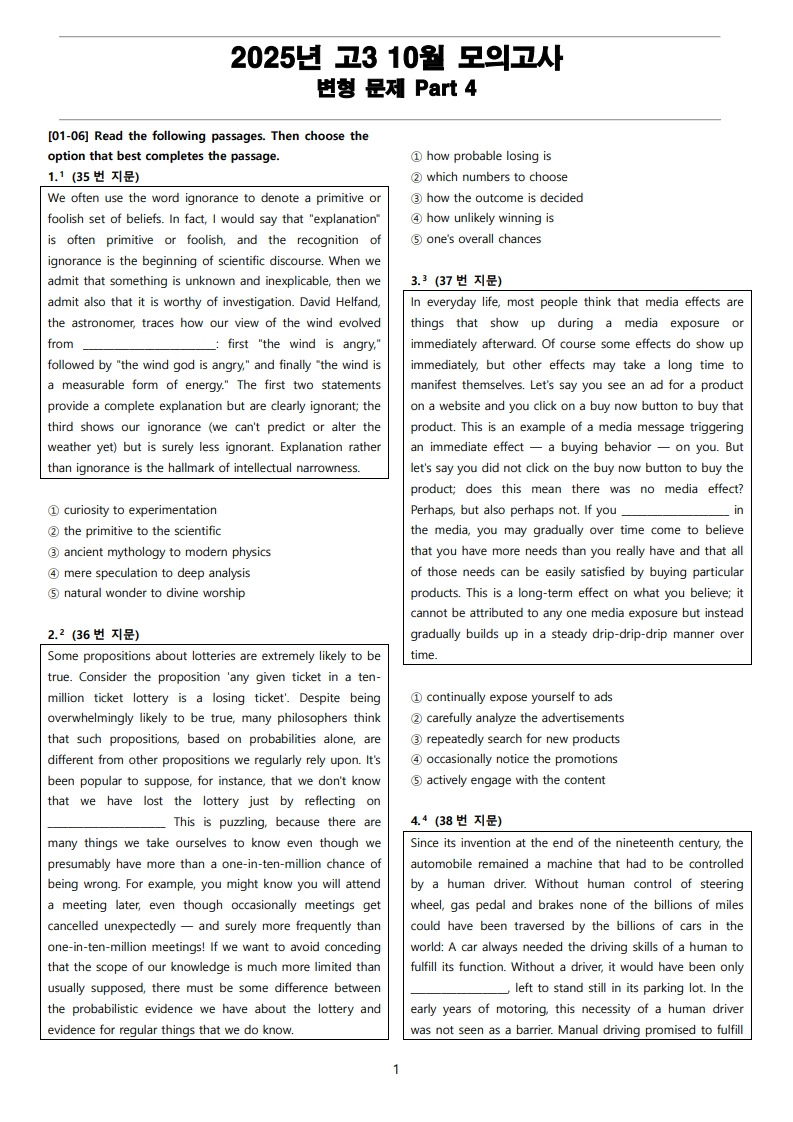
We often use the word ignorance to denote a primitive or foolish set of beliefs. In fact, I would say that "explanation" is often primitive or foolish, and the recognition of ignorance is the beginning of scientific discourse. When we admit that something is unknown and inexplicable, then we admit also that it is worthy of investigation. David Helfand, the astronomer, traces how our view of the wind evolved from the primitive to the scientific: first "the wind is angry," followed by "the wind god is angry," and finally "the wind is a measurable form of energy." The first two statements provide a complete explanation but are clearly ignorant; the third shows our ignorance (we can't predict or alter the weather yet) but is surely less ignorant. Explanation rather than ignorance is the hallmark of intellectual narrowness.
2번 지문(문항 번호 36번)
Some propositions about lotteries are extremely likely to be true. Consider the proposition 'any given ticket in a ten-million ticket lottery is a losing ticket'. Despite being overwhelmingly likely to be true, many philosophers think that such propositions, based on probabilities alone, are different from other propositions we regularly rely upon. It's been popular to suppose, for instance, that we don't know that we have lost the lottery just by reflecting on how unlikely winning is. This is puzzling, because there are many things we take ourselves to know even though we presumably have more than a one-in-ten-million chance of being wrong. For example, you might know you will attend a meeting later, even though occasionally meetings get cancelled unexpectedly ─ and surely more frequently than one-in-ten-million meetings! If we want to avoid conceding that the scope of our knowledge is much more limited than usually supposed, there must be some difference between the probabilistic evidence we have about the lottery and evidence for regular things that we do know.
3번 지문(문항 번호 37번)
In everyday life, most people think that media effects are things that show up during a media exposure or immediately afterward. Of course some effects do show up immediately, but other effects may take a long time to manifest themselves. Let's say you see an ad for a product on a website and you click on a buy now button to buy that product. This is an example of a media message triggering an immediate effect ─ a buying behavior ─ on you. But let's say you did not click on the buy now button to buy the product; does this mean there was no media effect? Perhaps, but also perhaps not. If you continually expose yourself to ads in the media, you may gradually over time come to believe that you have more needs than you really have and that all of those needs can be easily satisfied by buying particular products. This is a long-term effect on what you believe; it cannot be attributed to any one media exposure but instead gradually builds up in a steady drip-drip-drip manner over time.
4번 지문(문항 번호 38번)
Since its invention at the end of the nineteenth century, the automobile remained a machine that had to be controlled by a human driver. Without human control of steering wheel, gas pedal and brakes none of the billions of miles could have been traversed by the billions of cars in the world: A car always needed the driving skills of a human to fulfill its function. Without a driver, it would have been only an immobile artifact, left to stand still in its parking lot. In the early years of motoring, this necessity of a human driver was not seen as a barrier. Manual driving promised to fulfill the human dream of individual mobility and freedom, of self-guidance, of autonomy. But with the emerging mass automobility in the first decades of the twentieth century, the negative effects of human agency behind the steering wheel ─ accidents for example ─ became a serious topic of concern. It is no surprise that the fantasy of a self-driving car, a car that can navigate without a human driver, can be dated to this period.
5번 지문(문항 번호 39번)
That the brain had limitations on the amount of information processing it could handle was not news to psychologists. Indeed, about 15 years earlier, Miller showed this with his famous paper on the limited capacity of short-term memory. What was novel was the connection between categorization and stereotyping, and that categorization was an inevitable aspect of human cognition. At any given second, there are hundreds, even thousands, of different stimuli that can be perceived in our immediate environment. If we had to constantly think carefully about every one of those stimuli (or even a small subset thereof), in order to understand its nature and function, we would never get anything done! Instead, we learn about different stimuli, and tend to group them in terms of common features, attributes, or functions. This categorization process then becomes so well practiced as to become automatic, and it frees up our consciousness to attend to things that are novel in our environment, or to our current task. Thus, categorization helps us reduce the complexity of the stimuli in our social environment.
6번 지문(문항 번호 40번)
Cinema and law share the same subjects and audience. Rather than an abstract desire for truth as a value in itself, the law deals with the messiness of human relations. Both disciplines struggle with what it means to be human and try to communicate to us something about our existence; both are human artifacts directed at man. Indeed, foundational to law is its anxiety about human nature: man desires freedom but is simultaneously too violent to exist in a state of nature without a regime of commands and prohibitions. However, there is also an important difference here that makes a study of the interaction between cinema and law interesting: while cinema expresses man's affective life, the law keeps it in check. It tries to ensure that we are not overwhelmed and destroyed by our desires and drives. The law obsessively tries to suppress affects, fearing the horror of their consequences, whereas cinema introduces us to our affects, often forcing us to identify the most unbearable ones in ourselves.
'전국 연합 모의고사 변형 문제 > 고3 모의고사 변형 문제' 카테고리의 다른 글
| 2026년 9월 고3 영어 영역 모의고사 변형문제 Part 1 (0) | 2026.09.15 |
|---|---|
| 2026년 9월 고3 영어모의고사 변형문제 Part 1 (0) | 2026.09.06 |
| 2025년 10월 고3 영어 모의고사 변형문제 지문[29,30,31,32,33,34] (0) | 2026.08.06 |
| 2025년 10월 고3 영어 모의고사 변형문제 지문[22,23,24,26] (0) | 2026.08.05 |
| 2025년 9월 고3 영어 모의고사 변형문제 지문[35,36,37,38,39,40] (0) | 2026.08.01 |