
2025년 9월 3학년 모의고사 변형문제 지문[22,23,24,26]
다음 지문을 읽고 글의 내용과 다른 문장을 고르세요.
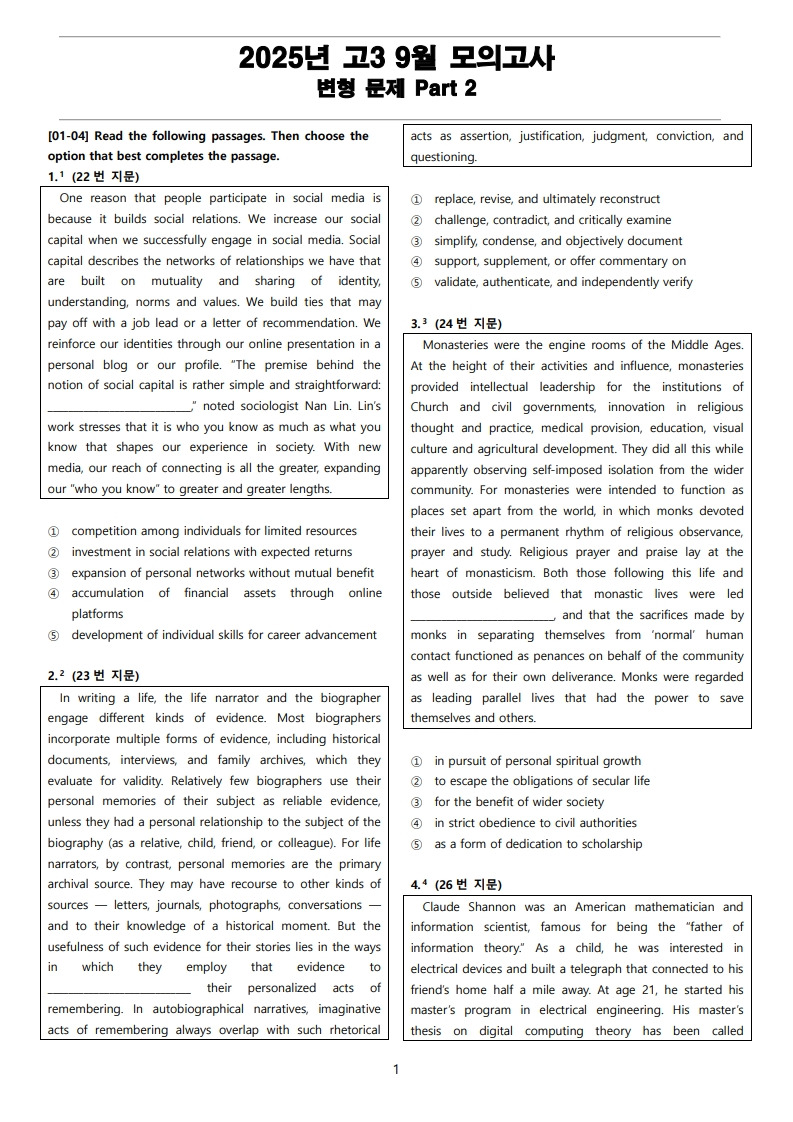
One reason that people participate in social media is because it builds social relations. We increase our social capital when we successfully engage in social media. Social capital describes the networks of relationships we have that are built on mutuality and sharing of identity, understanding, norms and values. We build ties that may pay off with a job lead or a letter of recommendation. We reinforce our identities through our online presentation in a personal blog or our profile. “The premise behind the notion of social capital is rather simple and straightforward: investment in social relations with expected returns,” noted sociologist Nan Lin. Lin’s work stresses that it is who you know as much as what you know that shapes our experience in society. With new media, our reach of connecting is all the greater, expanding our “who you know” to greater and greater lengths.
① Social media participation helps build social relationships.
② Social capital involves networks based on mutuality and shared values.
③ Nan Lin regarded the premise of social capital as difficult to grasp.
④ Online profiles and blogs can reinforce personal identity.
⑤ New media expands the range of people one can connect with.
전문항 확인 하러가기!
https://themakings.co.kr/404/?idx=1438
2025년 고3 10월 전국 연합 모의고사 변형 문제 Part 2 (44문항) (PDF)
2025년 고3 10월 전국 연합 모의고사 변형 문제, 내신대비, 영어내신자료,고등영어자료, 모의고사 변형문제,전국 연합모의고사 변형자료, 모의고사 영어 서술형 대비, 대치동 고등 영어자료, 대치
themakings.co.kr
사람들이 소셜 미디어에 참여하는 한 가지 이유는 그것이 사회적 관계를 구축하기 때문이다. 우리는 소셜 미디어에 성공적으로 참여할 때 사회적 자본을 증가시킨다. 사회적 자본은 상호성과 정체성, 이해, 규범, 가치의 공유를 기반으로 구축된 관계 네트워크를 말한다. 우리는 취업 정보나 추천서로 보상받을 수 있는 유대를 형성한다. 우리는 개인 블로그나 프로필에서의 온라인 표현을 통해 정체성을 강화한다. 사회학자 Nan Lin은 "사회적 자본이라는 개념의 전제는 꽤 단순하고 명쾌하다: 기대되는 수익을 가진 사회적 관계에 대한 투자"라고 언급했다. Lin의 연구는 사회에서의 경험을 형성하는 것이 무엇을 아느냐만큼이나 누구를 아느냐가 중요하다는 점을 강조한다. 뉴미디어를 통해 우리의 연결 범위는 훨씬 더 커지며, "누구를 아느냐"의 범위를 점점 더 넓히고 있다.
지문 내용 정리
이 지문은 소셜 미디어 → 사회적 자본 → 관계 네트워크 확장이라는 직선적 논리 구조를 갖고 있다. 선지 대부분이 지문의 핵심 문장을 거의 그대로 패러프레이징한 것이기 때문에, 원문 표현과 정반대되는 형용사나 동사가 슬며시 바뀐 선지를 찾는 것이 관건이다.
특히 인용문이 등장하면 그 안의 핵심 수식어를 정확히 확인해야 한다. Nan Lin의 직접 인용에서 "rather simple and straightforward"라는 표현이 나오는데, 이것이 선지에서 어떻게 변형되었는지가 이 문제의 승부처다.
전체 선지 분석
|
선지
|
판정
|
근거
|
|
① Social media participation helps build social relationships.
|
✅ 일치
|
"One reason that people participate in social media is because it builds social relations"와 정확히 대응
|
|
② Social capital involves networks based on mutuality and shared values.
|
✅ 일치
|
"networks of relationships … built on mutuality and sharing of identity, understanding, norms and values"와 대응
|
|
③ Nan Lin regarded the premise of social capital as difficult to grasp.
|
❌ 불일치
|
원문에서 Nan Lin은 "rather simple and straightforward"라고 했다. "difficult to grasp"는 이와 정반대.
|
|
④ Online profiles and blogs can reinforce personal identity.
|
✅ 일치
|
"We reinforce our identities through our online presentation in a personal blog or our profile"과 대응
|
|
⑤ New media expands the range of people one can connect with.
|
✅ 일치
|
"our reach of connecting is all the greater, expanding our 'who you know' to greater and greater lengths"와 대응
|
핵심 구문 정리
"The premise behind the notion of social capital is rather simple and straightforward" 사회적 자본의 전제는 꽤 단순하고 명쾌하다 → ③번의 "difficult to grasp(이해하기 어렵다)"와 정면 충돌
"investment in social relations with expected returns" 기대 수익이 있는 사회적 관계에 대한 투자 → 개념 자체가 직관적임을 보여주는 정의
한줄 정리
Nan Lin은 사회적 자본의 전제가 "simple and straightforward"하다고 했는데, ③번은 이를 "difficult to grasp"로 뒤집었으므로 정답이다.
The Makings의 2025년 고3 9월 전국 연합 모의고사 변형 문제는
총 11개의 유형으로 구성되어 있습니다.
1. 빈칸 채우기(객관식)
2. 글의 내용 일치/불일치(객관식/한글 선택지)
3. 글의 내용 일치/불일치(객관식/영어 선택지)
4. 글 끼어 넣기(객관식)
5. 어법(서술형)
6. 어휘(서술형)
7. 주제문(객관식/영어 선택지)
8. 어휘 빈칸 채우기(서술형)
9. 영작(서술형)
10. 요약문 완성하기(서술형)
11. 문단 재배열 하기(객관식)
더메이킹스(The Makings)가 제작한
2025년 고3 9월 전국 연합 모의고사 변형 문제 Part 2의 지문입니다.
1번 지문(문항 번호 22번)
One reason that people participate in social media is because it builds social relations. We increase our social capital when we successfully engage in social media. Social capital describes the networks of relationships we have that are built on mutuality and sharing of identity, understanding, norms and values. We build ties that may pay off with a job lead or a letter of recommendation. We reinforce our identities through our online presentation in a personal blog or our profile. “The premise behind the notion of social capital is rather simple and straightforward: investment in social relations with expected returns,” noted sociologist Nan Lin. Lin’s work stresses that it is who you know as much as what you know that shapes our experience in society. With new media, our reach of connecting is all the greater, expanding our “who you know” to greater and greater lengths.
2번 지문(문항 번호 23번)
In writing a life, the life narrator and the biographer engage different kinds of evidence. Most biographers incorporate multiple forms of evidence, including historical documents, interviews, and family archives, which they evaluate for validity. Relatively few biographers use their personal memories of their subject as reliable evidence, unless they had a personal relationship to the subject of the biography (as a relative, child, friend, or colleague). For life narrators, by contrast, personal memories are the primary archival source. They may have recourse to other kinds of sources ─ letters, journals, photographs, conversations ─ and to their knowledge of a historical moment. But the usefulness of such evidence for their stories lies in the ways in which they employ that evidence to support, supplement, or offer commentary on their personalized acts of remembering. In autobiographical narratives, imaginative acts of remembering always overlap with such rhetorical acts as assertion, justification, judgment, conviction, and questioning.
3번 지문(문항 번호 24번)
Monasteries were the engine rooms of the Middle Ages. At the height of their activities and influence, monasteries provided intellectual leadership for the institutions of Church and civil governments, innovation in religious thought and practice, medical provision, education, visual culture and agricultural development. They did all this while apparently observing self-imposed isolation from the wider community. For monasteries were intended to function as places set apart from the world, in which monks devoted their lives to a permanent rhythm of religious observance, prayer and study. Religious prayer and praise lay at the heart of monasticism. Both those following this life and those outside believed that monastic lives were led for the benefit of wider society, and that the sacrifices made by monks in separating themselves from ‘normal’ human contact functioned as penances on behalf of the community as well as for their own deliverance. Monks were regarded as leading parallel lives that had the power to save themselves and others.
4번 지문(문항 번호 26번)
Claude Shannon was an American mathematician and information scientist, famous for being the “father of information theory.” As a child, he was interested in electrical devices and built a telegraph that connected to his friend’s home half a mile away. At age 21, he started his master’s program in electrical engineering. His master’s thesis on digital computing theory has been called the “most important master’s thesis of all time.” During World War II, he worked to help win the war by inventing a machine that helped destroy German rockets. In 1950, with the help of his wife, he built a machine capable of learning by itself. This machine was viewed as part of the foundation of Artificial Intelligence. In 1958, he became a full professor at MIT and continued to teach there for more than 20 years. A biography written about his life called him, the “most important genius you’ve never heard of.”
'전국 연합 모의고사 변형 문제 > 고3 모의고사 변형 문제' 카테고리의 다른 글
| 2025년 9월 고3 영어 모의고사 변형문제 지문[35,36,37,38,39,40] (0) | 2026.08.01 |
|---|---|
| 2025년 9월 고3 영어 모의고사 변형문제 지문[29,30,31,32,33,34,35] (0) | 2026.07.31 |
| 2025년 9월 고3 영어 모의고사 변형문제 지문 [18,19,20,21] (0) | 2026.07.24 |
| 2025년 7월 고3 영어 모의고사 변형문제 지문 [35,36,37,38,39,40] (1) | 2026.07.22 |
| 2025년 7월 고3 모의고사 변형문제 지문 [29,30,31,32,33,34] (0) | 2026.07.21 |