
2025년 9월 고3 영어 모의고사
변형문제
지문[29,30,31,32,33,34,35]
https://themakings.co.kr/402/?idx=1428
2025년 고3 9월 전국 연합 모의고사 변형 문제 Part 3 (66문항) (PDF)
2025년 고3 9월 전국 연합 모의고사 변형 문제, 내신대비, 영어내신자료,고등영어자료, 모의고사 변형문제,전국 연합모의고사 변형자료, 모의고사 영어 서술형 대비, 대치동 고등 영어자료, 대치
themakings.co.kr
다음 지문을 읽고 글의 내용과 다른 문장을 고르세요.
What is soft-path river engineering? One way to visualize its spirit is to liken it to a footpath in the forest. Suppose a tree falls across a footpath. A soft-path response would be simply to redirect the trail around the fallen tree. A more interventionist response would be to remove the tree and restore the original route. A still more interventionist response might be to straighten and pave the path to insert it more permanently in the landscape. The true high-modernist step would, of course, be to create a superhighway that removes the landscape and bulldozes straight through all obstacles in the topography. Soft-path engineering has the unique advantage of intellectual modesty with respect to what we actually know about river movement and its environmental effects. In contrast to hard-path engineering, soft-path engineering accepts variability in the river’s movement as significant until proven otherwise. Backwaters, short-lived wetlands, braids and channels, swamps ─ all undesirable to hard-path engineering ─ are presumed by soft-path engineers to be ecologically important.
① Soft-path engineering is likened to a footpath in a forest.
② A soft-path response redirects the trail around obstacles.
③ Hard-path engineering removes the landscape and bulldozes through obstacles.
④ Soft-path engineering accepts river variability as significant.
⑤ Backwaters and wetlands are considered undesirable by soft-path engineers.
지문 해석
연성 경로(soft-path) 하천 공학이란 무엇인가? 그 정신을 시각화하는 한 가지 방법은 숲속 오솔길에 비유하는 것이다. 나무가 오솔길 위로 쓰러졌다고 가정해 보자. 연성 경로의 대응은 단순히 쓰러진 나무를 우회하도록 길을 바꾸는 것이다. 보다 개입적인 대응은 나무를 제거하고 원래 경로를 복원하는 것이다. 더 개입적인 대응은 길을 곧게 펴고 포장하여 지형에 더 영구적으로 삽입하는 것이다. 진정한 고도 근대주의적 단계는, 물론, 지형을 없애고 모든 장애물을 불도저로 밀어버리는 고속도로를 만드는 것이다. 연성 경로 공학은 하천의 움직임과 환경적 영향에 대해 우리가 실제로 아는 것에 대한 지적 겸손이라는 독특한 장점을 가지고 있다. 경성 경로 공학과 달리, 연성 경로 공학은 하천 움직임의 변동성을 반증될 때까지 중요한 것으로 받아들인다. 역류, 단기 습지, 분류와 수로, 늪 — 이 모든 것은 경성 경로 공학에는 바람직하지 않지만 — 연성 경로 공학자들은 이를 생태적으로 중요한 것으로 간주한다.
풀이 흐름
이 지문은 soft-path(연성)와 hard-path(경성)라는 두 접근법의 대비 구조로 이루어져 있다. 이런 대비 구조에서 가장 흔한 함정은 주어를 바꿔치기하는 것이다. A의 특성을 B에게 돌리거나, B의 특성을 A에게 씌우는 방식이다.
마지막 문장에서 "all undesirable to hard-path engineering"과 "presumed by soft-path engineers to be ecologically important"가 하나의 문장 안에 대시(─)로 묶여 나란히 등장한다. 이 구조를 정확히 읽지 못하면 누가 바람직하지 않다고 보는지, 누가 중요하다고 보는지 주어를 혼동하게 된다.
전체 선지 분석
|
선지
|
판정
|
근거
|
|
① Soft-path engineering is likened to a footpath in a forest.
|
✅ 일치
|
"One way to visualize its spirit is to liken it to a footpath in the forest"와 정확히 대응
|
|
② A soft-path response redirects the trail around obstacles.
|
✅ 일치
|
"A soft-path response would be simply to redirect the trail around the fallen tree"와 대응
|
|
③ Hard-path engineering removes the landscape and bulldozes through obstacles.
|
✅ 일치
|
"create a superhighway that removes the landscape and bulldozes straight through all obstacles"로 묘사된 고도 개입적 접근과 대응
|
|
④ Soft-path engineering accepts river variability as significant.
|
✅ 일치
|
"soft-path engineering accepts variability in the river's movement as significant"과 정확히 대응
|
|
⑤ Backwaters and wetlands are considered undesirable by soft-path engineers.
|
❌ 불일치
|
원문은 "all undesirable to hard-path engineering"이라고 했다. 연성 경로 공학자들은 오히려 이를 "ecologically important"로 간주한다. 주어가 바뀌었다.
|
핵심 구문 정리
"Backwaters, short-lived wetlands, braids and channels, swamps ─ all undesirable to hard-path engineering ─ are presumed by soft-path engineers to be ecologically important." 역류·습지·늪은 경성 공학에 바람직하지 않지만, 연성 공학자들은 생태적으로 중요하다고 본다 → ⑤번은 "undesirable"의 주체를 soft-path로 바꿔치기
"soft-path engineering accepts variability in the river's movement as significant until proven otherwise." 반증 전까지는 변동성을 중요하게 여긴다 → 연성 경로의 핵심 태도는 "지적 겸손"
한 줄 요약
역류와 습지를 바람직하지 않게 보는 것은 hard-path 공학이지 soft-path가 아니다. ⑤번은 주어를 바꿔치기한 전형적인 불일치 선지다.
The Makings의 2025년 고3 9월 전국 연합 모의고사 변형 문제는
총 11개의 유형으로 구성되어 있습니다.
1. 빈칸 채우기(객관식)
2. 글의 내용 일치/불일치(객관식/한글 선택지)
3. 글의 내용 일치/불일치(객관식/영어 선택지)
4. 글 끼어 넣기(객관식)
5. 어법(서술형)
6. 어휘(서술형)
7. 주제문(객관식/영어 선택지)
8. 어휘 빈칸 채우기(서술형)
9. 영작(서술형)
10. 요약문 완성하기(서술형)
11. 문단 재배열 하기(객관식)
더메이킹스(The Makings)가 제작한 2025년 고3
9월 전국 연합 모의고사 변형 문제 Part 3의 지문입니다.
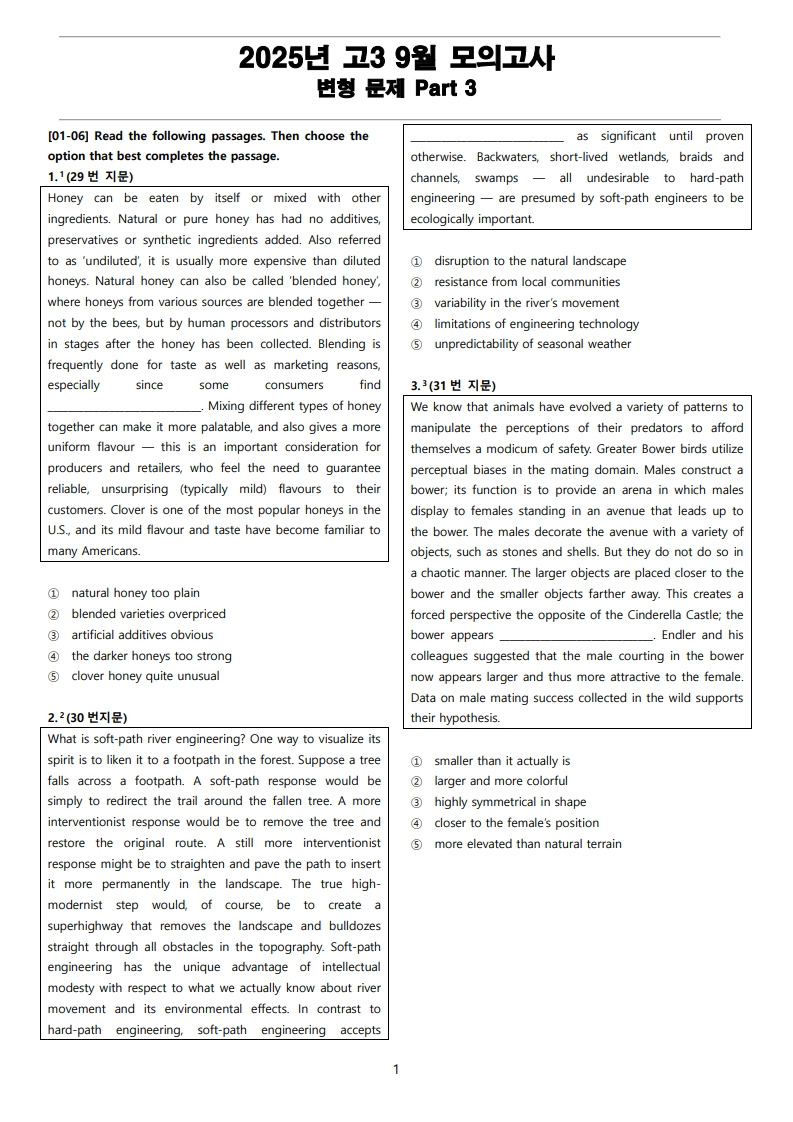
1번 지문(문항 번호 29번)
Honey can be eaten by itself or mixed with other ingredients. Natural or pure honey has had no additives, preservatives or synthetic ingredients added. Also referred to as ‘undiluted’, it is usually more expensive than diluted honeys. Natural honey can also be called ‘blended honey’, where honeys from various sources are blended together ─ not by the bees, but by human processors and distributors in stages after the honey has been collected. Blending is frequently done for taste as well as marketing reasons, especially since some consumers find the darker honeys too strong. Mixing different types of honey together can make it more palatable, and also gives a more uniform flavour ─ this is an important consideration for producers and retailers, who feel the need to guarantee reliable, unsurprising (typically mild) flavours to their customers. Clover is one of the most popular honeys in the U.S., and its mild flavour and taste have become familiar to many Americans.
2번 지문(문항 번호 30번)
What is soft-path river engineering? One way to visualize its spirit is to liken it to a footpath in the forest. Suppose a tree falls across a footpath. A soft-path response would be simply to redirect the trail around the fallen tree. A more interventionist response would be to remove the tree and restore the original route. A still more interventionist response might be to straighten and pave the path to insert it more permanently in the landscape. The true high-modernist step would, of course, be to create a superhighway that removes the landscape and bulldozes straight through all obstacles in the topography. Soft-path engineering has the unique advantage of intellectual modesty with respect to what we actually know about river movement and its environmental effects. In contrast to hard-path engineering, soft-path engineering accepts variability in the river’s movement as significant until proven otherwise. Backwaters, short-lived wetlands, braids and channels, swamps ─ all undesirable to hard-path engineering ─ are presumed by soft-path engineers to be ecologically important.
3번 지문(문항 번호 31번)
We know that animals have evolved a variety of patterns to manipulate the perceptions of their predators to afford themselves a modicum of safety. Greater Bower birds utilize perceptual biases in the mating domain. Males construct a bower; its function is to provide an arena in which males display to females standing in an avenue that leads up to the bower. The males decorate the avenue with a variety of objects, such as stones and shells. But they do not do so in a chaotic manner. The larger objects are placed closer to the bower and the smaller objects farther away. This creates a forced perspective the opposite of the Cinderella Castle; the bower appears smaller than it actually is. Endler and his colleagues suggested that the male courting in the bower now appears larger and thus more attractive to the female. Data on male mating success collected in the wild supports their hypothesis.
4번 지문(문항 번호 32번)
Although empathy is widely praised by scholars and public figures, not everyone is an empathy booster. Critics of empathy argue that empathy will not save us from interpersonal and intergroup conflict. In fact, they argue, empathy makes such conflicts worse. These critics maintain that empathy can be exhausting and lead to burnout, insensitivity to suffering, or worse. They argue that we tend to empathize strongly with our in-group and resist empathizing with out-groups, and even enjoy the suffering of out-groups in competitive or threatening contexts. Thus, the prescription for more empathy is often counterproductive in cases of conflict. Empathy, they argue, can further entrench conflict and force us into an us vs. them mentality. Finally, even when we try to empathize with others who are dissimilar from us or in unfamiliar contexts, sometimes we are unable to accurately empathize with their experiences, causing further misunderstandings and frustration. Critics of empathy argue that we should give up on empathy and employ other tools in pursuit of social harmony, e.g., rational compassion or moral emotions like fear, anger, and shame.
5번 지문(문항 번호 33번)
Compared to other ecosystems, forests are relatively diverse, but this should not necessarily be a justification for converting nonforests into forests. Wetlands, meadows, and grasslands have a unique biota too, even if it is often not as rich as a forest biota. The ecological problems of this process have been described from a number of places such as Iceland, South Africa, and Australia, but the classic example of this comes from Scotland and northern England. Here the Forestry Commission has drained, fertilized, and fenced extensive areas of wetlands to facilitate turning them into forests. Increasing the extent of forests in Britain is certainly a desirable goal, and most of the Forestry Commission’s efforts are directed toward sites that were forested before sheep and their keepers came to the island. However, ecologists frequently complain about the Commission’s work because it is not restricted to former forest sites, because the forests established are usually composed of exotic trees, and because the wildlife threatened by this activity includes many uncommon species.
6번 지문(문항 번호 34번)
When gathering the preferences of multiple agents into one collective choice, it is easily seen that certain cases call for randomization or other means of tiebreaking. For example, if there are two alternatives, a and b, and two agents such that one prefers a and the other one b, there is no deterministic way of selecting a single alternative without violating one of two basic fairness conditions known as anonymity and neutrality. Anonymity requires that the collective choice ought to be independent of the agents’ identities whereas neutrality requires impartiality towards the alternatives. Allowing lotteries as social outcomes hence seems like a necessity for impartial collective choice. Indeed, most common “deterministic” social choice functions such as plurality rule are only deterministic as long as there is no tie, which is usually resolved by drawing a lot. The use of lotteries for the selection of officials interestingly goes back to the world’s first democracy in Athens, where it was widely regarded as a principal characteristic of democracy, and has recently gained increasing attention in political science.
'전국 연합 모의고사 변형 문제 > 고3 모의고사 변형 문제' 카테고리의 다른 글
| 2025년 9월 고3 영어 모의고사 변형문제 지문[35,36,37,38,39,40] (0) | 2026.08.01 |
|---|---|
| 2025년 9월 3학년 모의고사 변형문제 지문[22,23,24,26] (0) | 2026.07.30 |
| 2025년 9월 고3 영어 모의고사 변형문제 지문 [18,19,20,21] (0) | 2026.07.24 |
| 2025년 7월 고3 영어 모의고사 변형문제 지문 [35,36,37,38,39,40] (1) | 2026.07.22 |
| 2025년 7월 고3 모의고사 변형문제 지문 [29,30,31,32,33,34] (0) | 2026.07.21 |