
수프림 유형독해 Ch 10 어법
변형문제
일반 워크북 형태의 문제에서 벗어나 The Makings가 만든 수프림 유형독해 Ch 10 어법은
출판사에서 오랫동안 영어 번역과 교정을 하셨던 원어민 선생님과
현직에서 강사를 하고 있는 연구진들이 학생들을 위한
최상의 수프림 유형독해 Ch 10 어법을 선보입니다.
사고력과 이해력을 요구하는 문제들로 내신 대비 뿐만이 아니라
수능도 한꺼번에 공부하실 수 있는 자료입니다.
중간고사&기말고사 전에 더메이킹스(The Makings)에서 제작한
수프림 유형독해 Ch 10 어법 변형 문제로 마무리 하세요.
정답 확인 하러가기!
https://themakings.co.kr/248/?idx=1304
수프림 유형독해 Ch 6 제목 (66문항) (PDF)
수프림 유형독해 Ch 6 제목 (66문항) (PDF)
themakings.co.kr
The Makings의 2025년수프림 유형독해 Ch 10 어법 변형 문제는
총 11개의 유형으로 구성되어 있습니다.
1. 빈칸 채우기(객관식)
2. 글의 내용 일치/불일치(객관식/한글 선택지)
3. 글의 내용 일치/불일치(객관식/영어 선택지)
4. 글 끼어 넣기(객관식)
5. 어법(서술형)
6. 어휘(서술형)
7. 주제문(객관식/영어 선택지)
8. 어휘 빈칸 채우기(서술형)
9. 영작(서술형)
10. 요약문 완성하기(서술형)
11. 문단 재배열 하기(객관식)
더메이킹스(The Makings)가 제작한 수프림 유형독해 Ch 10 어법 변형 문제의 지문입니다.
1번 지문
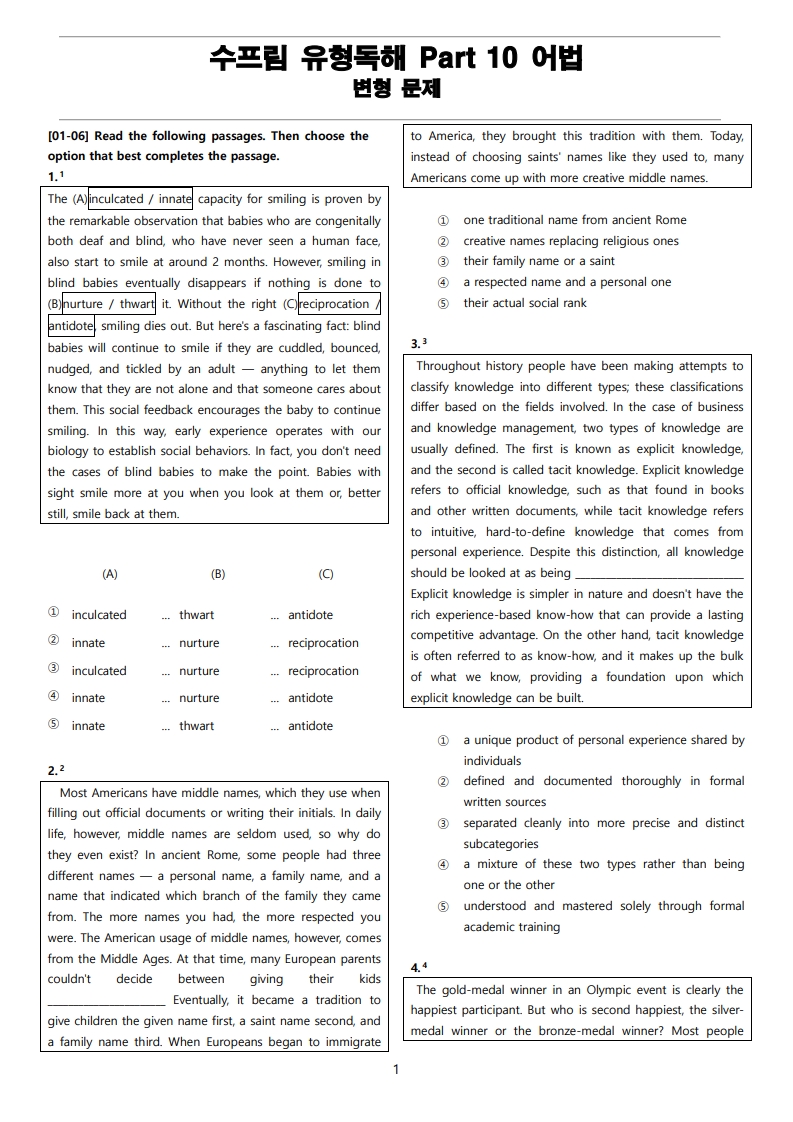
The built-in capacity for smiling is proven by the remarkable observation that babies who are congenitally both deaf and blind, who have never seen a human face, also start to smile at around 2 months. However, smiling in blind babies eventually disappears if nothing is done to reinforce it. Without the right feedback, smiling dies out. But here's a fascinating fact: blind babies will continue to smile if they are cuddled, bounced, nudged, and tickled by an adult ― anything to let them know that they are not alone and that someone cares about them. This social feedback encourages the baby to continue smiling. In this way, early experience operates with our biology to establish social behaviors. In fact, you don't need the cases of blind babies to make the point. Babies with sight smile more at you when you look at them or, better still, smile back at them.
2번 지문
Most Americans have middle names, which they use when filling out official documents or writing their initials. In daily life, however, middle names are seldom used, so why do they even exist? In ancient Rome, some people had three different names ─ a personal name, a family name, and a name that indicated which branch of the family they came from. The more names you had, the more respected you were. The American usage of middle names, however, comes from the Middle Ages. At that time, many European parents couldn't decide between giving their kids their family name or a saint. Eventually, it became a tradition to give children the given name first, a saint name second, and a family name third. When Europeans began to immigrate to America, they brought this tradition with them. Today, instead of choosing saints' names like they used to, many Americans come up with more creative middle names.
3번 지문
Throughout history people have been making attempts to classify knowledge into different types; these classifications differ based on the fields involved. In the case of business and knowledge management, two types of knowledge are usually defined. The first is known as explicit knowledge, and the second is called tacit knowledge. Explicit knowledge refers to official knowledge, such as that found in books and other written documents, while tacit knowledge refers to intuitive, hard-to-define knowledge that comes from personal experience. Despite this distinction, all knowledge should be looked at as being a mixture of these two types rather than being one or the other. Explicit knowledge is simpler in nature and doesn't have the rich experience-based know-how that can provide a lasting competitive advantage. On the other hand, tacit knowledge is often referred to as know-how, and it makes up the bulk of what we know, providing a foundation upon which explicit knowledge can be built.
4번 지문
The gold-medal winner in an Olympic event is clearly the happiest participant. But who is second happiest, the silver-medal winner or the bronze-medal winner? Most people would guess the former, but a study suggests otherwise. When rating athletes' emotions after an event based on their facial expressions, the study's participants judged the bronze medalists, on average, to be happier than the silver medalists. It is believed that this is due to the silver medalists focusing on what could have been ─ they envision what would have happened if they had run a little faster or nailed their landing. This makes them feel like they lost. Bronze medalists, on the other hand, tend to focus on the fact that they managed to win a medal. This makes them feel like winners. The results of this study show that our level of satisfaction with a situation depends largely on how we choose to view it.
5번 지문
I set out to cross an area affected by a terrible drought, and after walking for three days found myself in a landscape of unparalleled desolation. I camped near a deserted village. I hadn't had any water since the previous day, so I had to find some. Although the houses, which were grouped together tightly, were in ruins, they made me think there must once have been a spring or a well nearby. And indeed there was a spring, but it had dried up. Five or six roofless houses weathered away by the wind and a little chapel with a fallen tower were arranged like the houses and churches in any other village. But in them no life remained. In that barren land, the wind blew cruelly. The sound of it raging through the ruins of the houses was like the snarl of a wild beast disturbed while feeding on its prey.
6번 지문
There is little doubt that we are driven by the sell-by date. Once an item is past that date it goes into the waste stream, further increasing its carbon footprint. Remember those items have already travelled hundreds of miles to reach the shelves and once they go into waste they start a new carbon mile journey. But we all make our own judgement about sell-by dates; those brought up during the Second World War are often scornful of the terrible waste they believe such caution encourages. The manufacturer of the food has a view when making or growing something that by the time the product reaches the shelves it has already been travelling for so many days and possibly many miles. The manufacturer then decides that a product can reasonably be consumed within say 90 days and 90 days minus so many days for travelling gives the sell-by date. But whether it becomes toxic is something each individual can decide. It would seem to make sense not to buy large packs of perishable goods but nonperishable items may become cost-effective.
'문제집 변형문제 > 수프림(2025) 유형독해 변형문제' 카테고리의 다른 글
| 수프림 유형독해 Ch 12 빈칸 추론(1) 변형 문제 (0) | 2026.05.29 |
|---|---|
| 수프림 유형독해 Ch 11 어휘 변형 문제 (0) | 2026.05.26 |
| 수프림 유형독해 Ch 6 제목 변형 문제 (0) | 2026.05.01 |
| 수프림 유형독해 Ch 5 주제 변형 문제 (0) | 2026.04.28 |
| 수프림 유형독해 Ch 4 함의 추론 변형 문제 (0) | 2026.04.25 |