
수프림 유형독해 Ch 6 제목
변형 문제
일반 워크북 형태의 문제에서 벗어나 The Makings가 만든 수프림 유형독해 Ch 6 제목 변형 문제는
출판사에서 오랫동안 영어 번역과 교정을 하셨던 원어민 선생님과
현직에서 강사를 하고 있는 연구진들이 학생들을 위한
최상의 수프림 유형독해 Ch 6 제목 변형 문제를 선보입니다.
사고력과 이해력을 요구하는 문제들로 내신 대비 뿐만이 아니라
수능도 한꺼번에 공부하실 수 있는 자료입니다.
중간고사&기말고사 전에 더메이킹스(The Makings)에서 제작한
수프림 유형독해 Ch 6 제목 변형 문제로 마무리 하세요.
정답 확인 하러가기!
https://themakings.co.kr/248/?idx=1267
수프림 유형독해 Ch 6 제목 (66문항) (PDF)
수프림 유형독해 Ch 6 제목 (66문항) (PDF)
themakings.co.kr
The Makings의 2025년수프림 유형독해 Ch 6 제목 변형 문제는 총 11개의 유형으로 구성되어 있습니다.
1. 빈칸 채우기(객관식)
2. 글의 내용 일치/불일치(객관식/한글 선택지)
3. 글의 내용 일치/불일치(객관식/영어 선택지)
4. 글 끼어 넣기(객관식)
5. 어법(서술형)
6. 어휘(서술형)
7. 주제문(객관식/영어 선택지)
8. 어휘 빈칸 채우기(서술형)
9. 영작(서술형)
10. 요약문 완성하기(서술형)
11. 문단 재배열 하기(객관식)
더메이킹스(The Makings)가 제작한 수프림 유형독해 Ch 6 제목 변형 문제의 지문입니다.
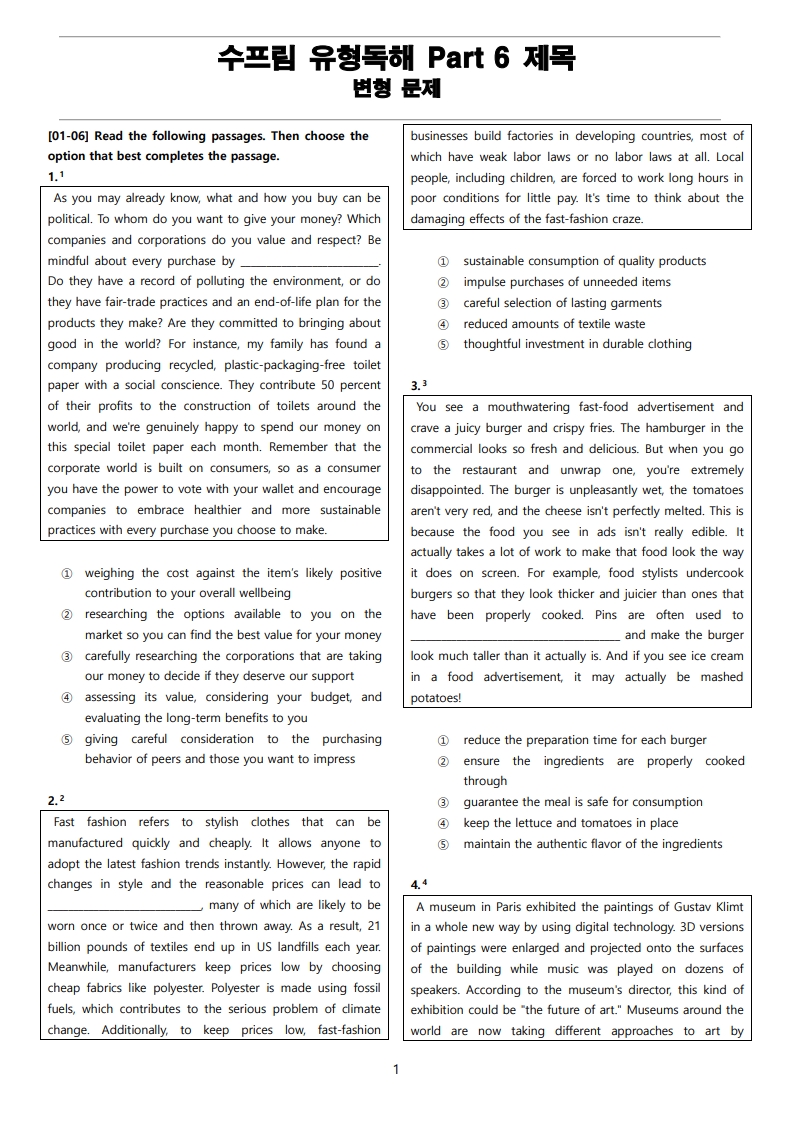
1번 지문
As you may already know, what and how you buy can be political. To whom do you want to give your money? Which companies and corporations do you value and respect? Be mindful about every purchase by carefully researching the corporations that are taking our money to decide if they deserve our support. Do they have a record of polluting the environment, or do they have fair-trade practices and an end-of-life plan for the products they make? Are they committed to bringing about good in the world? For instance, my family has found a company producing recycled, plastic-packaging-free toilet paper with a social conscience. They contribute 50 percent of their profits to the construction of toilets around the world, and we're genuinely happy to spend our money on this special toilet paper each month. Remember that the corporate world is built on consumers, so as a consumer you have the power to vote with your wallet and encourage companies to embrace healthier and more sustainable practices with every purchase you choose to make.
2번 지문
Fast fashion refers to stylish clothes that can be manufactured quickly and cheaply. It allows anyone to adopt the latest fashion trends instantly. However, the rapid changes in style and the reasonable prices can lead to impulse purchases of unneeded items, many of which are likely to be worn once or twice and then thrown away. As a result, 21 billion pounds of textiles end up in US landfills each year. Meanwhile, manufacturers keep prices low by choosing cheap fabrics like polyester. Polyester is made using fossil fuels, which contributes to the serious problem of climate change. Additionally, to keep prices low, fast-fashion businesses build factories in developing countries, most of which have weak labor laws or no labor laws at all. Local people, including children, are forced to work long hours in poor conditions for little pay. It's time to think about the damaging effects of the fast-fashion craze.
3번 지문
You see a mouthwatering fast-food advertisement and crave a juicy burger and crispy fries. The hamburger in the commercial looks so fresh and delicious. But when you go to the restaurant and unwrap one, you're extremely disappointed. The burger is unpleasantly wet, the tomatoes aren't very red, and the cheese isn't perfectly melted. This is because the food you see in ads isn't really edible. It actually takes a lot of work to make that food look the way it does on screen. For example, food stylists undercook burgers so that they look thicker and juicier than ones that have been properly cooked. Pins are often used to keep the lettuce and tomatoes in place and make the burger look much taller than it actually is. And if you see ice cream in a food advertisement, it may actually be mashed potatoes!
4번 지문
A museum in Paris exhibited the paintings of Gustav Klimt in a whole new way by using digital technology. 3D versions of paintings were enlarged and projected onto the surfaces of the building while music was played on dozens of speakers. According to the museum's director, this kind of exhibition could be "the future of art." Museums around the world are now taking different approaches to art by incorporating new technologies and trying to extend the notion of what art is. Along with presenting art in a more immersive or interactive way, they are also launching their own apps that allow people to learn about art with guided virtual tours and "explore museum" features. This is in recognition of the fact that more and more content is mediated through mobile devices, leading to greater dynamism and interactivity. As the world continues to adapt to our fast-moving, ever-changing information society, museums continue to evolve as well.
5번 지문
How a civilization develops is closely related to the natural setting in which it is located. The achievements of the ancient Egyptian civilization, for example, cannot be fully understood without first considering its geographic surroundings, including the Nile River and the Sahara desert. The Sahara gave the ancient Egyptians a huge defensive advantage ─ no army at that time had the ability to cross such a vast desert to attack Egypt. Free from the worry of foreign invaders, the ancient Egyptians were able to focus on improving their farming techniques. This is where the Nile provided assistance. The land along its banks was unusually fertile, and its seasonal flooding helped irrigate the Egyptian's crops. With a steady source of food guaranteed, the Egyptians began to rapidly develop in other fields, including art, architecture, philosophy and government ─ some of the basics needed to create a civilization. Eventually, pyramids, mummies, Cleopatra, and the Sphinx of Giza became touchstones of this flourishing culture.
6번 지문
Manufacturers masterfully sow seeds of doubt about the adequacy of our current devices. Suddenly, the phone that was your lifeline a year ago is now a museum piece, unable to keep pace with your digital demands. And thus, the itch to upgrade begins, often before there's a genuine need. This cycle isn't just confined to our digital companions. It spills over into almost every aspect of consumer electronics, from the self-driving car to the smart fridge. Every product seems to be on an unstoppable march towards the next version, the next generation that promises to revolutionize your life. What's fascinating, or perhaps disturbing, is the utter efficacy of this cycle in shaping our desires. It's not so much that we want the newest device; we're led to believe we need it. The distinction between want and need blurs, shifting our financial priorities in favor of staying current with trends. For all the logical arguments against this ceaseless upgrading, the temptation remains compelling.
'문제집 변형문제 > 수프림(2025) 유형독해 변형문제' 카테고리의 다른 글
| 수프림 유형독해 Ch 11 어휘 변형 문제 (0) | 2026.05.26 |
|---|---|
| 수프림 유형독해 Ch 10 어법 변형문제 (0) | 2026.05.24 |
| 수프림 유형독해 Ch 5 주제 변형 문제 (0) | 2026.04.28 |
| 수프림 유형독해 Ch 4 함의 추론 변형 문제 (0) | 2026.04.25 |
| 수프림 유형독해 Ch 3 주장 요지 변형 문제 (0) | 2026.04.22 |