
수능실감 영어 독해 5문항 모의고사 300제 Day 19 변형문제

전문항 확인 하러가기!
https://themakings.co.kr/421/?idx=1593
수능실감 영어 독해 5문항 모의고사 300제 DAY 19 변형문제(PDF)
수능실감 영어 독해 5문항 모의고사 300제 DAY 19 변형문제(PDF)은 원어민 선생님과 현직 강사가 제작한 수능 영어 변형문제. 실전 감각을 높이는 고퀄리티 문제로 내신·수능 완벽 대비.
themakings.co.kr
다음 지문을 읽고 글의 내용과 다른 선지를 고르세요.
Businesses that own enterprises and seek to market their goods and services in more than one nation are known as multinational corporations (MNCs). MNCs bring employment opportunities as well as goods and services to people who otherwise would not have them. At the same time, they create major and controversial changes in the natural, economic, social, and political environments. Poorer nations are particularly vulnerable to MNCs, many of which have yearly budgets greater than some of them. For example, in 2014, each of the world's 20 largest MNCs had gross revenues of more than $161 billion, larger than all but about 50 of the 208 countries tracked by the World Bank. The financial power of these corporations enables them to exert enormous influence and makes it extremely difficult for developing nations to regulate them. In addition, like all capitalist corporations, the fundamental goal of MNCs is to return wealth to their shareholders, the vast majority of whom live in wealthy nations. Thus, most MNC profits in poorer nations contribute to the economy of wealthy nations.
① MNCs provide goods, services, and employment opportunities to people who would not otherwise have access to them.
② Multinational corporations create uniformly positive changes in the natural, economic, social, and political environments of host nations.
③ Some of the world's largest MNCs have annual revenues exceeding those of many countries tracked by the World Bank.
④ Developing countries face significant challenges in regulating multinational corporations due to their immense financial power.
⑤ MNCs generate significant yet contentious transformations in various aspects of the environments of host nations.
지문 해석
기업을 소유하고 둘 이상의 국가에서 상품과 서비스를 판매하려는 기업을 다국적 기업(MNC)이라고 한다. MNC는 그렇지 않았다면 누릴 수 없었을 사람들에게 고용 기회와 상품 및 서비스를 가져다준다. 동시에 자연적, 경제적, 사회적, 정치적 환경에 중대하고 논란이 되는(major and controversial) 변화를 만들어낸다. 가난한 국가들은 MNC에 특히 취약한데, 많은 MNC의 연간 예산이 이들 국가 중 일부보다 크기 때문이다. 예를 들어, 2014년 세계 20대 MNC 각각의 총 매출은 1,610억 달러 이상이었으며, 이는 세계은행이 추적하는 208개 국가 중 약 50개를 제외한 모든 국가보다 큰 규모이다. 이러한 기업의 재정적 힘은 엄청난 영향력을 행사할 수 있게 하며, 개발도상국이 이들을 규제하기 극히 어렵게 만든다. 또한, 모든 자본주의 기업처럼 MNC의 근본적 목표는 주주에게 부를 돌려주는 것이며, 주주의 대다수는 부유한 국가에 산다. 따라서 가난한 국가에서의 MNC 이익의 대부분은 부유한 국가의 경제에 기여한다.
풀이 흐름
이 지문은 MNC가 가져오는 변화의 성격을 핵심적으로 다룬다. 특히 이 변화가 긍정적이기만 한지, 아니면 부정적 측면도 포함하는지를 정확히 파악하는 것이 핵심이다.
지문은 MNC가 만들어내는 변화에 대해 "they create major and controversial changes"라고 명시한다. 여기서 "controversial(논란이 되는)"이라는 표현은 이 변화가 긍정적 측면만이 아니라 부정적 측면도 함께 가진 양면적 성격임을 보여준다.
따라서 MNC가 진출국의 환경에 "균일하게 긍정적인(uniformly positive)" 변화를 만들어낸다고 서술하는 선지가 있다면, 이는 지문과 정면으로 모순된다.
전체 선지 분석
|
선지
|
판정
|
근거
|
|
① MNCs provide goods, services, and employment opportunities to people who would not otherwise have access to them.
|
✅ 일치
|
지문의 "MNCs bring employment opportunities as well as goods and services to people who otherwise would not have them"과 직접 대응.
|
|
② Multinational corporations create uniformly positive changes in the natural, economic, social, and political environments of host nations.
|
❌ 불일치
|
지문은 "they create major and controversial changes"라고 명시. uniformly positive ↔ controversial로 정반대. "controversial"은 긍정적이기만 한 것이 아니라 논란이 있는 양면적 변화임을 의미한다.
|
|
③ Some of the world's largest MNCs have annual revenues exceeding those of many countries tracked by the World Bank.
|
✅ 일치
|
지문의 "each of the world's 20 largest MNCs had gross revenues of more than $161 billion, larger than all but about 50 of the 208 countries"와 정확히 대응.
|
|
④ Developing countries face significant challenges in regulating multinational corporations due to their immense financial power.
|
✅ 일치
|
지문의 "makes it extremely difficult for developing nations to regulate them"과 직접 대응. significant challenges = extremely difficult.
|
|
⑤ MNCs generate significant yet contentious transformations in various aspects of the environments of host nations.
|
✅ 일치
|
지문의 "they create major and controversial changes in the natural, economic, social, and political environments"와 정확히 대응. significant = major, contentious = controversial.
|
핵심 문장 정리
"At the same time, they create major and controversial changes in the natural, economic, social, and political environments."
이 문장이 ②번 선지의 오류를 판별하는 결정적 근거다. 지문은 MNC가 만들어내는 변화가 "중대하고 논란이 되는(major and controversial)" 것이라고 서술하여 양면적 성격을 밝히는 반면, ②번은 "균일하게 긍정적인(uniformly positive)" 변화라고 서술하여 부정적 측면을 완전히 제거했다.
한 줄 정리
MNC가 진출국에 만들어내는 변화는 "균일하게 긍정적인" 것이 아니라 "중대하고 논란이 되는" 양면적 성격의 변화이다.
The Makings의 DAY 19 변형문제는
총 11개의 유형으로 구성되어 있습니다.
1. 빈칸 채우기(객관식)
2. 글의 내용 일치/불일치(객관식/한글 선택지)
3. 글의 내용 일치/불일치(객관식/영어 선택지)
4. 글 끼어 넣기(객관식)
5. 어법(서술형)
6. 어휘(서술형)
7. 주제문(객관식/영어 선택지)
8. 어휘 빈칸 채우기(서술형)
9. 영작(서술형)
10. 요약문 완성하기(서술형)
11. 문단 재배열 하기(객관식)
더메이킹스(The Makings)가 제작한 수능실감 영어 독해 5문항 모의고사 300제
DAY 19(55문항) 변형문제의 지문입니다.
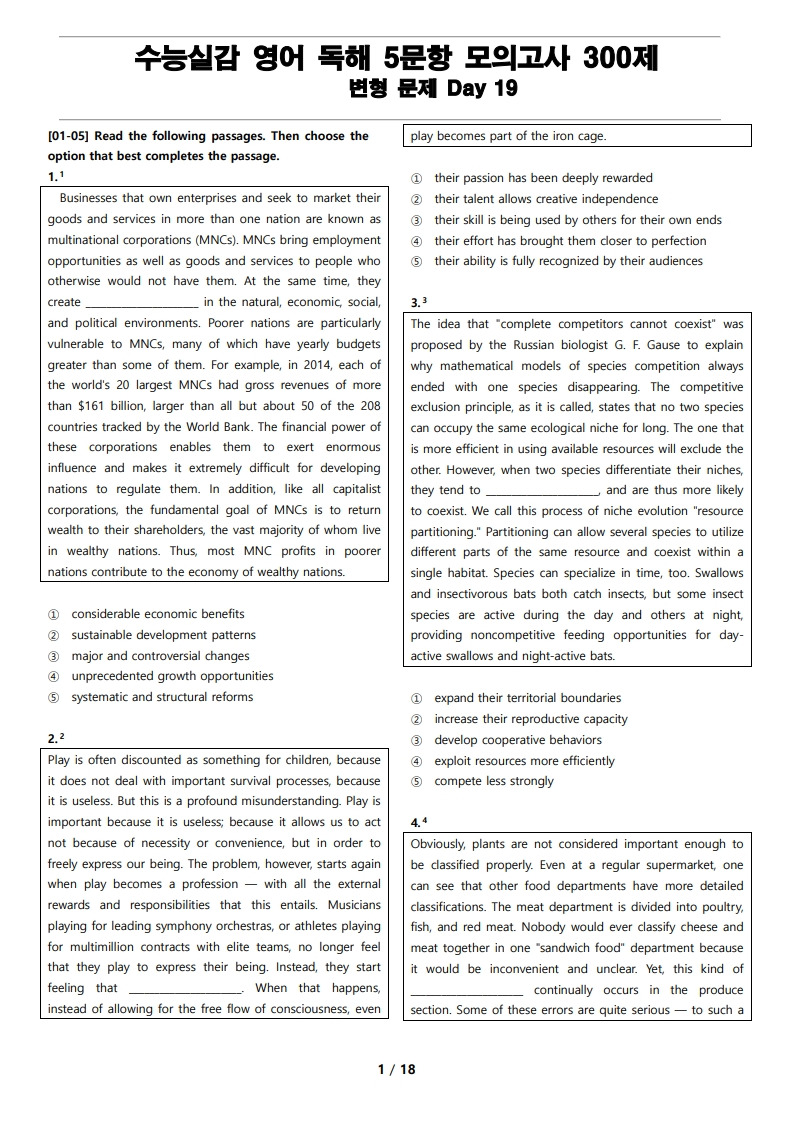
1번 지문
Businesses that own enterprises and seek to market their goods and services in more than one nation are known as multinational corporations (MNCs). MNCs bring employment opportunities as well as goods and services to people who otherwise would not have them. At the same time, they create major and controversial changes in the natural, economic, social, and political environments. Poorer nations are particularly vulnerable to MNCs, many of which have yearly budgets greater than some of them. For example, in 2014, each of the world's 20 largest MNCs had gross revenues of more than $161 billion, larger than all but about 50 of the 208 countries tracked by the World Bank. The financial power of these corporations enables them to exert enormous influence and makes it extremely difficult for developing nations to regulate them. In addition, like all capitalist corporations, the fundamental goal of MNCs is to return wealth to their shareholders, the vast majority of whom live in wealthy nations. Thus, most MNC profits in poorer nations contribute to the economy of wealthy nations.
2번 지문
Play is often discounted as something for children, because it does not deal with important survival processes, because it is useless. But this is a profound misunderstanding. Play is important because it is useless; because it allows us to act not because of necessity or convenience, but in order to freely express our being. The problem, however, starts again when play becomes a profession ─ with all the external rewards and responsibilities that this entails. Musicians playing for leading symphony orchestras, or athletes playing for multimillion contracts with elite teams, no longer feel that they play to express their being. Instead, they start feeling that their skill is being used by others for their own ends. When that happens, instead of allowing for the free flow of consciousness, even play becomes part of the iron cage.
3번 지문
The idea that "complete competitors cannot coexist" was proposed by the Russian biologist G. F. Gause to explain why mathematical models of species competition always ended with one species disappearing. The competitive exclusion principle, as it is called, states that no two species can occupy the same ecological niche for long. The one that is more efficient in using available resources will exclude the other. However, when two species differentiate their niches, they tend to compete less strongly, and are thus more likely to coexist. We call this process of niche evolution "resource partitioning." Partitioning can allow several species to utilize different parts of the same resource and coexist within a single habitat. Species can specialize in time, too. Swallows and insectivorous bats both catch insects, but some insect species are active during the day and others at night, providing noncompetitive feeding opportunities for day-active swallows and night-active bats.
4번 지문
Obviously, plants are not considered important enough to be classified properly. Even at a regular supermarket, one can see that other food departments have more detailed classifications. The meat department is divided into poultry, fish, and red meat. Nobody would ever classify cheese and meat together in one "sandwich food" department because it would be inconvenient and unclear. Yet, this kind of confusion and error continually occurs in the produce section. Some of these errors are quite serious ─ to such a degree that they could cause health problems. For example, placing starch roots in the same category with tomatoes could prompt customers to make improper food-combination choices, which can create fermentation and gas in our intestines.
5번 지문
Human social life originates with the evolution of parental care and the mother-infant bond. The behavior between mother and infant, and later between father and infant, is the foundation stone for adult bonding, friendliness, and love, all of which are at the heart of social organization. Unfortunately, all mammals, including humans, demonstrate ambivalence about other people. As powerfully wired as we are for social contact, so too are we wired for "xenophobia": the fear of strangers. This fear begins during the second half of the first year of life, and although it is modifiable by culture, it is never totally absent from human social relationships. This inherent conflict is probably what propelled our evolution into relatively small social groups; we needed social bonds, and yet we had to minimize our fear-arousing contact with strangers. Thus, the perfect solution is a fixed, relatively small group of familiar people. Modern urban life, of course, poses serious problems in this regard.
'문제집 변형문제 > 수능 실감 영어 독해 5문항 300제' 카테고리의 다른 글
| 수능실감 영어 독해 5문항 모의고사 300제 Day 21 변형문제 (0) | 2026.10.05 |
|---|---|
| 수능실감 영어 독해 5문항 모의고사 300제 Day 20 변형문제 (0) | 2026.10.04 |
| 수능실감 영어 독해 5문항 모의고사 300제 Day 17 변형문제 (0) | 2026.09.25 |
| 수능실감 영어 독해 5문항 모의고사 300제 Day 16 변형문제 (0) | 2026.09.24 |
| 수능실감 영어 독해 5문항 모의고사 300제 Day 15 변형문제 (0) | 2026.09.24 |