
수프림 유형독해
Ch 17 요약문 완성 변형문제
수프림 유형독해 Ch 17 요약문 완성(66문항) (PDF)
수프림 유형독해 Ch 17 요약문 완성 (66문항)은 원어민 선생님과 현직 강사가 제작한 수능 영어 변형문제. 실전 감각을 높이는 고퀄리티 문제로 내신·수능 완벽 대비.
themakings.co.kr
다음 지문을 읽고 글의 내용과 다른 선지를 고르세요.
Greenwashing involves misleading a consumer into thinking a good or service is more environmentally friendly than it really is. Greenwashing ranges from making environmental claims required by law, and therefore irrelevant (CFC-free for example), to puffery (exaggerating environmental claims) to fraud. Researchers have shown that claims on products are often too vague or misleading. Some products are labeled "chemical-free," when the fact is everything contains chemicals, including plants and animals. Products with the highest number of misleading or unverifiable claims were laundry detergents, household cleaners, and paints. Environmental advocates agree there is still a long way to go to ensure shoppers are adequately informed about the environmental impact of the products they buy. The most common reason for greenwashing is to attract environmentally conscious consumers. Many consumers do not find out about the false claims until after the purchase. Therefore, greenwashing may increase sales in the short term. However, this strategy can seriously backfire when consumers find out they are being deceived.
① Greenwashing can occur when a company highlights something true about a product (albeit misleadingly) or when a company outright lies.
② A claim by a company that its product is “chemical-free,” while true, is a redundant and, therefore, misleading statement.
③ Environmental advocates do not believe that customers are currently sufficiently conversant with the environmental impact of the products they buy.
④ Greenwashing is primarily employed to attract customers who are already concerned about the environment.
⑤ If greenwashing can be found out, then the company resorting to it may find that disillusioned customers do not make future purchases.
지문 해석
그린워싱(Greenwashing)은 소비자로 하여금 어떤 상품이나 서비스가 실제보다 더 환경 친화적이라고 오해하도록 유도하는 것이다. 그린워싱의 범위는 법적으로 이미 요구되는 환경 관련 주장(예: CFC 미포함)을 마치 특별한 것처럼 내세우는 것에서부터, 과장 광고(puffery), 나아가 사기(fraud)에까지 이른다. 연구자들은 제품에 붙은 주장들이 너무 모호하거나 오해의 소지가 있는 경우가 많다는 것을 보여주었다. 일부 제품은 "무화학물질(chemical-free)"이라고 표시되어 있지만, 사실상 식물과 동물을 포함해 모든 것이 화학물질을 포함하고 있다. 오해의 소지가 있거나 검증 불가능한 주장이 가장 많은 제품은 세탁세제, 가정용 세제, 페인트였다. 환경 옹호론자들은 소비자들이 구매하는 제품의 환경적 영향에 대해 충분히 알 수 있도록 하기까지 아직 갈 길이 멀다는 데 동의한다. 그린워싱의 가장 흔한 이유는 환경을 의식하는 소비자들을 유인하기 위해서이다. 많은 소비자들은 구매 후에야 허위 주장을 알게 된다. 따라서 그린워싱은 단기적으로는 매출을 높일 수 있지만, 소비자들이 속았다는 것을 알게 되면 이 전략은 심각하게 역효과를 낼 수 있다.
풀이 흐름
이 문제를 풀 때 핵심은 "chemical-free"라는 주장의 사실 여부를 정확히 파악하는 것이다. 지문은 "chemical-free"라는 라벨에 대해 "the fact is everything contains chemicals, including plants and animals"라고 명시한다. 즉, 세상에 화학물질이 없는 것은 존재하지 않으므로 "chemical-free"라는 주장 자체가 거짓(false)이다.
그런데 ②번 선지는 이 주장이 "while true"(사실이긴 하지만)라고 전제한 뒤, "redundant(불필요한) 진술이므로 오해의 소지가 있다"고 서술한다. 지문에 따르면 이 주장은 사실이 아니라 허위이기 때문에, "while true"라는 전제 자체가 지문과 정면으로 모순된다.
전체 선지 분석
|
선지
|
판정
|
근거
|
|
① Greenwashing can occur when a company highlights something true about a product (albeit misleadingly) or when a company outright lies.
|
✅ 일치
|
지문에서 CFC-free 표시(법적 요구사항이라 사실이지만 오해 유도)는 "사실이지만 오해의 소지가 있는" 사례이고, fraud는 "노골적인 거짓말"에 해당. 두 경우 모두 그린워싱의 범위에 포함된다고 서술.
|
|
② A claim by a company that its product is "chemical-free," while true, is a redundant and, therefore, misleading statement.
|
❌ 불일치
|
지문은 **"everything contains chemicals"**라고 명시하므로 "chemical-free"는 거짓 주장이다. 선지가 이를 **"while true(사실이긴 하지만)"**라고 서술한 부분이 지문과 정반대.
|
|
③ Environmental advocates do not believe that customers are currently sufficiently conversant with the environmental impact of the products they buy.
|
✅ 일치
|
지문의 "there is still a long way to go to ensure shoppers are adequately informed"와 정확히 일치. "충분히 알지 못한다"는 내용을 "sufficiently conversant"로 패러프레이징.
|
|
④ Greenwashing is primarily employed to attract customers who are already concerned about the environment.
|
✅ 일치
|
지문의 "The most common reason for greenwashing is to attract environmentally conscious consumers"와 일치. primarily = most common reason, environmentally conscious = concerned about the environment.
|
|
⑤ If greenwashing can be found out, then the company resorting to it may find that disillusioned customers do not make future purchases.
|
✅ 일치
|
지문의 "this strategy can seriously backfire when consumers find out they are being deceived"를 구체화한 진술. backfire = disillusioned customers가 재구매를 하지 않는 것으로 해석 가능.
|
핵심 문장 정리
"Some products are labeled 'chemical-free,' when the fact is everything contains chemicals, including plants and animals."
이 문장이 ②번 선지의 오류를 판별하는 결정적 근거다. "chemical-free"는 사실이 아니라 허위 주장이므로, 이를 "while true"로 전제한 ②번이 지문과 불일치한다.
"chemical-free"는 모든 것이 화학물질을 포함하고 있다는 사실에 비추어 거짓된 주장이지, 사실이지만 불필요한 주장이 아니다.
The Makings의 2025년 수프림 유형독해 Ch 17 요약문 완성 변형문제는
총 11개의 유형으로 구성되어 있습니다.
1. 빈칸 채우기(객관식)
2. 글의 내용 일치/불일치(객관식/한글 선택지)
3. 글의 내용 일치/불일치(객관식/영어 선택지)
4. 글 끼어 넣기(객관식)
5. 어법(서술형)
6. 어휘(서술형)
7. 주제문(객관식/영어 선택지)
8. 어휘 빈칸 채우기(서술형)
9. 영작(서술형)
10. 요약문 완성하기(서술형)
11. 문단 재배열 하기(객관식)
더메이킹스(The Makings)가 제작한
수프림 유형독해 Ch 17 요약문 완성 변형문제의 지문입니다.
1번 지문
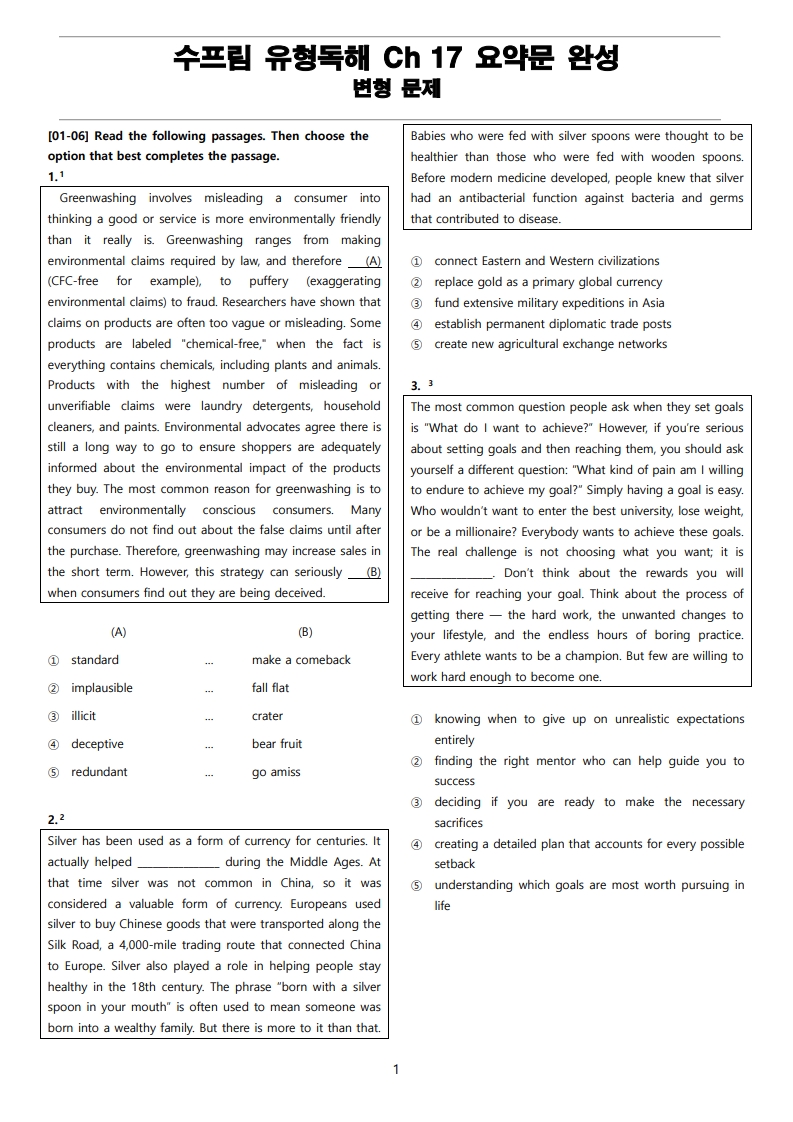
Greenwashing involves misleading a consumer into thinking a good or service is more environmentally friendly than it really is. Greenwashing ranges from making environmental claims required by law, and therefore irrelevant (CFC-free for example), to puffery (exaggerating environmental claims) to fraud. Researchers have shown that claims on products are often too vague or misleading. Some products are labeled "chemical-free," when the fact is everything contains chemicals, including plants and animals. Products with the highest number of misleading or unverifiable claims were laundry detergents, household cleaners, and paints. Environmental advocates agree there is still a long way to go to ensure shoppers are adequately informed about the environmental impact of the products they buy. The most common reason for greenwashing is to attract environmentally conscious consumers. Many consumers do not find out about the false claims until after the purchase. Therefore, greenwashing may increase sales in the short term. However, this strategy can seriously backfire when consumers find out they are being deceived.
2번 지문
Silver has been used as a form of currency for centuries. It actually helped connect Eastern and Western civilizations during the Middle Ages. At that time silver was not common in China, so it was considered a valuable form of currency. Europeans used silver to buy Chinese goods that were transported along the Silk Road, a 4,000-mile trading route that connected China to Europe. Silver also played a role in helping people stay healthy in the 18th century. The phrase “born with a silver spoon in your mouth” is often used to mean someone was born into a wealthy family. But there is more to it than that. Babies who were fed with silver spoons were thought to be healthier than those who were fed with wooden spoons. Before modern medicine developed, people knew that silver had an antibacterial function against bacteria and germs that contributed to disease.
3번 지문
The most common question people ask when they set goals is “What do I want to achieve?” However, if you’re serious about setting goals and then reaching them, you should ask yourself a different question: “What kind of pain am I willing to endure to achieve my goal?” Simply having a goal is easy. Who wouldn’t want to enter the best university, lose weight, or be a millionaire? Everybody wants to achieve these goals. The real challenge is not choosing what you want; it is deciding if you are ready to make the necessary sacrifices to get it. Don’t think about the rewards you will receive for reaching your goal. Think about the process of getting there ─ the hard work, the unwanted changes to your lifestyle, and the endless hours of boring practice. Every athlete wants to be a champion. But few are willing to work hard enough to become one.
4번 지문
Intuition is an inexplicable feeling that something is true even though we have no proof or evidence that it really is. When it comes to philosophy and science, intuition plays a complicated role. Intuition alone can’t be a dependable source of information. Just because we feel something is true doesn’t mean it is. That is why intuition is often questioned by philosophers, especially scientists. Nevertheless, intuition can be a vital source of inspiration for both scientists and philosophers. It can inspire scientists to come up with fresh ideas and design new experiments that will lead to the discovery of truth. Similarly, intuition plays an important role in philosophy as well, for most good philosophical arguments contain a mixture of intuition and logic. Logic is like a powerful machine for analyzing and evaluating ideas. Before using the machine, however, you should have some “raw material” to feed it, and often, that’s where intuition fits in.
5번 지문
We typically view charity as “morally optional” ─ good to do, but not wrong to fail to do. As long as one does not kill, harm, steal, or cheat, one can be considered morally virtuous, even while spending extravagantly and giving nothing to charity. However, it can be argued that those who can afford luxuries yet fail to share even a small fraction must bear responsibility for the suffering of the less fortunate. If they do not meet a minimal standard of generosity, isn’t that a problem? Anyone who thinks seriously about their ethical obligations will rightly conclude that ─ since not everyone will give up even a tiny portion of their wealth ─ they should do more themselves. In order to have a realistic chance of improving charitable giving, we must focus on what we can expect everyone to do. Therefore, we should establish a minimum donation of 1% of our annual income to help address world poverty. This is what we need to do to lead a morally decent life. To give that amount requires no moral heroics. To fail to give it shows indifference to our fellow humans.
6번 지문
The fast-growing, tremendous amount of data, collected and stored in large and numerous data repositories, has far exceeded our human ability for understanding without powerful tools. As a result, data collected in large data repositories become “data tombs” ─ data archives that are hardly visited. Important decisions are often made based not on the information-rich data stored in data repositories but rather on a decision maker’s instinct, simply because the decision maker does not have the tools to extract the valuable knowledge hidden in the vast amounts of data. Efforts have been made to develop expert system and knowledge-based technologies, which typically rely on users or domain experts to manually input knowledge into knowledge bases. However, this procedure is likely to cause biases and errors and is extremely costly and time-consuming. The widening gap between data and information calls for the systematic development of tools that can turn data tombs into “golden nuggets” of knowledge.
'문제집 변형문제 > 수프림(2025) 유형독해 변형문제' 카테고리의 다른 글
| 수프림 유형독해 미니모의고사 1 변형문제 (0) | 2026.08.11 |
|---|---|
| 수프림 유형독해 변형문제 Ch 19 장문(2) 변형문제 (1) | 2026.08.10 |
| 수프림 유형독해 Ch 18 장문(1) 변형문제 (0) | 2026.08.08 |
| 수프림 유형독해 Ch 15 이어질 글의 순서 변형문제 (0) | 2026.07.07 |
| 수프림 유형독해 Ch 14 흐름과 무관한 문장 변형문제 (0) | 2026.06.23 |