
2026년 7월 고3 영어 모의고사
변형문제
지문 [35,36,37,38,39,40]
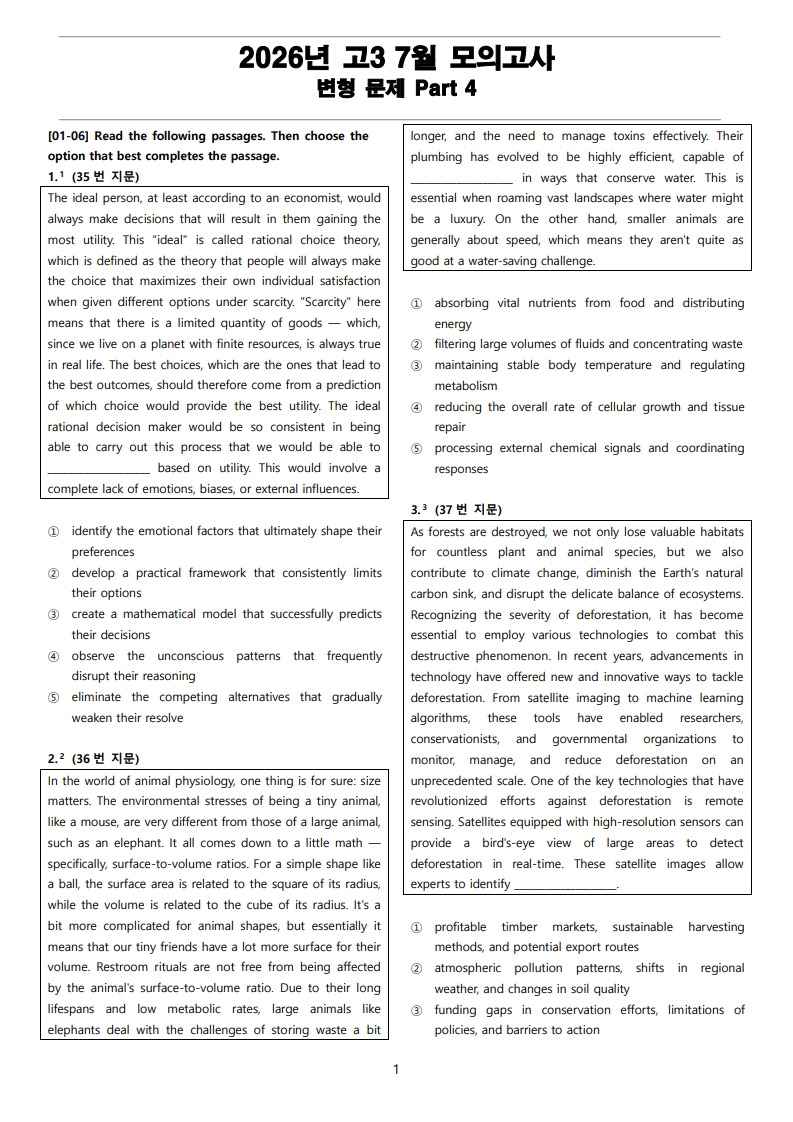
2026년 고3 7월 전국 연합 모의고사 변형 문제 Part 4 (66문항) (PDF)
2026년 고3 7월 전국 연합 모의고사 변형 문제, 내신대비, 영어내신자료,고등영어자료, 모의고사 변형문제,전국 연합모의고사 변형자료, 모의고사 영어 서술형 대비, 대치동 고등 영어자료, 대치
themakings.co.kr
다음 지문을 읽고 글의 내용과 다른 지문을 고르세요.
The ideal person, at least according to an economist, would always make decisions that will result in them gaining the most utility. This "ideal" is called rational choice theory, which is defined as the theory that people will always make the choice that maximizes their own individual satisfaction when given different options under scarcity. "Scarcity" here means that there is a limited quantity of goods ─ which, since we live on a planet with finite resources, is always true in real life. The best choices, which are the ones that lead to the best outcomes, should therefore come from a prediction of which choice would provide the best utility. The ideal rational decision maker would be so consistent in being able to carry out this process that we would be able to create a mathematical model that successfully predicts their decisions based on utility. This would involve a complete lack of emotions, biases, or external influences.
① Rational choice theory assumes people maximize individual satisfaction under scarcity.
② Scarcity refers to the limited quantity of goods, which applies to real life.
③ The best choices should come from predicting which option provides the best utility.
④ An ideal rational decision maker could be modeled mathematically based on utility.
⑤ Scarcity in rational choice theory is a purely hypothetical concept unrelated to real life.
지문 한눈에 보기
이 글은 경제학의 '합리적 선택 이론(rational choice theory)'을 설명하는 글이에요.
경제학자가 생각하는 이상적 인간은 항상 효용(utility)을 최대화하는 결정을 내려요. 이걸 합리적 선택 이론이라고 하는데, 정의는 이래요: 희소성(scarcity) 하에서 다양한 선택지가 주어졌을 때, 사람들은 항상 자신의 개인적 만족을 최대화하는 선택을 할 것이라는 이론이에요.
여기서 "희소성"이란 재화의 양이 제한되어 있다는 뜻인데 — 그리고 유한한 자원을 가진 행성에 살고 있으니, 현실에서 이건 항상 사실이에요. 즉, 희소성은 가상의 개념이 아니라 실제 현실에 그대로 적용되는 개념이에요.
최선의 선택은 어떤 선택이 최고의 효용을 제공할지 예측하는 데서 나와야 해요. 이상적인 합리적 의사결정자는 이 과정을 일관되게 수행해서 수학적 모델로 예측 가능할 정도여야 하고, 여기엔 감정·편견·외부 영향이 전혀 없어야 해요.
⑤번 함정의 포인트: 원문은 희소성이 "현실에서 항상 사실"이라고 했는데, ⑤번은 이걸 "현실과 무관한 순전히 가상적 개념"이라고 정반대로 뒤집었어요.
선택지 O/X 분석
|
번호
|
선택지 요약
|
원문 대조
|
판정
|
|
①
|
합리적 선택 이론은 사람들이 희소성 하에서 개인적 만족을 최대화한다고 가정함
|
"the theory that people will always make the choice that maximizes their own individual satisfaction when given different options under scarcity"
|
⭕ 일치
|
|
②
|
희소성은 재화의 제한된 양을 의미하며 현실 생활에 적용됨
|
"'Scarcity' here means that there is a limited quantity of goods ─ which... is always true in real life"
|
⭕ 일치
|
|
③
|
최선의 선택은 어떤 선택지가 최고의 효용을 제공하는지 예측하는 데서 나와야 함
|
"The best choices... should therefore come from a prediction of which choice would provide the best utility"
|
⭕ 일치
|
|
④
|
이상적 합리적 의사결정자는 효용에 기반해 수학적으로 모델링될 수 있음
|
"we would be able to create a mathematical model that successfully predicts their decisions based on utility"
|
⭕ 일치
|
|
⑤
|
합리적 선택 이론에서 희소성은 현실과 무관한 순전히 가상적 개념임
|
"since we live on a planet with finite resources, is always true in real life" — 현실에서 항상 사실인 개념으로 명시
|
❌ 불일치
|
정답은 ⑤
함정 패턴: 현실 적용성 역전(always true in real life → unrelated to real life)
이번 함정은 원문이 "현실에서 항상 사실"이라고 명시한 것을 "현실과 무관한 가상"으로 뒤집는 패턴이에요. 원문은 희소성에 대해 이렇게 말합니다:
"'Scarcity' here means that there is a limited quantity of goods ─ which, since we live on a planet with finite resources, is always true in real life."
희소성은 이론 속 가상의 전제가 아니라, 유한한 자원의 행성에 살기 때문에 현실에서 항상 적용되는 사실이라고
명확히 밝히고 있어요.
그런데 ⑤번은 이걸 이렇게 바꿔놓았어요:
"Scarcity in rational choice theory is a purely hypothetical concept unrelated to real life." (합리적 선택 이론에서 희소성은 현실과 무관한 순전히 가상적 개념이다)
"always true in real life(현실에서 항상 사실)" → "purely hypothetical concept unrelated to real life(현실과 무관한 순전히 가상적 개념)"
현실 적용성이 완전히 뒤집혔어요. 원문에서 희소성이 현실과 연결되는 근거로 제시한 "유한한 자원의 행성"이라는 표현도 통째로 사라졌고요.
함정 유형 정리: 현실-가상 역전(real → hypothetical) 지문에서 "in real life, applies to reality, is always the case, in practice" 같은 현실 적용 표현이 나오면, 선택지에서 이게 "hypothetical, theoretical, unrelated to reality, purely abstract" 같은 가상·이론적 표현으로 바뀌어 있지 않은지 확인하세요. 경제학·사회과학 지문에서 이론의 개념이 현실에 적용되는지 여부를 뒤집는 이 패턴은 특히 자주 등장해요.
핵심 어휘 정리
- rational choice theory — 합리적 선택 이론
- utility — 효용
- scarcity — 희소성
- maximize — 최대화하다
- finite resources — 유한한 자원
- mathematical model — 수학적 모델
- bias — 편견
- purely hypothetical — 순전히 가상적인 (선택지의 함정 표현)
- unrelated to real life — 현실과 무관한 (선택지의 함정 표현)
풀이 전략 팁
경제학·사회과학 이론을 설명하는 지문에서는 "이 이론/개념이 현실에 적용되는가"에 관한 서술이 핵심 포인트가 되는 경우가 많아요.
이번 지문은 특히 구조가 이렇게 설계됐어요:
이론 정의 → 핵심 개념(희소성) 정의 → 현실 적용 확인 → 이론의 이상적 결론
"희소성은 현실에서 항상 사실"이라는 문장은 단순한 부연 설명이 아니라, 이 이론이 단순한 추상이 아니라 현실에 기반한다는 것을 보여주는 핵심 진술이에요. 출제자는 바로 이 지점을 "현실과 무관한 가상적 개념"으로 뒤집어 함정을 만들었죠.
지문을 읽을 때 "in real life", "in practice", "always", "is indeed the case" 같은 표현이 나오면, 그 문장이 이론과 현실을 연결하는 핵심 고리라는 신호예요. 선택지에서 그 연결이 끊겨 있다면 바로 정답입니다.
The Makings의 2026년 고3 7월 전국 연합 모의고사 변형 문제는
총 11개의 유형으로 구성되어 있습니다.
1. 빈칸 채우기(객관식)
2. 글의 내용 일치/불일치(객관식/한글 선택지)
3. 글의 내용 일치/불일치(객관식/영어 선택지)
4. 글 끼어 넣기(객관식)
5. 어법(서술형)
6. 어휘(서술형)
7. 주제문(객관식/영어 선택지)
8. 어휘 빈칸 채우기(서술형)
9. 영작(서술형)
10. 요약문 완성하기(서술형)
11. 문단 재배열 하기(객관식)
더메이킹스(The Makings)가 제작한
2026년 고3 7월 전국 연합 모의고사 변형 문제 Part 4의 지문입니다.
1번 지문(문항 번호 35번)
The ideal person, at least according to an economist, would always make decisions that will result in them gaining the most utility. This "ideal" is called rational choice theory, which is defined as the theory that people will always make the choice that maximizes their own individual satisfaction when given different options under scarcity. "Scarcity" here means that there is a limited quantity of goods ─ which, since we live on a planet with finite resources, is always true in real life. The best choices, which are the ones that lead to the best outcomes, should therefore come from a prediction of which choice would provide the best utility. The ideal rational decision maker would be so consistent in being able to carry out this process that we would be able to create a mathematical model that successfully predicts their decisions based on utility. This would involve a complete lack of emotions, biases, or external influences.
2번 지문(문항 번호 36번)
n the world of animal physiology, one thing is for sure: size matters. The environmental stresses of being a tiny animal, like a mouse, are very different from those of a large animal, such as an elephant. It all comes down to a little math ─ specifically, surface-to-volume ratios. For a simple shape like a ball, the surface area is related to the square of its radius, while the volume is related to the cube of its radius. It's a bit more complicated for animal shapes, but essentially it means that our tiny friends have a lot more surface for their volume. Restroom rituals are not free from being affected by the animal's surface-to-volume ratio. Due to their long lifespans and low metabolic rates, large animals like elephants deal with the challenges of storing waste a bit longer, and the need to manage toxins effectively. Their plumbing has evolved to be highly efficient, capable of filtering large volumes of fluids and concentrating waste in ways that conserve water. This is essential when roaming vast landscapes where water might be a luxury. On the other hand, smaller animals are generally about speed, which means they aren't quite as good at a water-saving challenge.
3번 지문(문항 번호 37번)
As forests are destroyed, we not only lose valuable habitats for countless plant and animal species, but we also contribute to climate change, diminish the Earth's natural carbon sink, and disrupt the delicate balance of ecosystems. Recognizing the severity of deforestation, it has become essential to employ various technologies to combat this destructive phenomenon. In recent years, advancements in technology have offered new and innovative ways to tackle deforestation. From satellite imaging to machine learning algorithms, these tools have enabled researchers, conservationists, and governmental organizations to monitor, manage, and reduce deforestation on an unprecedented scale. One of the key technologies that have revolutionized efforts against deforestation is remote sensing. Satellites equipped with high-resolution sensors can provide a bird's-eye view of large areas to detect deforestation in real-time. These satellite images allow experts to identify illegal logging activities, encroachments on protected lands, and areas at risk for deforestation.
4번 지문(문항 번호 38번)
As the number of children shrinks, the total dependency ratio (that is the ratio of workers to both the elderly and to children) will be slightly positively affected. Yes, more capital and labour will need to go into building old-age homes and staffing them, but fewer resources will be required by nurseries and schools. Manufacturers of children's diapers can reallocate their plant and workers to making adults' ─ Japan supposedly already uses more of the latter than the former each year. But solving the total dependency ratio by having fewer children is clearly the worst way of addressing the problem. Children do require resources from society and don't immediately put anything back, at least in economic terms. But they are the workers of the future. To invest in the care of an elderly person is compassionate and morally correct. To invest in the education and development of a young person is strengthening the seed corn for the future functioning of society.
5번 지문(문항 번호 39번)
The ways in which the natural world changes over time are registered in our cultural memory. An organization called the Snowchange Cooperative, based in northern Scandinavia, documents the ways in which native communities read and respond to climate change. A Sami woman called Gun Aira notes that a lake whose traditional name is Biehtsejavrre, or Lake of the Pines, is now entirely surrounded by birch ─ a sign of changing environmental conditions. In this way, recognition of environmental change is encoded into native history and knowledge. Most of us do not have access to have such extensive cultural memory banks: we are dependent upon the short attention spans of our contemporary knowledge-making technologies. All too often, this blinds us to deeper, longer changes in the world around us. Climate change is a clear example of this: an alteration to the world occurring at such inhuman scales of time and geography that we struggle to fit it into conventional narratives, let alone respond effectively.
6번 지문(문항 번호 40번)
The arrival of digital media technology has resulted in more direct lines of feedback than had previously been the case in media communications. Before the age of digital media technology, media communicators had no immediate way of knowing whether the audience was truly involved in the communication process. Much of the feedback in the mass communication process was delayed (e.g., letters to the editor, petitions, or phone calls), indirect (e.g., revenue from sales or critical responses) or cumulative (reflecting a collective opinion). But although ratings systems present numerical information about how many people watch a particular program, these ratings cannot measure whether the audience actually enjoy the program. However, the interactive feature of digital media gives audience members the opportunity to respond immediately to media programming. Indeed, programs like talent competition shows incorporate audience response into the presentation, as viewers vote for their favorite performers.
'전국 연합 모의고사 변형 문제 > 고3 모의고사 변형 문제' 카테고리의 다른 글
| 2025년 7월 고3 모의고사 변형문제 지문 [29,30,31,32,33,34] (0) | 2026.07.21 |
|---|---|
| 2026년 7월 고3 모의고사 변형문제 지문 [41,42,43,44,45] (0) | 2026.07.20 |
| 2026년 고3 7월 모의고사 변형문제 지문 [29,30,31,32,33,34] (0) | 2026.07.13 |
| 2026년 7월 고3 모의고사 변형문제 지문 [22,23,24,26] (0) | 2026.07.12 |
| 2026년 고3 7월 모의고사 변형문제 지문 [18,19,20,21] (0) | 2026.07.11 |