
2026년 7월 고3 모의고사
변형문제
지문 [22,23,24,26]
전문항 보러가기!
https://themakings.co.kr/403/?idx=1412
2026년 고3 7월 전국 연합 모의고사 변형 문제 Part 2 (44문항) (PDF)
2026년 고3 7월 전국 연합 모의고사 변형 문제, 내신대비, 영어내신자료,고등영어자료, 모의고사 변형문제,전국 연합모의고사 변형자료, 모의고사 영어 서술형 대비, 대치동 고등 영어자료, 대치
themakings.co.kr
다음 지문을 읽고 글의 내용과 다른 문장을 고르세요.
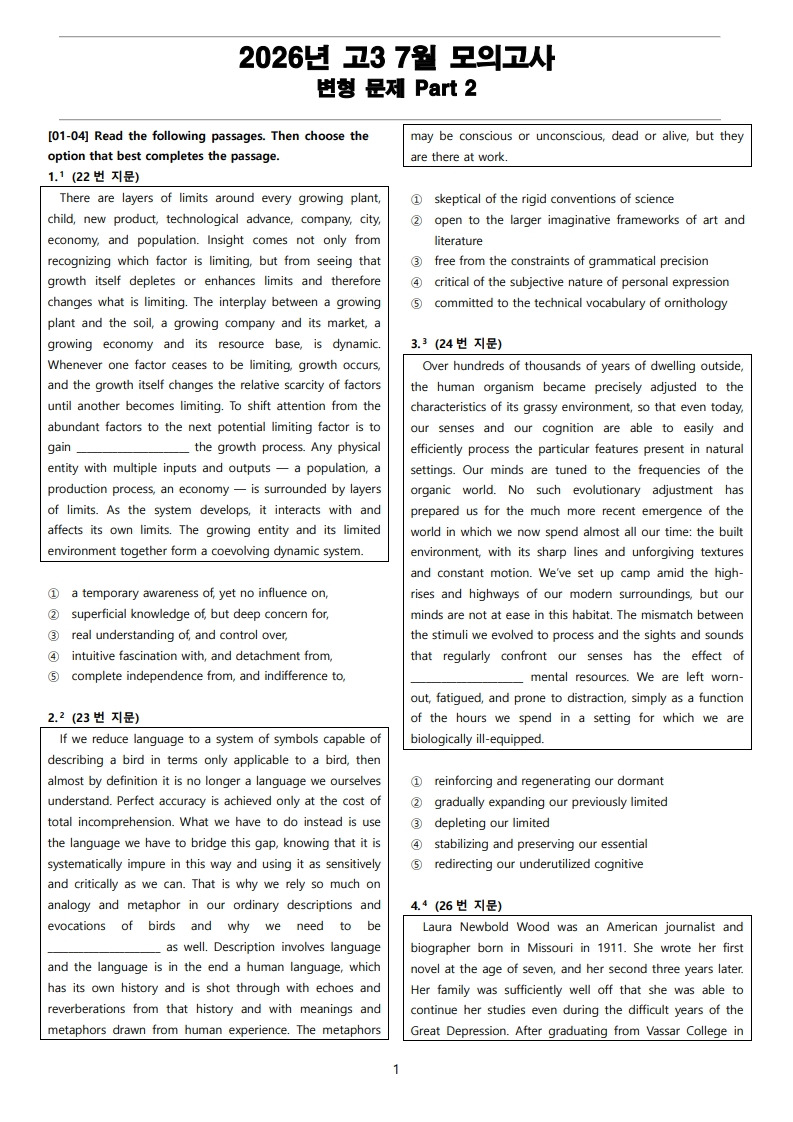
There are layers of limits around every growing plant, child, new product, technological advance, company, city, economy, and population. Insight comes not only from recognizing which factor is limiting, but from seeing that growth itself depletes or enhances limits and therefore changes what is limiting. The interplay between a growing plant and the soil, a growing company and its market, a growing economy and its resource base, is dynamic. Whenever one factor ceases to be limiting, growth occurs, and the growth itself changes the relative scarcity of factors until another becomes limiting. To shift attention from the abundant factors to the next potential limiting factor is to gain real understanding of, and control over, the growth process. Any physical entity with multiple inputs and outputs ─ a population, a production process, an economy ─ is surrounded by layers of limits. As the system develops, it interacts with and affects its own limits. The growing entity and its limited environment together form a coevolving dynamic system.
① Growth itself can either deplete or enhance the factors that set limits on further development.
② A growing entity and its limited environment together form a coevolving dynamic system.
③ Multiple inputs and outputs characterize physical entities such as populations and economies.
④ Once a limiting factor disappears, the system reaches a permanent state of unlimited expansion.
⑤ The relative scarcity of factors shifts as one factor ceases to be limiting and growth takes place.
지문 정리하기
이 글은 성장과 한계 요인(limiting factor) 사이의 역동적 관계를 설명하는 논설문이에요. 모든 성장하는 존재 — 식물, 아이, 신제품, 기업, 도시, 경제, 인구 — 는 여러 겹의 한계에 둘러싸여 있어요. 핵심 통찰은 이거예요: 성장 자체가 한계를 고갈시키거나 강화시키고, 그 결과 무엇이 한계 요인인지가 계속 바뀐다는 거예요.
예를 들어, 한 요인이 더 이상 한계로 작용하지 않으면 성장이 일어나고, 그 성장이 다시 요인들의 상대적 희소성을 바꿔서 또 다른 요인이 한계로 떠오르게 됩니다. 즉, 한계 요인은 하나가 해소되면 끝나는 게 아니라 다음 한계 요인이 등장해요.
그리고 풍부한 요인에서 다음 잠재적 한계 요인으로 주의를 이동하는 것이 성장 과정을 진정으로 이해하고 통제하는 길이에요. 결론적으로, 성장하는 존재와 그것을 둘러싼 제한된 환경은 함께 공진화하는 역동적 시스템(coevolving dynamic system)을 형성해요. 여기서 ④번 함정의 포인트: 한 한계 요인이 사라지면 또 다른 한계 요인이 등장한다고 했는데, ④번은 이걸 영구적인 무한 팽창 상태에 도달한다고 왜곡했어요.
선택지 O/X 분석
|
번호
|
선택지 요약
|
원문 대조
|
판정
|
|
①
|
성장 자체가 추가 발전에 한계를 설정하는 요인을 고갈시키거나 강화할 수 있음
|
"growth itself depletes or enhances limits and therefore changes what is limiting"
|
⭕ 일치
|
|
②
|
성장하는 존재와 그것의 제한된 환경은 함께 공진화하는 역동적 시스템을 형성함
|
"The growing entity and its limited environment together form a coevolving dynamic system"
|
⭕ 일치
|
|
③
|
다중 투입·산출이 인구, 경제 같은 물리적 존재의 특성임
|
"Any physical entity with multiple inputs and outputs ─ a population, a production process, an economy"
|
⭕ 일치
|
|
④
|
한계 요인이 사라지면 시스템은 무한 팽창의 영구적 상태에 도달함
|
"growth occurs, and the growth itself changes the relative scarcity of factors until another becomes limiting" — 한계 요인이 사라지면 또 다른 한계 요인이 등장함
|
❌ 불일치
|
|
⑤
|
한 요인이 한계 작용을 멈추고 성장이 일어나면서 요인들의 상대적 희소성이 이동함
|
"growth occurs, and the growth itself changes the relative scarcity of factors until another becomes limiting"
|
⭕ 일치
|
정답은 ④ — 함정 패턴: 순환 과정을 종착점으로 왜곡(cycling → permanent endpoint)
이번 함정은 끝없이 순환하는 과정을 마치 종착점이 있는 것처럼 왜곡하는 패턴이에요.
원문은 이렇게 말합니다:
"Whenever one factor ceases to be limiting, growth occurs, and the growth itself changes the relative scarcity of factors until another becomes limiting."
한 한계 요인이 해소되면 → 성장 → 요인들의 희소성 변화 → 또 다른 한계 요인 등장. 이건 끝이 없는 순환 과정이에요. 한계 요인은 하나가 사라지면 다음 것이 나타나는 방식으로 계속 이어져요.
그런데 ④번은 이걸 이렇게 바꿔놓았어요:
"Once a limiting factor disappears, the system reaches a permanent state of unlimited expansion."
(한계 요인이 사라지면 시스템은 무한 팽창의 영구적 상태에 도달한다)
"another becomes limiting(또 다른 한계 요인 등장)" → "permanent state of unlimited expansion(무한 팽창의 영구적 상태)"
순환이 계속된다는 걸, 한번 한계가 해소되면 그걸로 끝이고 이후엔 무한히 팽창한다는 것으로 완전히 왜곡했어요. 이건 글 전체의 핵심 논지 — 한계는 항상 존재하며 계속 바뀐다 — 를 정면으로 부정하는 함정이에요.
함정 유형 정리: 순환 과정의 종착점 왜곡(endless cycle → permanent endpoint)
지문에서 "whenever, until another, then the next, keeps changing" 같은 반복·순환 표현이 나오면, 선택지에서 이게 "permanent, final, no longer, once and for all" 같은 종착·완결 표현으로 바뀌어 있지 않은지 확인하세요. 특히 시스템·생태·경제 관련 논설문에서 "한계는 끊임없이 변한다"는 논지를 "한계가 사라진다"로 단순화하는 패턴은 자주 등장하는 함정이에요.
핵심 어휘 정리
- limiting factor — 한계 요인
- deplete — 고갈시키다
- enhance — 강화하다
- interplay — 상호작용
- relative scarcity — 상대적 희소성
- coevolving — 공진화하는
- dynamic system — 역동적 시스템
- permanent state — 영구적 상태 (선택지의 함정 표현)
- unlimited expansion — 무한 팽창 (선택지의 함정 표현)
풀이 전략 팁
시스템·생태·경제 관련 논설문에서는 글이 설명하는 과정이 "일회성 이벤트"인지 "반복·순환 과정"인지를 정확히 파악하는 게 핵심이에요.
이번 지문은 처음부터 끝까지 "한계는 항상 존재하며 계속 바뀐다"는 메시지를 반복해요:
- "layers of limits" — 겹겹이 쌓인 한계
- "changes what is limiting" — 무엇이 한계인지가 계속 바뀜
- "until another becomes limiting" — 또 다른 한계 요인이 등장
이 세 표현 모두 한계가 사라지지 않고 형태를 바꿔 계속 존재한다는 뜻이에요. 선택지에서 "permanent(영구적)", "unlimited(무한한)", "no longer limited(더 이상 제한 없는)" 같은 표현이 나오면, 이 순환 논리와 정면으로 충돌하는 함정 신호예요.
과정을 설명하는 글에서는 "Whenever, As long as, Until" 같은 반복·조건 접속어에 주목하세요. 이 접속어들이 담고 있는 순환성이 선택지에서 종착점으로 왜곡되는 경우가 많습니다.
The Makings의 2026년 고3 7월 전국 연합 모의고사 변형 문제는
총 11개의 유형으로 구성되어 있습니다.
1. 빈칸 채우기(객관식)
2. 글의 내용 일치/불일치(객관식/한글 선택지)
3. 글의 내용 일치/불일치(객관식/영어 선택지)
4. 글 끼어 넣기(객관식)
5. 어법(서술형)
6. 어휘(서술형)
7. 주제문(객관식/영어 선택지)
8. 어휘 빈칸 채우기(서술형)
9. 영작(서술형)
10. 요약문 완성하기(서술형)
11. 문단 재배열 하기(객관식)
더메이킹스(The Makings)가 제작한
2026년 고3 7월 전국 연합 모의고사 변형 문제 Part 2의 지문입니다.
1번 지문(문항 번호 22번)
There are layers of limits around every growing plant, child, new product, technological advance, company, city, economy, and population. Insight comes not only from recognizing which factor is limiting, but from seeing that growth itself depletes or enhances limits and therefore changes what is limiting. The interplay between a growing plant and the soil, a growing company and its market, a growing economy and its resource base, is dynamic. Whenever one factor ceases to be limiting, growth occurs, and the growth itself changes the relative scarcity of factors until another becomes limiting. To shift attention from the abundant factors to the next potential limiting factor is to gain real understanding of, and control over, the growth process. Any physical entity with multiple inputs and outputs ─ a population, a production process, an economy ─ is surrounded by layers of limits. As the system develops, it interacts with and affects its own limits. The growing entity and its limited environment together form a coevolving dynamic system.
2번 지문(문항 번호 23번)
If we reduce language to a system of symbols capable of describing a bird in terms only applicable to a bird, then almost by definition it is no longer a language we ourselves understand. Perfect accuracy is achieved only at the cost of total incomprehension. What we have to do instead is use the language we have to bridge this gap, knowing that it is systematically impure in this way and using it as sensitively and critically as we can. That is why we rely so much on analogy and metaphor in our ordinary descriptions and evocations of birds and why we need to be open to the larger imaginative frameworks of art and literature as well. Description involves language and the language is in the end a human language, which has its own history and is shot through with echoes and reverberations from that history and with meanings and metaphors drawn from human experience. The metaphors may be conscious or unconscious, dead or alive, but they are there at work.
3번 지문(문항 번호 24번)
Over hundreds of thousands of years of dwelling outside, the human organism became precisely adjusted to the characteristics of its grassy environment, so that even today, our senses and our cognition are able to easily and efficiently process the particular features present in natural settings. Our minds are tuned to the frequencies of the organic world. No such evolutionary adjustment has prepared us for the much more recent emergence of the world in which we now spend almost all our time: the built environment, with its sharp lines and unforgiving textures and constant motion. We’ve set up camp amid the high-rises and highways of our modern surroundings, but our minds are not at ease in this habitat. The mismatch between the stimuli we evolved to process and the sights and sounds that regularly confront our senses has the effect of depleting our limited mental resources. We are left worn-out, fatigued, and prone to distraction, simply as a function of the hours we spend in a setting for which we are biologically ill-equipped.
4번 지문(문항 번호 26번)
Laura Newbold Wood was an American journalist and biographer born in Missouri in 1911. She wrote her first novel at the age of seven, and her second three years later. Her family was sufficiently well off that she was able to continue her studies even during the difficult years of the Great Depression. After graduating from Vassar College in 1932, she began her career as a journalist and contributed to several well-known periodicals. In 1940, she married a lawyer and soon turned to writing full-length nonfiction. In 1943, her first full-length biography, Walter Reed: Doctor in Uniform, was published. In 1948, she published a biography of Louis Pasteur, in which she detailed not only his famous achievements but lesser-known experiments. In addition to her journalism and editorial work, Wood was active as an amateur photographer and volunteered at her children’s schools. She died in Massachusetts in 2003.
'전국 연합 모의고사 변형 문제 > 고3 모의고사 변형 문제' 카테고리의 다른 글
| 2026년 7월 고3 영어 모의고사 변형문제 지문 [35,36,37,38,39,40] (0) | 2026.07.16 |
|---|---|
| 2026년 고3 7월 모의고사 변형문제 지문 [29,30,31,32,33,34] (0) | 2026.07.13 |
| 2026년 고3 7월 모의고사 변형문제 지문 [18,19,20,21] (0) | 2026.07.11 |
| 2025년 7월 고3 영어 모의고사 [22,23,24,26] 지문 변형문제 (0) | 2026.06.29 |
| 2025년 7월 고3 모의고사 [18,19,20,21] 지문 변형문제 (0) | 2026.06.24 |