
2026년 6월 고3 영어 모의고사
[41,42,43,44,45] 지문
변형문제

전문항 확인 하러가기!
https://themakings.co.kr/250/?idx=1371
2026년 고3 6월 전국 연합 모의고사 변형 문제 Part 5 (22문항) (PDF)
2026년 고3 6월 전국 연합 모의고사 변형 문제, 내신대비, 영어내신자료,고등영어자료, 모의고사 변형문제,전국 연합모의고사 변형자료, 모의고사 영어 서술형 대비, 대치동 고등 영어자료, 대치
themakings.co.kr
다음 글을 읽고 지문의 내용과 다른 글을 고르세요.
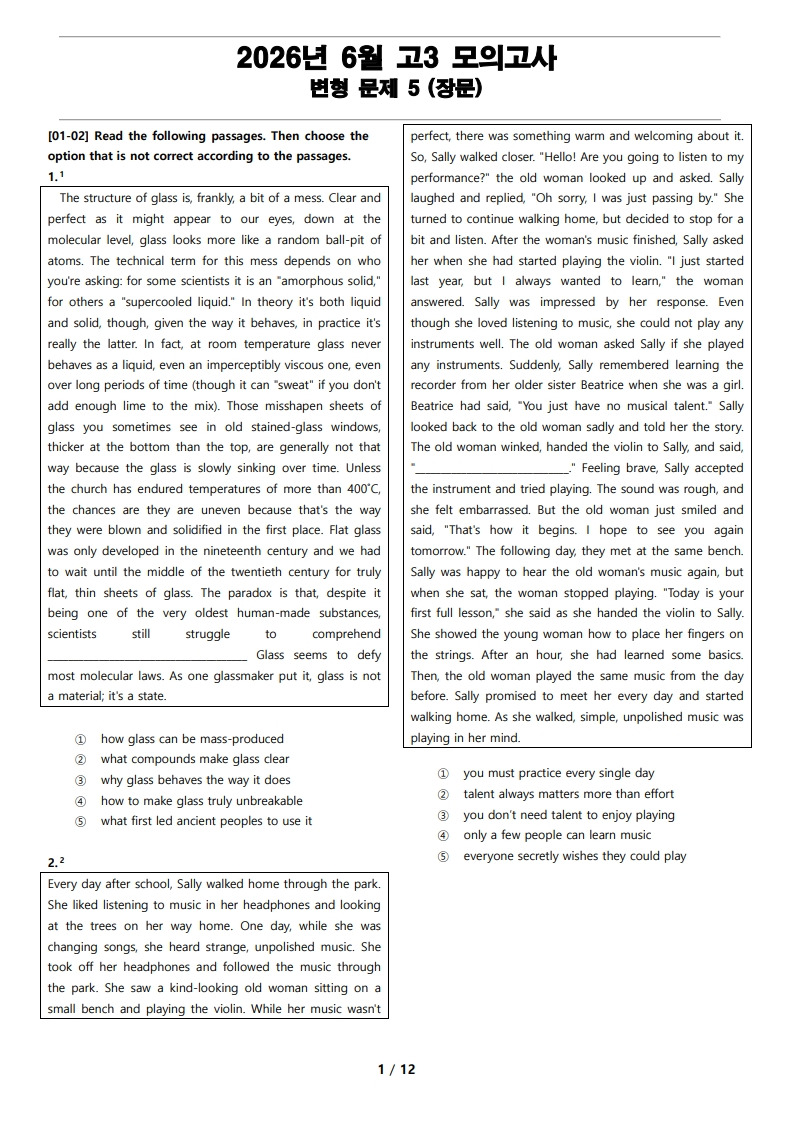
The structure of glass is, frankly, a bit of a mess. Clear and perfect as it might appear to our eyes, down at the molecular level, glass looks more like a random ball-pit of atoms. The technical term for this mess depends on who you're asking: for some scientists it is an "amorphous solid," for others a "supercooled liquid." In theory it's both liquid and solid, though, given the way it behaves, in practice it's really the latter. In fact, at room temperature glass never behaves as a liquid, even an imperceptibly viscous one, even over long periods of time (though it can "sweat" if you don't add enough lime to the mix). Those misshapen sheets of glass you sometimes see in old stained-glass windows, thicker at the bottom than the top, are generally not that way because the glass is slowly sinking over time. Unless the church has endured temperatures of more than 400˚C, the chances are they are uneven because that's the way they were blown and solidified in the first place. Flat glass was only developed in the nineteenth century and we had to wait until the middle of the twentieth century for truly flat, thin sheets of glass. The paradox is that, despite it being one of the very oldest human-made substances, scientists still struggle to comprehend why glass behaves the way it does. Glass seems to defy most molecular laws. As one glassmaker put it, glass is not a material; it's a state.
① At the molecular level, the structure of glass resembles a random arrangement of atoms.
② Glass is classified by scientists as either an amorphous solid or a supercooled liquid.
③ Flat glass was not developed until the nineteenth century.
④ At room temperature, glass sometimes behaves like a very slow-moving liquid over long periods.
⑤ Despite being one of the oldest human-made substances, glass still puzzles scientists.
내용 정리
이 글은 유리(glass)의 정체에 관한 흥미로운 과학 미스터리를 다루고 있어요.
우리 눈에는 유리가 맑고 완벽해 보이지만, 분자 단위로 들어가면 마치 원자들이 무작위로 뒤섞인 "공 풀장(ball-pit)"처럼 보인다고 합니다. 그래서 과학자들 사이에서도 유리를 부르는 명칭이 갈려요 — 어떤 이는 "비정질 고체(amorphous solid)", 어떤 이는 "과냉각 액체(supercooled liquid)"라고 부르죠. 이론상으로는 액체이자 고체이지만, 실제 거동 방식을 보면 사실상 고체에 가깝다는 게 글의 입장이에요.
여기서 글이 분명히 못 박는 부분이 있습니다: 상온(room temperature)에서 유리는 절대 액체처럼 행동하지 않는다는 거예요. 아무리 긴 시간이 지나도, 아무리 미세하게 점성이 있는 액체처럼이라도 말이죠 (다만 라임 성분이 부족하면 "땀을 흘리는" 현상은 있을 수 있다고 합니다). 그래서 옛날 스테인드글라스 창문이 아래쪽이 더 두꺼운 것도, 사실 유리가 시간이 지나면서 서서히 흘러내려서가 아니라 애초에 그렇게 불어서 만들어졌기 때문이라고 설명합니다.
평면 유리(flat glass)는 19세기에 와서야 개발되었고, 진짜 얇고 평평한 유리는 20세기 중반에야 가능해졌어요. 글은 마지막에 역설을 짚으며 마무리됩니다 — 유리는 인류가 만든 가장 오래된 물질 중 하나임에도 불구하고, 과학자들은 여전히 왜 유리가 그렇게 행동하는지 완전히 이해하지 못하고 있다고요.
선택지 O/X 분석
|
번호
|
선택지 요약
|
원문 대조
|
판정
|
|
①
|
분자 단위에서 유리의 구조는 원자들이 무작위로 배열된 것처럼 보임
|
"down at the molecular level, glass looks more like a random ball-pit of atoms"
|
⭕ 일치
|
|
②
|
과학자들은 유리를 비정질 고체 또는 과냉각 액체로 분류함
|
"for some scientists it is an 'amorphous solid,' for others a 'supercooled liquid'"
|
⭕ 일치
|
|
③
|
평면 유리는 19세기가 되어서야 개발됨
|
"Flat glass was only developed in the nineteenth century"
|
⭕ 일치
|
|
④
|
상온에서 유리는 때때로 오랜 시간에 걸쳐 매우 느리게 움직이는 액체처럼 행동함
|
"at room temperature glass never behaves as a liquid... even over long periods of time"
|
❌ 불일치
|
|
⑤
|
가장 오래된 인공 물질 중 하나임에도 여전히 과학자들을 곤혹스럽게 함
|
"despite it being one of the very oldest human-made substances, scientists still struggle to comprehend why glass behaves the way it does"
|
⭕ 일치
|
정답은 ④ — 함정 패턴: 부정의 긍정화(negation reversal)
이 문제의 함정은 "절대 아니다"를 "가끔은 그렇다"로 슬쩍 바꿔치기하는 패턴이에요.
원문은 아주 단호하게 말합니다:
"In fact, at room temperature glass never behaves as a liquid, even an imperceptibly viscous one, even over long periods of time."
번역하면 "사실 상온에서 유리는 절대 액체처럼 행동하지 않는다. 아무리 미세하게 점성 있는 액체로라도, 아무리 오랜 시간이 지나도"라는 뜻이에요. "never"라는 강한 부정어로 가능성 자체를 완전히 차단하고 있죠.
그런데 ④번은 이걸 이렇게 바꿔놓았어요:
"At room temperature, glass sometimes behaves like a very slow-moving liquid over long periods." (상온에서 유리는 때때로 오랜 시간에 걸쳐 매우 느리게 움직이는 액체처럼 행동한다)
"never behaves as a liquid... even over long periods of time" → "sometimes behaves like a... liquid over long periods"
원문의 "never(절대 ~않다)"가 선택지에서는 "sometimes(때때로 ~한다)"로 완전히 뒤집혔습니다. 이건 흔히 사람들이 믿는 "유리는 사실 아주 천천히 흐르는 액체다"라는 **속설(myth)**을 정답처럼 보이게 만드는 함정이에요. 실제로 글 전체가 바로 이 속설을 반박하기 위해 쓰인 글이라는 점에서, 이 함정은 글의 핵심 주제와 정반대 방향을 찌르고 있는 셈입니다.
함정 유형 정리: 부정어 무력화(never → sometimes) 지문에 never, not, no, none 같은 강한 부정어가 등장하면, 선택지에서 이게 sometimes, occasionally, can, may 같은 약화된 긍정 표현으로 바뀌어 있지 않은지 반드시 확인하세요. 특히 이 지문처럼 "사람들이 흔히 오해하는 통념을 반박"하는 구조의 글에서는, 그 통념 자체가 매력적인 오답으로 둔갑하는 경우가 많습니다.
핵심 어휘 정리
- amorphous solid — 비정질 고체
- supercooled liquid — 과냉각 액체
- viscous — 점성이 있는
- imperceptibly — 감지할 수 없을 정도로
- stained-glass window — 스테인드글라스 창문
- solidify — 응고하다, 굳다
- defy — (법칙 등을) 거스르다, 따르지 않다
- paradox — 역설
풀이 전략 팁
이 유형은 "통념을 반박하는 글"일 때 특히 조심해야 합니다.
이런 글은 보통 "사람들은 보통 ~라고 생각하지만, 사실은 그렇지 않다(In fact, never, actually)"는 구조를 취하는데, 출제자는 종종 그 반박당한 통념을 다시 정답처럼 꾸며서 오답 선택지에 집어넣습니다. 그러니:
- 지문에서 never, in fact, actually 뒤에 나오는 문장은 그 글의 핵심 주장일 가능성이 높으니 정확히 읽고
- 선택지가 그 부정어를 슬쩍 빼거나 약화시켰는지(never → sometimes, not → rarely 등) 끝까지 비교하세요.
이번 지문에서도 "유리는 천천히 흐르는 액체"라는 흔한 속설이 바로 그 함정이었죠.
The Makings의 2026년 고3 6월 전국 연합 모의고사 변형 문제는
총 11개의 유형으로 구성되어 있습니다.
1. 빈칸 채우기(객관식)
2. 글의 내용 일치/불일치(객관식/한글 선택지)
3. 글의 내용 일치/불일치(객관식/영어 선택지)
4. 글 끼어 넣기(객관식)
5. 어법(서술형)
6. 어휘(서술형)
7. 주제문(객관식/영어 선택지)
8. 어휘 빈칸 채우기(서술형)
9. 영작(서술형)
10. 요약문 완성하기(서술형)
11. 문단 재배열 하기(객관식)
더메이킹스(The Makings)가 제작한
2026년 고3 6월 전국 연합 모의고사 변형 문제 Part 5의 지문입니다.
1번 지문(문항 번호 41-42번)
The structure of glass is, frankly, a bit of a mess. Clear and perfect as it might appear to our eyes, down at the molecular level, glass looks more like a random ball-pit of atoms. The technical term for this mess depends on who you're asking: for some scientists it is an "amorphous solid," for others a "supercooled liquid." In theory it's both liquid and solid, though, given the way it behaves, in practice it's really the latter. In fact, at room temperature glass never behaves as a liquid, even an imperceptibly viscous one, even over long periods of time (though it can "sweat" if you don't add enough lime to the mix). Those misshapen sheets of glass you sometimes see in old stained-glass windows, thicker at the bottom than the top, are generally not that way because the glass is slowly sinking over time. Unless the church has endured temperatures of more than 400˚C, the chances are they are uneven because that's the way they were blown and solidified in the first place. Flat glass was only developed in the nineteenth century and we had to wait until the middle of the twentieth century for truly flat, thin sheets of glass. The paradox is that, despite it being one of the very oldest human-made substances, scientists still struggle to comprehend why glass behaves the way it does. Glass seems to defy most molecular laws. As one glassmaker put it, glass is not a material; it's a state.
2번 지문(문항 번호 43-45번)
Every day after school, Sally walked home through the park. She liked listening to music in her headphones and looking at the trees on her way home. One day, while she was changing songs, she heard strange, unpolished music. She took off her headphones and followed the music through the park. She saw a kind-looking old woman sitting on a small bench and playing the violin. While her music wasn't perfect, there was something warm and welcoming about it. So, Sally walked closer. "Hello! Are you going to listen to my performance?" the old woman looked up and asked. Sally laughed and replied, "Oh sorry, I was just passing by." She turned to continue walking home, but decided to stop for a bit and listen. After the woman's music finished, Sally asked her when she had started playing the violin. "I just started last year, but I always wanted to learn," the woman answered. Sally was impressed by her response. Even though she loved listening to music, she could not play any instruments well. The old woman asked Sally if she played any instruments. Suddenly, Sally remembered learning the recorder from her older sister Beatrice when she was a girl. Beatrice had said, "You just have no musical talent." Sally looked back to the old woman sadly and told her the story. The old woman winked, handed the violin to Sally, and said, "You don't need talent to enjoy playing." Feeling brave, Sally accepted the instrument and tried playing. The sound was rough, and she felt embarrassed. But the old woman just smiled and said, "That's how it begins. I hope to see you again tomorrow." The following day, they met at the same bench. Sally was happy to hear the old woman's music again, but when she sat, the woman stopped playing. "Today is your first full lesson," she said as she handed the violin to Sally. She showed the young woman how to place her fingers on the strings. After an hour, she had learned some basics. Then, the old woman played the same music from the day before. Sally promised to meet her every day and started walking home. As she walked, simple, unpolished music was playing in her mind.
'전국 연합 모의고사 변형 문제 > 고3 모의고사 변형 문제' 카테고리의 다른 글
| 2025년 7월 고3 영어 모의고사 [22,23,24,26] 지문 변형문제 (0) | 2026.06.29 |
|---|---|
| 2025년 7월 고3 모의고사 [18,19,20,21] 지문 변형문제 (0) | 2026.06.24 |
| 2026년 고3 6월 영어 모의고사 [35,36,37,38,39,40] 지문 변형문제 (0) | 2026.06.19 |
| 2026년 6월 고3 영어 모의고사 [29,30,31,32,33,34] 지문 변형문제 (0) | 2026.06.16 |
| 2026년 고3 6월 고3 영어 모의고사 변형문제 Part 2 (1) | 2026.06.13 |