
수능실감 영어 독해 5문항 모의고사 300제 Day 30 변형문제

전문항 확인 하러가기!
https://themakings.co.kr/421/?idx=1681
수능실감 영어 독해 5문항 모의고사 300제 DAY 30 변형문제(PDF)
수능실감 영어 독해 5문항 모의고사 300제 DAY 30 변형문제(PDF)은 원어민 선생님과 현직 강사가 제작한 수능 영어 변형문제. 실전 감각을 높이는 고퀄리티 문제로 내신·수능 완벽 대비.
themakings.co.kr
다음 지문을 읽고 글의 내용과 다른 문장을 고르세요.
There is nothing inherently irrational about preferring pleasure now to pleasure later. All things being equal, it pays to enjoy things now. That is why, when we lend out money, we insist on interest. A dollar tomorrow really is worth less than a dollar today (even if we assume there is no inflation), and interest is the price we put on the difference. Interest is charged at a fixed rate per unit of time, which means that it compounds, or increases exponentially. That compensates you exactly for the decreasing value of the money coming back to you as time elapses, because the decrease in value also rapidly changes. Why is it rapidly changing? With every passing day, there is a fixed chance that you will die, or that the borrower will abscond or go bankrupt and you'll never see the money again. Going back to pleasure, a rational agent, when deciding between indulging today and indulging tomorrow, would opt for tomorrow only if the pleasure would be exceptionally great.
① It is irrational by nature to prefer immediate pleasure over future pleasure when making decisions.
② Interest serves as the price assigned to the gap between the value of money today and in the future.
③ Because interest compounds at a fixed rate per unit of time, it grows exponentially over the lending period.
④ Each day that passes carries a constant probability that the lender may die or the borrower may disappear.
⑤ A rational person would choose to postpone enjoyment only when the anticipated future pleasure were remarkably large.
지문 해석
나중의 쾌락보다 지금의 쾌락을 선호하는 것에는 본질적으로 비합리적인 것이 아무것도 없다. 다른 조건이 같다면, 지금 즐기는 것이 이득이다. 그래서 돈을 빌려줄 때 이자를 요구하는 것이다. 내일의 1달러는 오늘의 1달러보다 정말로 가치가 낮으며(인플레이션이 없다고 가정하더라도), 이자는 그 차이에 매기는 가격이다. 이자는 시간 단위당 고정된 비율로 부과되는데, 이는 이자가 복리로, 즉 기하급수적으로 증가한다는 것을 의미한다. 이것은 시간이 지남에 따라 돌아오는 돈의 가치 감소를 정확히 보상해주는데, 가치 감소 또한 빠르게 변하기 때문이다. 왜 빠르게 변하는가? 매일 지나갈 때마다 당신이 죽거나, 차용인이 도주하거나 파산하여 그 돈을 다시는 보지 못할 고정된 확률이 있기 때문이다. 쾌락으로 돌아가서, 합리적 행위자는 오늘 즐기는 것과 내일 즐기는 것 사이에서 결정할 때, 쾌락이 예외적으로 클 때만 내일을 선택할 것이다.
풀이 흐름
이 지문의 핵심 전제는 ”즉각적 쾌락을 선호하는 것은 합리적이다"라는 것이다. 지문의 첫 문장이 이 전제를 명확히 선언하며, 이후의 이자 논의와 합리적 행위자 논의가 모두 이 전제 위에 구축된다.
지문은 ”There is nothing inherently irrational about preferring pleasure now to pleasure later”라고 명시한다. “nothing inherently irrational”은 "본질적으로 비합리적인 것이 아무것도 없다" — 즉, 즉각적 쾌락 선호는 합리적이라는 의미이다.
따라서 즉각적 쾌락을 선호하는 것이 ”본질적으로 비합리적이다(irrational by nature)”고 서술하는 선지가 있다면, 이는 지문과 정면으로 모순된다.
전체 선지 분석
|
선지
|
판정
|
근거
|
|
① It is irrational by nature to prefer immediate pleasure over future pleasure when making decisions.
|
❌ 불일치
|
지문은 ”There is nothing inherently irrational about preferring pleasure now to pleasure later”라고 명시. irrational by nature ↔ nothing inherently irrational로 정반대. 즉각적 쾌락 선호는 비합리적인 것이 아니라 합리적이다.
|
|
② Interest serves as the price assigned to the gap between the value of money today and in the future.
|
✅ 일치
|
지문의 “interest is the price we put on the difference”와 직접 대응. gap = difference.
|
|
③ Because interest compounds at a fixed rate per unit of time, it grows exponentially over the lending period.
|
✅ 일치
|
지문의 “Interest is charged at a fixed rate per unit of time, which means that it compounds, or increases exponentially”와 정확히 대응.
|
|
④ Each day that passes carries a constant probability that the lender may die or the borrower may disappear.
|
✅ 일치
|
지문의 “With every passing day, there is a fixed chance that you will die, or that the borrower will abscond or go bankrupt”와 직접 대응. constant = fixed, disappear = abscond.
|
|
⑤ A rational person would choose to postpone enjoyment only when the anticipated future pleasure were remarkably large.
|
✅ 일치
|
지문의 “a rational agent... would opt for tomorrow only if the pleasure would be exceptionally great”와 정확히 대응. remarkably large = exceptionally great.
|
핵심 문장 정리
“There is nothing inherently irrational about preferring pleasure now to pleasure later.”
이 문장이 ①번 선지의 오류를 판별하는 결정적 근거다. 지문은 즉각적 쾌락을 선호하는 것에 ”본질적으로 비합리적인 것이 아무것도 없다(nothing inherently irrational)”고 서술하는 반면, ①번은 ”본질적으로 비합리적이다(irrational by nature)”고 정반대로 서술했다.
한 줄 정리
즉각적 쾌락을 선호하는 것은 "본질적으로 비합리적인" 것이 아니라 오히려 "본질적으로 비합리적인 것이 아무것도 없는" 합리적 선택이다.
The Makings의 DAY 30 변형문제는 총 11개의 유형으로 구성되어 있습니다.
1. 빈칸 채우기(객관식)
2. 글의 내용 일치/불일치(객관식/한글 선택지)
3. 글의 내용 일치/불일치(객관식/영어 선택지)
4. 글 끼어 넣기(객관식)
5. 어법(서술형)
6. 어휘(서술형)
7. 주제문(객관식/영어 선택지)
8. 어휘 빈칸 채우기(서술형)
9. 영작(서술형)
10. 요약문 완성하기(서술형)
11. 문단 재배열 하기(객관식)
더메이킹스(The Makings)가 제작한 수능실감 영어 독해 5문항 모의고사 300제
DAY 30(44문항) 변형문제의 지문입니다.
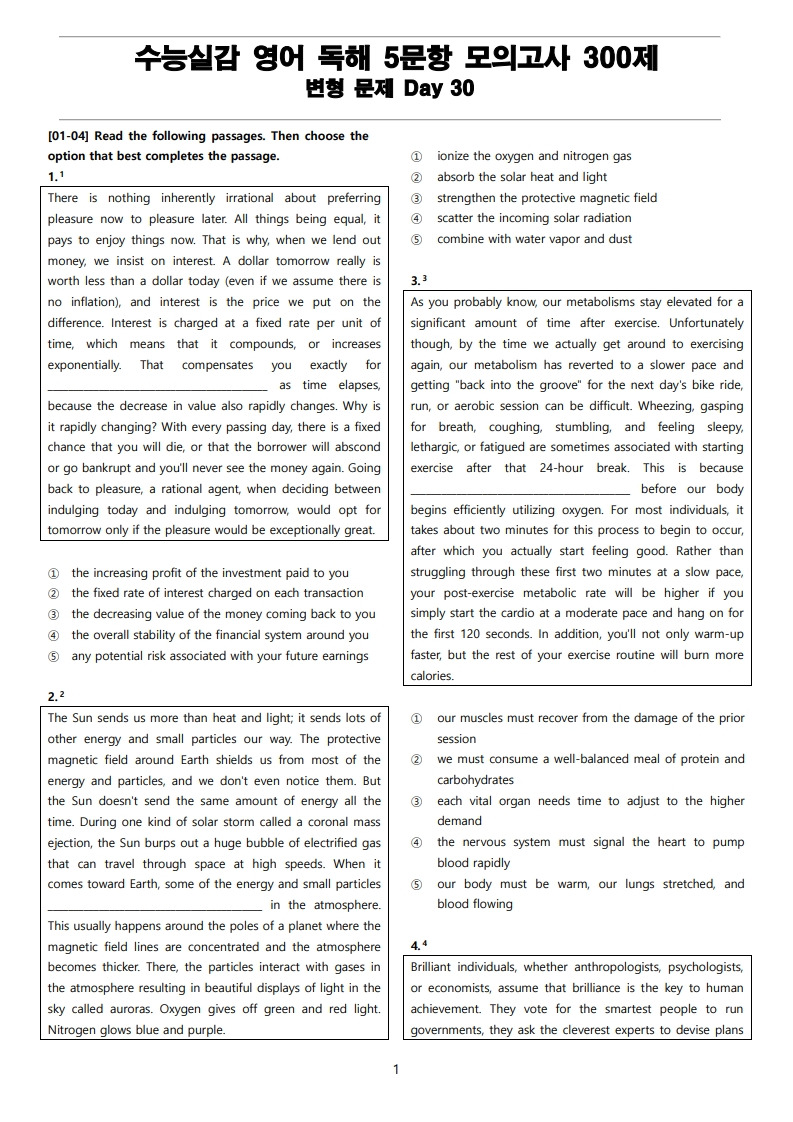
1번 지문
There is nothing inherently irrational about preferring pleasure now to pleasure later. All things being equal, it pays to enjoy things now. That is why, when we lend out money, we insist on interest. A dollar tomorrow really is worth less than a dollar today (even if we assume there is no inflation), and interest is the price we put on the difference. Interest is charged at a fixed rate per unit of time, which means that it compounds, or increases exponentially. That compensates you exactly for the decreasing value of the money coming back to you as time elapses, because the decrease in value also rapidly changes. Why is it rapidly changing? With every passing day, there is a fixed chance that you will die, or that the borrower will abscond or go bankrupt and you'll never see the money again. Going back to pleasure, a rational agent, when deciding between indulging today and indulging tomorrow, would opt for tomorrow only if the pleasure would be exceptionally great.
2번 지문
The Sun sends us more than heat and light; it sends lots of other energy and small particles our way. The protective magnetic field around Earth shields us from most of the energy and particles, and we don't even notice them. But the Sun doesn't send the same amount of energy all the time. During one kind of solar storm called a coronal mass ejection, the Sun burps out a huge bubble of electrified gas that can travel through space at high speeds. When it comes toward Earth, some of the energy and small particles ionize the oxygen and nitrogen gas in the atmosphere. This usually happens around the poles of a planet where the magnetic field lines are concentrated and the atmosphere becomes thicker. There, the particles interact with gases in the atmosphere resulting in beautiful displays of light in the sky called auroras. Oxygen gives off green and red light. Nitrogen glows blue and purple.
3번 지문
As you probably know, our metabolisms stay elevated for a significant amount of time after exercise. Unfortunately though, by the time we actually get around to exercising again, our metabolism has reverted to a slower pace and getting "back into the groove" for the next day's bike ride, run, or aerobic session can be difficult. Wheezing, gasping for breath, coughing, stumbling, and feeling sleepy, lethargic, or fatigued are sometimes associated with starting exercise after that 24-hour break. This is because our body must be warm, our lungs must be stretched, and our blood must be actively flowing before our body begins efficiently utilizing oxygen. For most individuals, it takes about two minutes for this process to begin to occur, after which you actually start feeling good. Rather than struggling through these first two minutes at a slow pace, your post-exercise metabolic rate will be higher if you simply start the cardio at a moderate pace and hang on for the first 120 seconds. In addition, you'll not only warm-up faster, but the rest of your exercise routine will burn more calories.
4번 지문
Brilliant individuals, whether anthropologists, psychologists, or economists, assume that brilliance is the key to human achievement. They vote for the smartest people to run governments, they ask the cleverest experts to devise plans for the economy, and they credit the sharpest scientists with discoveries. They are all barking up the wrong tree. The key to human achievement is not individual intelligence at all. Human achievement is entirely a networking phenomenon. It is by combining brainpower through the division of labor that human society happened upon a way to raise the living standards, technological virtuosity, and knowledge base of the species. We can see this in all sorts of phenomena: the collapse of technology in people who became isolated, like native Tasmanians; the prosperity of trading city states in Greece, Italy, Holland, and Southeast Asia; the creative consequences of trade. Human achievement is rooted in collective intelligence ─ the nodes in the human neural network are people themselves. By each doing one thing and mastering it, then combining the results through exchange, people become capable of doing things they do not even understand. As the economist Leonard Read pointed out in his essay "I, Pencil," no single person knows how to make even a pencil ─ the knowledge is distributed in society among many thousands of graphite miners, lumberjacks, designers and factory workers.
'문제집 변형문제 > 수능 실감 영어 독해 5문항 300제' 카테고리의 다른 글
| 수능실감 영어 독해 5문항 모의고사 300제 Day 29 변형문제 (0) | 2026.10.09 |
|---|---|
| 수능실감 영어 독해 5문항 모의고사 300제 Day 28 변형문제 (0) | 2026.10.08 |
| 수능실감 영어 독해 5문항 모의고사 300제 Day 27 변형문제 (0) | 2026.10.08 |
| 수능실감 영어 독해 5문항 모의고사 300제 Day 24 변형문제 (0) | 2026.10.06 |
| 수능실감 영어 독해 5문항 모의고사 300제 Day 23 변형문제 (0) | 2026.10.06 |