
수능실감 영어 독해 5문항 모의고사 300제 Day 23 변형문제
전문항 확인 하러가기!
https://themakings.co.kr/421/?idx=1601
수능실감 영어 독해 5문항 모의고사 300제 DAY 23 변형문제(PDF)
수능실감 영어 독해 5문항 모의고사 300제 DAY 23 변형문제(PDF)은 원어민 선생님과 현직 강사가 제작한 수능 영어 변형문제. 실전 감각을 높이는 고퀄리티 문제로 내신·수능 완벽 대비.
themakings.co.kr
다음 지문을 읽고 글의 내용과 다른 문장을 고르세요.
Even though science believes it is predicated on physical laws that describe objective processes, the historian of science Thomas Kuhn pointed out that scientific facts are instead embedded in cultural practices or paradigms. Science operates within the context of the culture it exists in; it does not exist in a vacuum where pure absolute objectivity prevails. In biomedicine, for example, physicians always base their diagnosis on assumptions within the context of their culture. In the United States, a reasonably healthy person with an enlarged spleen would be suspected of mononucleosis. In South America, this same person would be suspected of having Chagas' disease; in Ethiopia, Ewing's tumor. All these diagnoses would be correct. If an American physician were put in sub-Sahara Africa, or a Saudi physician in Nebraska, each would have trouble making proper diagnoses of their patients. Because biomedicine operates within the context of the culture of which it is part, these physicians would be like fish out of water and not fully cognizant of the cultural mores of their host land.
① Thomas Kuhn argued that scientific facts are embedded in cultural paradigms rather than reflecting pure objectivity.
② Physicians in biomedicine make diagnoses based on assumptions shaped by the cultural context they work in.
③ An enlarged spleen in a healthy person would lead to different diagnoses depending on the country where the physician practices.
④ The diverse diagnoses given for the same symptom across different regions are all considered incorrect.
⑤ Physicians placed in unfamiliar cultural settings would struggle to make proper diagnoses of their patients.
지문 해석
과학이 객관적 과정을 기술하는 물리 법칙에 기반한다고 믿지만, 과학사학자 Thomas Kuhn은 과학적 사실이 대신 문화적 관행이나 패러다임에 배태되어 있다고 지적했다. 과학은 그것이 존재하는 문화의 맥락 안에서 작동하며, 순수한 절대적 객관성이 지배하는 진공 속에 존재하지 않는다. 예를 들어 생의학에서 의사들은 항상 자신의 문화적 맥락 안의 가정에 기반하여 진단을 내린다. 미국에서 비교적 건강한 사람의 비장이 비대해지면 단핵구증(mononucleosis)을 의심할 것이다. 남미에서 같은 사람은 샤가스병(Chagas' disease)을 의심받을 것이고, 에티오피아에서는 유잉 종양(Ewing's tumor)을 의심받을 것이다. 이 모든 진단은 정확할 것이다(All these diagnoses would be correct). 미국 의사가 사하라 이남 아프리카에 가거나, 사우디 의사가 네브래스카에 가면, 각각은 환자에 대한 적절한 진단을 내리는 데 어려움을 겪을 것이다. 생의학이 자신이 속한 문화의 맥락 안에서 작동하기 때문에, 이 의사들은 물 밖에 나온 물고기처럼 이질적인 땅의 문화적 관습을 완전히 인식하지 못할 것이다.
풀이 흐름
이 지문의 핵심 논지는 "과학적 진단도 문화적 맥락에 따라 달라지며, 각 맥락 안에서의 진단은 모두 유효하다"는 것이다. 특히 서로 다른 지역에서 같은 증상에 대해 내려진 다양한 진단의 정확성 여부를 파악하는 것이 핵심이다.
지문은 미국, 남미, 에티오피아에서 각각 다른 진단이 내려지는 사례를 제시한 뒤 "All these diagnoses would be correct"라고 명시한다. 즉, 서로 다른 진단 모두가 "정확하다(correct)"는 것이다.
따라서 이 다양한 진단이 모두 "부정확한 것으로 간주된다(are all considered incorrect)"고 서술하는 선지가 있다면, 이는 지문과 정면으로 모순된다.
전체 선지 분석
|
선지
|
판정
|
근거
|
|
① Thomas Kuhn argued that scientific facts are embedded in cultural paradigms rather than reflecting pure objectivity.
|
✅ 일치
|
지문의 "Thomas Kuhn pointed out that scientific facts are instead embedded in cultural practices or paradigms"와 직접 대응.
|
|
② Physicians in biomedicine make diagnoses based on assumptions shaped by the cultural context they work in.
|
✅ 일치
|
지문의 "physicians always base their diagnosis on assumptions within the context of their culture"와 정확히 대응.
|
|
③ An enlarged spleen in a healthy person would lead to different diagnoses depending on the country where the physician practices.
|
✅ 일치
|
지문의 미국(단핵구증), 남미(샤가스병), 에티오피아(유잉 종양) 사례와 직접 대응. different diagnoses depending on the country = 각 지역별 다른 진단.
|
|
④ The diverse diagnoses given for the same symptom across different regions are all considered incorrect.
|
❌ 불일치
|
지문은 "All these diagnoses would be correct"라고 명시. all considered incorrect ↔ all would be correct로 정반대. 다양한 진단 모두 부정확한 것이 아니라 모두 정확하다.
|
|
⑤ Physicians placed in unfamiliar cultural settings would struggle to make proper diagnoses of their patients.
|
✅ 일치
|
지문의 "each would have trouble making proper diagnoses of their patients"와 직접 대응. struggle = have trouble.
|
핵심 문장 정리
"All these diagnoses would be correct."
이 문장이 ④번 선지의 오류를 판별하는 결정적 근거다. 지문은 서로 다른 지역에서 같은 증상에 대해 내려진 다양한 진단이 "모두 정확하다(all correct)"고 서술하는 반면, ④번은 "모두 부정확한 것으로 간주된다(all considered incorrect)"고 정반대로 서술했다.
한 줄 정리
서로 다른 지역에서 같은 증상에 대해 내려진 다양한 진단은 "모두 부정확한" 것이 아니라, 각 문화적 맥락 안에서 "모두 정확하다."
The Makings의 DAY 23 변형문제는
총 11개의 유형으로 구성되어 있습니다.
1. 빈칸 채우기(객관식)
2. 글의 내용 일치/불일치(객관식/한글 선택지)
3. 글의 내용 일치/불일치(객관식/영어 선택지)
4. 글 끼어 넣기(객관식)
5. 어법(서술형)
6. 어휘(서술형)
7. 주제문(객관식/영어 선택지)
8. 어휘 빈칸 채우기(서술형)
9. 영작(서술형)
10. 요약문 완성하기(서술형)
11. 문단 재배열 하기(객관식)
더메이킹스(The Makings)가 제작한 수능실감 영어 독해 5문항 모의고사 300제
DAY 23(55문항) 변형문제의 지문입니다.
1번 지문
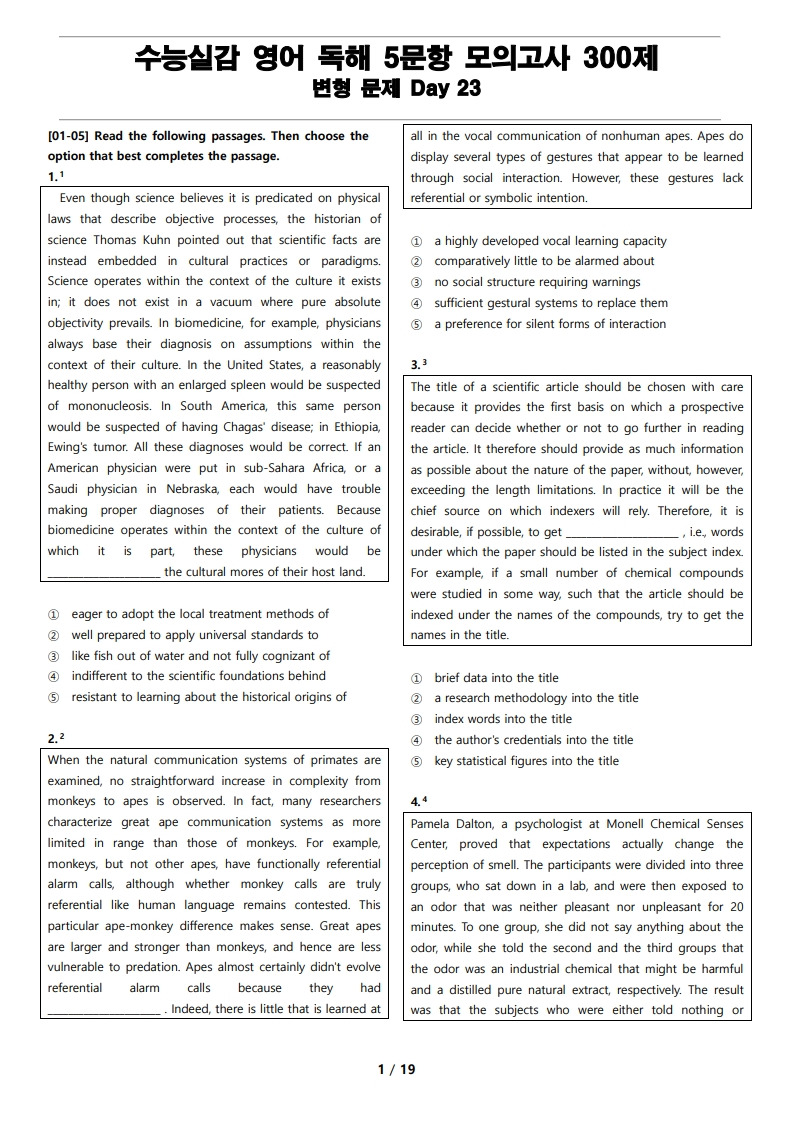
Even though science believes it is predicated on physical laws that describe objective processes, the historian of science Thomas Kuhn pointed out that scientific facts are instead embedded in cultural practices or paradigms. Science operates within the context of the culture it exists in; it does not exist in a vacuum where pure absolute objectivity prevails. In biomedicine, for example, physicians always base their diagnosis on assumptions within the context of their culture. In the United States, a reasonably healthy person with an enlarged spleen would be suspected of mononucleosis. In South America, this same person would be suspected of having Chagas' disease; in Ethiopia, Ewing's tumor. All these diagnoses would be correct. If an American physician were put in sub-Sahara Africa, or a Saudi physician in Nebraska, each would have trouble making proper diagnoses of their patients. Because biomedicine operates within the context of the culture of which it is part, these physicians would be like fish out of water and not fully cognizant of the cultural mores of their host land.
2번 지문
When the natural communication systems of primates are examined, no straightforward increase in complexity from monkeys to apes is observed. In fact, many researchers characterize great ape communication systems as more limited in range than those of monkeys. For example, monkeys, but not other apes, have functionally referential alarm calls, although whether monkey calls are truly referential like human language remains contested. This particular ape-monkey difference makes sense. Great apes are larger and stronger than monkeys, and hence are less vulnerable to predation. Apes almost certainly didn't evolve referential alarm calls because they had comparatively little to be alarmed about. Indeed, there is little that is learned at all in the vocal communication of nonhuman apes. Apes do display several types of gestures that appear to be learned through social interaction. However, these gestures lack referential or symbolic intention.
3번 지문
The title of a scientific article should be chosen with care because it provides the first basis on which a prospective reader can decide whether or not to go further in reading the article. It therefore should provide as much information as possible about the nature of the paper, without, however, exceeding the length limitations. In practice it will be the chief source on which indexers will rely. Therefore, it is desirable, if possible, to get index words into the title, i.e., words under which the paper should be listed in the subject index. For example, if a small number of chemical compounds were studied in some way, such that the article should be indexed under the names of the compounds, try to get the names in the title.
4번 지문
Pamela Dalton, a psychologist at Monell Chemical Senses Center, proved that expectations actually change the perception of smell. The participants were divided into three groups, who sat down in a lab, and were then exposed to an odor that was neither pleasant nor unpleasant for 20 minutes. To one group, she did not say anything about the odor, while she told the second and the third groups that the odor was an industrial chemical that might be harmful and a distilled pure natural extract, respectively. The result was that the subjects who were either told nothing or positive information felt the odor became weaker as time passed. In contrast, the subjects who were told negative information felt the odor became stronger as time passed. In other words, an odor that is thought to be good disappears from consciousness fast, while an odor thought to be harmful keeps our attention and remains strong. This experiment shows that prejudices are very effective at distorting the senses.
5번 지문
In a study conducted at the Old North Church, one of the most-visited historical landmarks in Boston, American tourists completed a travel checklist just before entering the church, marking off the other cities they had visited. Some tourists saw a checklist that included commonplace destinations, such as New York, Orlando, and Las Vegas, places many Americans have visited. Others saw a checklist that included more exotic international destinations, such as Tokyo, Paris, and Sydney. Tourists checked off a lot more places when they were presented with the list of U.S. destinations, leading them to feel more well-traveled than people presented with the broader list of international destinations. The tourists went on their way, heading inside to check out the church. But the checklist changed how they behaved when they got there. Those who saw the list of exotic international destinations entered the church feeling like they were not well-traveled and ended up savoring their visit more. They spent significantly more time enjoying the church compared to those who saw the domestic checklist.
'문제집 변형문제 > 수능 실감 영어 독해 5문항 300제' 카테고리의 다른 글
| 수능실감 영어 독해 5문항 모의고사 300제 Day 24 변형문제 (0) | 2026.10.06 |
|---|---|
| 수능실감 영어 독해 5문항 모의고사 300제 Day 22 변형문제 (0) | 2026.10.05 |
| 수능실감 영어 독해 5문항 모의고사 300제 Day 21 변형문제 (0) | 2026.10.05 |
| 수능실감 영어 독해 5문항 모의고사 300제 Day 20 변형문제 (0) | 2026.10.04 |
| 수능실감 영어 독해 5문항 모의고사 300제 Day 19 변형문제 (0) | 2026.10.04 |