
수능실감 영어 독해 5문항 모의고사 300제
Day 14 변형문제
전문항 확인 하러가기!
https://themakings.co.kr/421/?idx=1543
수능실감 영어 독해 5문항 모의고사 300제 DAY 14 변형문제(PDF)
수능실감 영어 독해 5문항 모의고사 300제 DAY 14 변형문제(PDF)은 원어민 선생님과 현직 강사가 제작한 수능 영어 변형문제. 실전 감각을 높이는 고퀄리티 문제로 내신·수능 완벽 대비.
themakings.co.kr
다음 지문을 읽고 글의 내용과 다른 문장을 고르세요.
Bruce Abernethy, working with a group from Brunel University London, used fMRI (functional magnetic resonance imaging) to examine the brains of elite badminton players as they exercised their skills of anticipation. They scanned players of various skill levels as they watched occluded clips of shots being played (the video clips would cut off just before contact was made with the shuttlecock) and tried to predict in which area of the court the shots would land. The expert players showed more brain activity in areas of the brain associated with observing and understanding other people’s actions. The more experience an athlete has, the better they are at doing this. A few years later, the same group at Brunel did a similar study with footballers, who watched occluded clips of an opponent running towards them with the ball. In some clips, the players would start a feint just before the video cut off, and the footballer in the scanner would have to predict whether they would go left or right. The earlier the clips were cut off, the bigger the difference in neural activity between semipro and novice footballers on fMRI scans.
① Bruce Abernethy’s team used fMRI to study the brains of elite badminton players as they demonstrated anticipation skills.
② Players of different skill levels watched video clips that were cut off just before the shuttlecock was hit.
③ Expert players showed increased brain activity in regions responsible for controlling their own motor responses.
④ In a follow-up study, footballers watched clips of an opponent approaching with the ball.
⑤ Some clips featured the beginning of a deceptive movement before they were cut off.
지문 해석
Bruce Abernethy는 브루넬 대학교 런던 그룹과 협력하여 엘리트 배드민턴 선수들이 예측 기술을 발휘하는 동안 그들의 뇌를 fMRI(기능적 자기공명영상)로 검사했다. 다양한 기술 수준의 선수들이 차단된(occluded) 영상 클립 — 셔틀콕에 접촉하기 직전에 잘리는 영상 — 을 보면서 코트의 어느 영역에 샷이 떨어질지 예측하는 동안 스캔했다. 전문가 선수들은 다른 사람의 행동을 관찰하고 이해하는 것과 관련된 뇌 영역에서 더 많은 뇌 활동을 보였다. 운동선수의 경험이 많을수록 이것을 더 잘한다. 몇 년 후, 브루넬의 같은 그룹이 축구 선수들을 대상으로 유사한 연구를 수행했는데, 축구 선수들은 상대방이 공을 가지고 달려오는 차단된 영상을 보았다. 일부 클립에서는 영상이 잘리기 직전에 선수가 페인트(feint)를 시작했고, 스캐너 안의 축구 선수는 그들이 왼쪽으로 갈지 오른쪽으로 갈지 예측해야 했다. 클립이 더 일찍 잘릴수록 fMRI 스캔에서 준프로와 초보 축구 선수 사이의 신경 활동 차이가 더 컸다.
풀이 흐름
이 지문은 엘리트 선수들의 뇌에서 어떤 영역이 활성화되는지를 핵심 발견으로 제시한다. 활성화된 뇌 영역의 기능을 정확히 파악하는 것이 핵심이다.
지문은 전문가 선수들의 뇌 활동에 대해 "more brain activity in areas of the brain associated with observing and understanding other people's actions"라고 명시한다. 즉, 활성화된 영역은 "다른 사람의 행동을 관찰하고 이해하는" 것과 관련된 영역이다.
따라서 전문가 선수들이 "자신의 운동 반응을 통제하는(controlling their own motor responses)" 영역에서 활동 증가를 보였다고 서술하는 선지가 있다면, 이는 활성화된 뇌 영역의 기능을 잘못 서술한 것이다.
전체 선지 분석
|
선지
|
판정
|
근거
|
|
① Bruce Abernethy's team used fMRI to study the brains of elite badminton players as they demonstrated anticipation skills.
|
✅ 일치
|
지문의 "used fMRI to examine the brains of elite badminton players as they exercised their skills of anticipation"과 직접 대응. demonstrated = exercised.
|
|
② Players of different skill levels watched video clips that were cut off just before the shuttlecock was hit.
|
✅ 일치
|
지문의 "scanned players of various skill levels as they watched occluded clips... the video clips would cut off just before contact was made with the shuttlecock"과 정확히 대응.
|
|
③ Expert players showed increased brain activity in regions responsible for controlling their own motor responses.
|
❌ 불일치
|
지문은 "more brain activity in areas of the brain associated with observing and understanding other people's actions"라고 명시. controlling their own motor responses ↔ observing and understanding other people's actions로 뇌 영역의 기능이 완전히 다르다. 자기 자신의 운동 반응 통제가 아니라 타인의 행동 관찰·이해이다.
|
|
④ In a follow-up study, footballers watched clips of an opponent approaching with the ball.
|
✅ 일치
|
지문의 "did a similar study with footballers, who watched occluded clips of an opponent running towards them with the ball"과 직접 대응. approaching = running towards.
|
|
⑤ Some clips featured the beginning of a deceptive movement before they were cut off.
|
✅ 일치
|
지문의 "the players would start a feint just before the video cut off"와 정확히 대응. deceptive movement = feint.
|
핵심 문장 정리
"The expert players showed more brain activity in areas of the brain associated with observing and understanding other people's actions."
이 문장이 ③번 선지의 오류를 판별하는 결정적 근거다. 지문은 전문가 선수들이 "다른 사람의 행동을 관찰하고 이해하는(observing and understanding other people's actions)" 영역에서 활동 증가를 보였다고 서술하는 반면, ③번은 "자신의 운동 반응을 통제하는(controlling their own motor responses)" 영역이라고 서술하여 뇌 활성화 영역의 기능을 완전히 다르게 왜곡했다.
한 줄 정리
전문가 선수들에게서 활성화된 뇌 영역은 "자신의 운동 반응을 통제하는" 영역이 아니라 "다른 사람의 행동을 관찰하고 이해하는" 영역이다.
The Makings의 DAY 14 변형문제는
총 11개의 유형으로 구성되어 있습니다.
1. 빈칸 채우기(객관식)
2. 글의 내용 일치/불일치(객관식/한글 선택지)
3. 글의 내용 일치/불일치(객관식/영어 선택지)
4. 글 끼어 넣기(객관식)
5. 어법(서술형)
6. 어휘(서술형)
7. 주제문(객관식/영어 선택지)
8. 어휘 빈칸 채우기(서술형)
9. 영작(서술형)
10. 요약문 완성하기(서술형)
11. 문단 재배열 하기(객관식)
더메이킹스(The Makings)가 제작한 수능실감 영어 독해 5문항 모의고사 300제
DAY 14(55문항) 변형문제의 지문입니다.
1번 지문
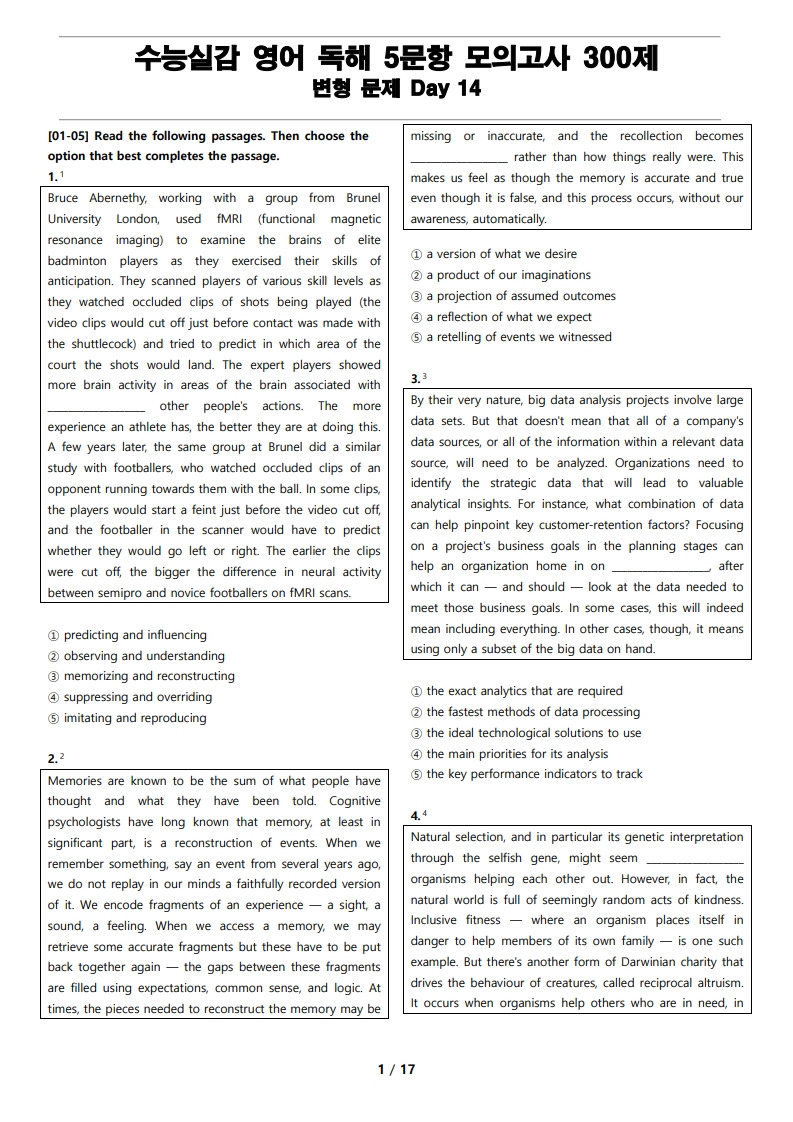
Bruce Abernethy, working with a group from Brunel University London, used fMRI (functional magnetic resonance imaging) to examine the brains of elite badminton players as they exercised their skills of anticipation. They scanned players of various skill levels as they watched occluded clips of shots being played (the video clips would cut off just before contact was made with the shuttlecock) and tried to predict in which area of the court the shots would land. The expert players showed more brain activity in areas of the brain associated with observing and understanding other people’s actions. The more experience an athlete has, the better they are at doing this. A few years later, the same group at Brunel did a similar study with footballers, who watched occluded clips of an opponent running towards them with the ball. In some clips, the players would start a feint just before the video cut off, and the footballer in the scanner would have to predict whether they would go left or right. The earlier the clips were cut off, the bigger the difference in neural activity between semipro and novice footballers on fMRI scans.
2번 지문
Memories are known to be the sum of what people have thought and what they have been told. Cognitive psychologists have long known that memory, at least in significant part, is a reconstruction of events. When we remember something, say an event from several years ago, we do not replay in our minds a faithfully recorded version of it. We encode fragments of an experience ─ a sight, a sound, a feeling. When we access a memory, we may retrieve some accurate fragments but these have to be put back together again ─ the gaps between these fragments are filled using expectations, common sense, and logic. At times, the pieces needed to reconstruct the memory may be missing or inaccurate, and the recollection becomes a reflection of what we expect rather than how things really were. This makes us feel as though the memory is accurate and true even though it is false, and this process occurs, without our awareness, automatically.
3번 지문
By their very nature, big data analysis projects involve large data sets. But that doesn’t mean that all of a company’s data sources, or all of the information within a relevant data source, will need to be analyzed. Organizations need to identify the strategic data that will lead to valuable analytical insights. For instance, what combination of data can help pinpoint key customer-retention factors? Or what data are required to uncover hidden patterns in stock market transactions? Focusing on a project’s business goals in the planning stages can help an organization home in on the exact analytics that are required, after which it can ─ and should ─ look at the data needed to meet those business goals. In some cases, this will indeed mean including everything. In other cases, though, it means using only a subset of the big data on hand.
4번 지문
Natural selection, and in particular its genetic interpretation through the selfish gene, might seem incompatible with the idea of organisms helping each other out. However, in fact, the natural world is full of seemingly random acts of kindness. Inclusive fitness ─ where an organism places itself in danger to help members of its own family ─ is one such example. But there’s another form of Darwinian charity that drives the behaviour of creatures, called reciprocal altruism. It occurs when organisms help others who are in need, in the hope that one day, when they themselves are in need, others will help them back. This behavior is easily observed in ants that have extra stomachs to store reserve food to feed other members of the colony who are hungry. Any ant who fails to help a comrade, however, is starved by other members of the colony when it needs food itself.
5번 지문
Quota sampling is a technique whereby the researcher chooses a sample that reflects the make-up, in numerical terms, of the wider population. So, for example, if a researcher wanted to study gender differences in first-year undergraduate psychology students, and the wider population comprised a 60/40 per cent split females/males, then the sample must be comprised of this same ratio of females to males. Thus, in a sample population of, say, 100 participants, the sample would contain 60 females and 40 males. This quota system can also be used for other factors, such as age, ethnic background, etc. Like all techniques, quota sampling does have its drawbacks. For example, it can be time-consuming and the researcher would still need to consider exactly how the subgroups that make up the sample are selected: e.g., what if those who are selected refuse to participate ─ how might this affect the sample?
'문제집 변형문제 > 수능 실감 영어 독해 5문항 300제' 카테고리의 다른 글
| 수능실감 영어 독해 5문항 모의고사 300제 Day 16 변형문제 (0) | 2026.09.24 |
|---|---|
| 수능실감 영어 독해 5문항 모의고사 300제 Day 15 변형문제 (0) | 2026.09.24 |
| 수능실감 영어 독해 5문항 모의고사 300제 Day 13 변형문제 (0) | 2026.09.23 |
| 수능실감 영어 독해 5문항 모의고사 300제 Day 12 변형문제 (0) | 2026.09.22 |
| 수능실감 영어 독해 5문항 모의고사 300제 Day 11 변형문제 (0) | 2026.09.22 |