
2026년 9월 고2 영어 모의고사
변형문제 Part 5
전문항 확인 하러가기!
https://themakings.co.kr/239/?idx=1655
2026년 고2 9월 전국 연합 모의고사 변형 문제 Part 5 (22문항) (PDF)
2026년 고2 9월 전국 연합 모의고사 변형 문제, 내신대비, 영어내신자료,고등영어자료, 모의고사 변형문제,전국 연합모의고사 변형자료, 모의고사 영어 서술형 대비, 대치동 고등 영어자료, 대치
themakings.co.kr
다음 지문을 읽고 글의 내용과 다른 문장을 고르세요.
The concept of "choice architecture," popularized in behavioral economics, highlights how the design of the environment in which choices are made can significantly influence the decisions people make. Algorithms are, in essence, sophisticated architects of our digital environments. By curating what we see, what we are recommended, and what options are presented to us, they subtly, and sometimes not so subtly, nudge us towards particular paths. While nudges can be used for beneficial purposes, such as encouraging healthier habits, they also carry the potential for manipulation, particularly when the underlying objectives of the architects are not aligned with the well-being or autonomy of the individual. The question then becomes: how can we cultivate and protect our human agency in an increasingly algorithmic world? It requires a conscious effort to maintain critical engagement with the technologies we use. It means actively seeking out diverse perspectives, challenging algorithmic recommendations, and making deliberate choices that go against the predicted grain. It involves cultivating a healthy skepticism towards the seemingly objective outputs of algorithms and remembering that these systems are designed by humans with specific goals, and that their data is a reflection of past realities, not necessarily a prescription for future flourishing.
① The concept of "choice architecture" shows how the design of environments can significantly influence people's decisions.
② Algorithms serve as sophisticated architects by curating what we see and what options are presented to us.
③ Protecting human agency involves making choices that follow the path predicted by algorithms.
④ The data used by algorithmic systems is described as a reflection of past realities rather than a guide for future flourishing.
⑤ Cultivating healthy skepticism toward algorithmic outputs is presented as part of maintaining human agency.
지문 해석
행동 경제학에서 대중화된 "선택 구조(choice architecture)" 개념은 선택이 이루어지는 환경의 설계가 사람들의 결정에 크게 영향을 미칠 수 있음을 강조한다. 알고리즘은 본질적으로 디지털 환경의 정교한 건축가이다. 우리가 무엇을 보는지, 무엇을 추천받는지, 어떤 선택지가 제시되는지를 선별함으로써, 알고리즘은 미묘하게, 때로는 그다지 미묘하지 않게 우리를 특정 경로로 유도한다. 넛지는 더 건강한 습관을 장려하는 것과 같은 유익한 목적으로 사용될 수 있지만, 특히 건축가의 근본적 목표가 개인의 안녕이나 자율성과 일치하지 않을 때 조작의 가능성도 지닌다. 그렇다면 질문은 이것이다: 점점 알고리즘화되는 세상에서 인간의 주체성을 어떻게 기르고 보호할 수 있는가? 이는 우리가 사용하는 기술에 대한 비판적 참여를 유지하기 위한 의식적 노력이 필요하다. 다양한 관점을 적극적으로 찾고, 알고리즘 추천에 도전하며, 예측된 흐름을 거스르는 의도적 선택을 하는 것을 의미한다. 알고리즘의 겉보기에 객관적인 결과물에 대해 건전한 회의론을 기르고, 이 시스템이 특정 목표를 가진 인간에 의해 설계되었으며 그 데이터가 과거 현실의 반영이지 미래 번영의 처방이 아닐 수 있음을 기억하는 것이다.
풀이 흐름
이 지문의 핵심 주장은 "알고리즘이 예측한 경로를 그대로 따르지 말고, 의도적으로 거슬러야 인간의 주체성을 보호할 수 있다"는 것이다. 인간의 주체성 보호 방법을 서술하는 부분을 정확히 파악하는 것이 핵심이다.
지문은 "making deliberate choices that go against the predicted grain"이라고 명시한다. 즉, 인간 주체성을 보호하는 것은 알고리즘이 예측한 흐름을 "거스르는(go against)" 의도적 선택을 하는 것이다.
따라서 인간 주체성 보호가 알고리즘이 예측한 경로를 "따르는(follow)" 선택을 하는 것이라고 서술하는 선지가 있다면, 이는 지문과 정면으로 모순된다.
전체 선지 분석
|
선지
|
판정
|
근거
|
|
① The concept of "choice architecture" shows how the design of environments can significantly influence people's decisions.
|
✅ 일치
|
지문의 "highlights how the design of the environment in which choices are made can significantly influence the decisions people make"와 직접 대응.
|
|
② Algorithms serve as sophisticated architects by curating what we see and what options are presented to us.
|
✅ 일치
|
지문의 "Algorithms are, in essence, sophisticated architects" + "By curating what we see... and what options are presented to us"와 정확히 대응.
|
|
③ Protecting human agency involves making choices that follow the path predicted by algorithms.
|
❌ 불일치
|
지문은 "making deliberate choices that go against the predicted grain"이라고 명시. follow the path predicted ↔ go against the predicted grain으로 정반대. 알고리즘의 예측을 따르는 것이 아니라 거슬러야 한다.
|
|
④ The data used by algorithmic systems is described as a reflection of past realities rather than a guide for future flourishing.
|
✅ 일치
|
지문의 "their data is a reflection of past realities, not necessarily a prescription for future flourishing"과 직접 대응. guide = prescription.
|
|
⑤ Cultivating healthy skepticism toward algorithmic outputs is presented as part of maintaining human agency.
|
✅ 일치
|
지문의 "cultivating a healthy skepticism towards the seemingly objective outputs of algorithms"가 인간 주체성 보호 방법의 일환으로 제시된 것과 일치.
|
핵심 문장 정리
"It means... making deliberate choices that go against the predicted grain."
이 문장이 ③번 선지의 오류를 판별하는 결정적 근거다. 지문은 인간 주체성 보호가 알고리즘이 예측한 흐름을 "거스르는(go against)" 의도적 선택을 포함한다고 서술하는 반면, ③번은 알고리즘이 예측한 경로를 "따르는(follow)" 선택을 하는 것이라고 정반대로 서술했다.
한 줄 정리
인간의 주체성을 보호하는 것은 알고리즘이 예측한 경로를 "따르는" 것이 아니라 오히려 "거스르는" 의도적 선택을 하는 것이다.
The Makings의 2026년 고2 9월 전국 연합 모의고사 변형 문제는
총 11개의 유형으로 구성되어 있습니다.
1. 빈칸 채우기(객관식)
2. 글의 내용 일치/불일치(객관식/한글 선택지)
3. 글의 내용 일치/불일치(객관식/영어 선택지)
4. 글 끼어 넣기(객관식)
5. 어법(서술형)
6. 어휘(서술형)
7. 주제문(객관식/영어 선택지)
8. 어휘 빈칸 채우기(서술형)
9. 영작(서술형)
10. 요약문 완성하기(서술형)
11. 문단 재배열 하기(객관식)
더메이킹스(The Makings)가 제작한
2026년 고2 9월 전국 연합 모의고사 변형 문제 Part 5의 지문입니다.
1번 지문(문항 번호 41-42번)
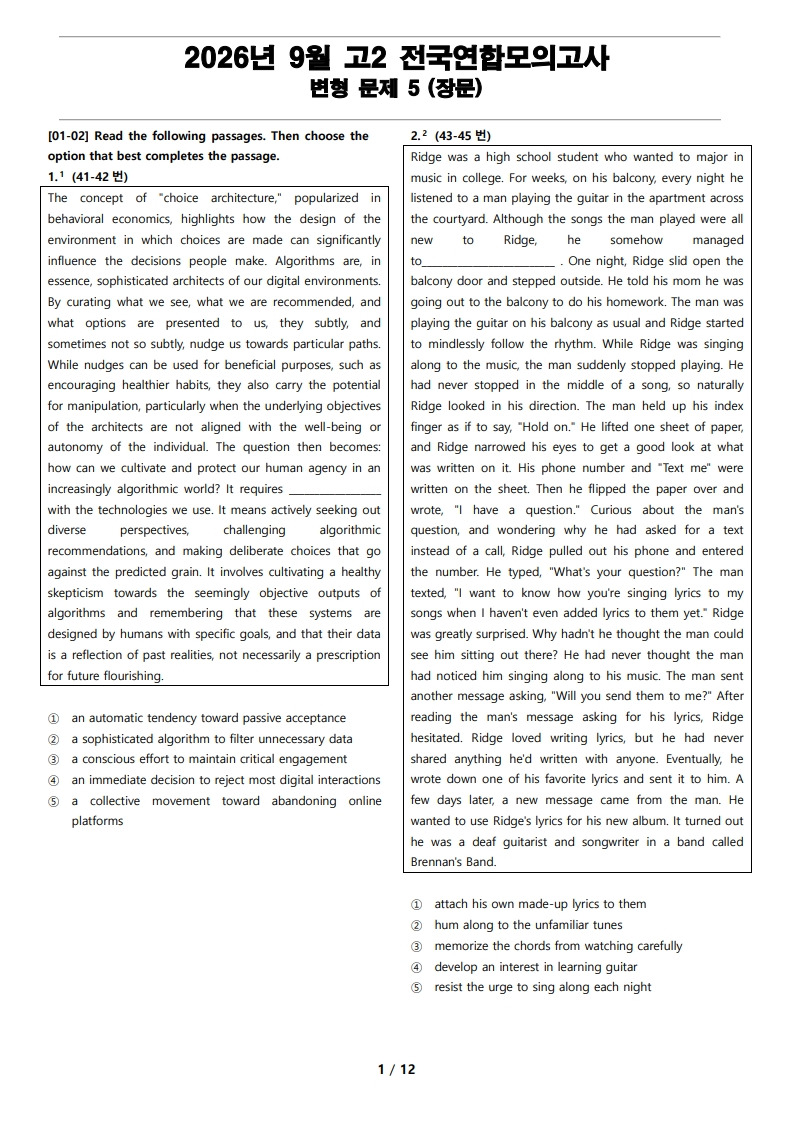
The concept of "choice architecture," popularized in behavioral economics, highlights how the design of the environment in which choices are made can significantly influence the decisions people make. Algorithms are, in essence, sophisticated architects of our digital environments. By curating what we see, what we are recommended, and what options are presented to us, they subtly, and sometimes not so subtly, nudge us towards particular paths. While nudges can be used for beneficial purposes, such as encouraging healthier habits, they also carry the potential for manipulation, particularly when the underlying objectives of the architects are not aligned with the well-being or autonomy of the individual. The question then becomes: how can we cultivate and protect our human agency in an increasingly algorithmic world? It requires a conscious effort to maintain critical engagement with the technologies we use. It means actively seeking out diverse perspectives, challenging algorithmic recommendations, and making deliberate choices that go against the predicted grain. It involves cultivating a healthy skepticism towards the seemingly objective outputs of algorithms and remembering that these systems are designed by humans with specific goals, and that their data is a reflection of past realities, not necessarily a prescription for future flourishing.
2번 지문(문항 번호 43-45번)
Ridge was a high school student who wanted to major in music in college. For weeks, on his balcony, every night he listened to a man playing the guitar in the apartment across the courtyard. Although the songs the man played were all new to Ridge, he somehow managed to attach his own made-up lyrics to them. One night, Ridge slid open the balcony door and stepped outside. He told his mom he was going out to the balcony to do his homework. The man was playing the guitar on his balcony as usual and Ridge started to mindlessly follow the rhythm. While Ridge was singing along to the music, the man suddenly stopped playing. He had never stopped in the middle of a song, so naturally Ridge looked in his direction. The man held up his index finger as if to say, "Hold on." He lifted one sheet of paper, and Ridge narrowed his eyes to get a good look at what was written on it. His phone number and "Text me" were written on the sheet. Then he flipped the paper over and wrote, "I have a question." Curious about the man's question, and wondering why he had asked for a text instead of a call, Ridge pulled out his phone and entered the number. He typed, "What's your question?" The man texted, "I want to know how you're singing lyrics to my songs when I haven't even added lyrics to them yet." Ridge was greatly surprised. Why hadn't he thought the man could see him sitting out there? He had never thought the man had noticed him singing along to his music. The man sent another message asking, "Will you send them to me?" After reading the man's message asking for his lyrics, Ridge hesitated. Ridge loved writing lyrics, but he had never shared anything he'd written with anyone. Eventually, he wrote down one of his favorite lyrics and sent it to him. A few days later, a new message came from the man. He wanted to use Ridge's lyrics for his new album. It turned out he was a deaf guitarist and songwriter in a band called Brennan's Band.
'전국 연합 모의고사 변형 문제 > 고2 모의고사 변형 문제' 카테고리의 다른 글
| 2026년 9월 고2 영어 모의고사 변형문제 Part 4 (0) | 2026.09.13 |
|---|---|
| 2026년 9월 고2 영어모의고사 변형문제 Part 3 (1) | 2026.09.11 |
| 2026년 9월 고2 영어모의고사 변형문제 Part 2 (0) | 2026.09.08 |
| 2026년 9월 고2 영어 모의고사 변형문제 Part 1 (0) | 2026.09.04 |
| 2026년 고2 6월 영어 모의고사 [41,42,43,44,45] 변형문제 (0) | 2026.06.21 |