
수능 실감 영어 독해 5문항 300제
Day 9 변형문제

전문항 확인 하러가기!
https://themakings.co.kr/421/?idx=1532
수능실감 영어 독해 5문항 모의고사 300제 DAY 9 변형문제(PDF)
수능실감 영어 독해 5문항 모의고사 300제 DAY 9 변형문제(PDF)은 원어민 선생님과 현직 강사가 제작한 수능 영어 변형문제. 실전 감각을 높이는 고퀄리티 문제로 내신·수능 완벽 대비.
themakings.co.kr
다음 지문을 읽고 글의 내용과 다른 문장을 고르세요.
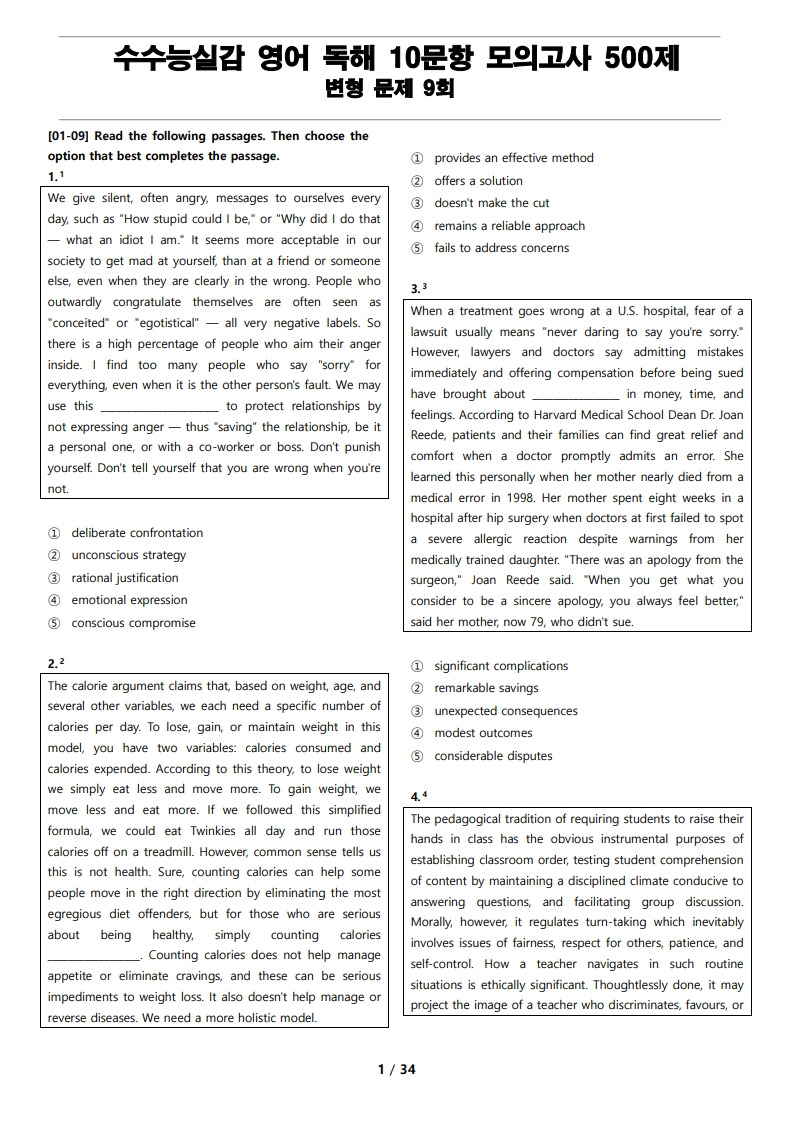
The calorie argument claims that, based on weight, age, and several other variables, we each need a specific number of calories per day. To lose, gain, or maintain weight in this model, you have two variables: calories consumed and calories expended. According to this theory, to lose weight we simply eat less and move more. To gain weight, we move less and eat more. If we followed this simplified formula, we could eat Twinkies all day and run those calories off on a treadmill. However, common sense tells us this is not health. Sure, counting calories can help some people move in the right direction by eliminating the most egregious diet offenders, but for those who are serious about being healthy, simply counting calories doesn't make the cut. Counting calories does not help manage appetite or eliminate cravings, and these can be serious impediments to weight loss. It also doesn't help manage or reverse diseases. We need a more holistic model.
① The calorie argument is based on the idea that each person requires a certain daily caloric intake depending on factors such as weight and age.
② Following the simplified calorie formula would logically allow a person to eat unhealthy food all day as long as they exercise enough.
③ The author acknowledges that calorie counting can be partially useful for removing the worst dietary habits.
④ Calorie counting is effective at managing appetite and eliminating food cravings for most people.
⑤ The author argues that a more comprehensive approach to health is needed beyond simply tracking calorie intake.
지문 해석
칼로리 주장(calorie argument)은 체중, 나이 및 기타 여러 변수에 따라 우리 각자가 하루에 특정 칼로리 수가 필요하다고 주장한다. 이 모델에서 체중을 줄이거나, 늘리거나, 유지하기 위해 두 가지 변수가 있다: 섭취 칼로리와 소비 칼로리. 이 이론에 따르면, 체중을 줄이려면 단순히 덜 먹고 더 움직이면 된다. 체중을 늘리려면 덜 움직이고 더 먹으면 된다. 이 단순화된 공식을 따른다면, 하루 종일 트윙키를 먹고 러닝머신에서 그 칼로리를 소모할 수 있을 것이다. 그러나 상식적으로 이것은 건강이 아니다. 물론, 칼로리 계산은 가장 심각한 식단 문제를 제거함으로써 일부 사람들이 올바른 방향으로 나아가는 데 도움이 될 수 있지만, 건강에 진지한 사람들에게 단순히 칼로리를 세는 것은 충분하지 않다. 칼로리 계산은 식욕을 관리하거나 갈망을 제거하는 데 도움이 되지 않으며, 이것들은 체중 감량에 심각한 장애가 될 수 있다. 또한 질병을 관리하거나 역전시키는 데도 도움이 되지 않는다. 우리에게는 더 총체적인 모델이 필요하다.
풀이 흐름
이 지문의 핵심 논지는 "칼로리 계산만으로는 진정한 건강을 달성할 수 없다"는 것이다. 지문은 칼로리 계산의 부분적 유용성은 인정하면서도, 그 한계를 구체적으로 열거한다.
특히 칼로리 계산의 한계를 서술하는 부분에서 지문은 "Counting calories does not help manage appetite or eliminate cravings"라고 명시한다. 즉, 칼로리 계산은 식욕 관리나 갈망 제거에 "도움이 되지 않는다(does not help)".
따라서 칼로리 계산이 식욕 관리와 음식 갈망 제거에 "효과적이다(is effective)"고 서술하는 선지가 있다면, 이는 지문과 정면으로 모순된다.
전체 선지 분석
|
선지
|
판정
|
근거
|
|
① The calorie argument is based on the idea that each person requires a certain daily caloric intake depending on factors such as weight and age.
|
✅ 일치
|
지문의 "based on weight, age, and several other variables, we each need a specific number of calories per day"와 직접 대응.
|
|
② Following the simplified calorie formula would logically allow a person to eat unhealthy food all day as long as they exercise enough.
|
✅ 일치
|
지문의 "If we followed this simplified formula, we could eat Twinkies all day and run those calories off on a treadmill"과 정확히 대응.
|
|
③ The author acknowledges that calorie counting can be partially useful for removing the worst dietary habits.
|
✅ 일치
|
지문의 "counting calories can help some people move in the right direction by eliminating the most egregious diet offenders"와 일치. partially useful = can help some people, worst dietary habits = most egregious diet offenders.
|
|
④ Calorie counting is effective at managing appetite and eliminating food cravings for most people.
|
❌ 불일치
|
지문은 "Counting calories does not help manage appetite or eliminate cravings"라고 명시. is effective ↔ does not help로 정반대. 또한 "for most people"이라는 범위도 지문에 존재하지 않는다.
|
|
⑤ The author argues that a more comprehensive approach to health is needed beyond simply tracking calorie intake.
|
✅ 일치
|
지문의 "We need a more holistic model"과 직접 대응. comprehensive = holistic, beyond simply tracking = 단순 칼로리 계산을 넘어서.
|
핵심 문장 정리
"Counting calories does not help manage appetite or eliminate cravings, and these can be serious impediments to weight loss."
이 문장이 ④번 선지의 오류를 판별하는 결정적 근거다. 지문은 칼로리 계산이 식욕 관리나 갈망 제거에 "도움이 되지 않는다(does not help)"고 서술하는 반면, ④번은 "효과적이다(is effective)"고 정반대로 서술했다.
한 줄 정리
칼로리 계산은 식욕 관리와 음식 갈망 제거에 "효과적인" 것이 아니라 오히려 "도움이 되지 않으며", 이것이 체중 감량의 심각한 장애가 될 수 있다.
The Makings의 DAY 9 변형문제는 총 11개의 유형으로 구성되어 있습니다.
1. 빈칸 채우기(객관식)
2. 글의 내용 일치/불일치(객관식/한글 선택지)
3. 글의 내용 일치/불일치(객관식/영어 선택지)
4. 글 끼어 넣기(객관식)
5. 어법(서술형)
6. 어휘(서술형)
7. 주제문(객관식/영어 선택지)
8. 어휘 빈칸 채우기(서술형)
9. 영작(서술형)
10. 요약문 완성하기(서술형)
11. 문단 재배열 하기(객관식)
더메이킹스(The Makings)가 제작한 수능실감 영어 독해 5문항 모의고사 300제
DAY 9(44문항) 변형문제의 지문입니다.
1번 지문
It's worth noting that refusing to use social media icons and comments to interact means that some people will inevitably fall out of your social orbit ─ in particular, those whose relationship with you exists only over social media. Here's my sincere tough love reassurance: let them go. The idea that it's valuable to maintain vast numbers of weak-tie social connections is largely an invention of the past decade or so ─ the detritus of overexuberant network scientists spilling inappropriately into the social sphere. Humans have maintained rich and fulfilling social lives for our entire history without needing the ability to send a few bits of information each month to people we knew briefly during high school. Nothing about your life will notably diminish when you return to this steady state. As an academic who studies and teaches social media explained to me: "I don't think we're meant to keep in touch with so many people."
2번 지문
There are multiple views of the learner in theories of cognition, just as there are multiple theories of the nature of art. Some portray the learner as a lone individual trying to make sense of a work of art or, for that matter, the world. Others picture learners as living within a social or cultural context from which knowledge derives its meaning. Such different views of the learner have consequences for teaching the arts. At the same time, if works of art are to be understood in terms of their social and cultural origins and purposes, then it would make sense to integrate the knowledge of the artwork into those subjects, such as the social studies or history, where knowledge of the culture and society is collaterally provided. But if works of art are thought of as autonomous structures whose meaning is set by the artist, where there is one "objective" or "right" interpretation, independent of its social context, then it might make more sense to pair this conception of art with the view of the learner as a lone individual.
3번 지문
Economic growth is almost universally considered a worthwhile goal. Ecological conservation and cultural preservation are also accepted as important. These three large-scale systems are not independent, so one cannot focus on one goal while ignoring the other two. The ever-expanding web of globalization and industrialization, partly caused by the expanding human population, further links these three systems. In 1987, the term 'sustainable development' was brought into common use by the World Commission on Environment and Development. The commission's report, Our Common Future, defined the term as a form of development that "meets the needs of the present without compromising the ability of future generations to meet their own needs." Both developed and developing countries have embraced the concept of sustainable development, but often in different ways. The shared goal, however, is to maintain and improve the long-term welfare of both humans and ecosystems.
4번 지문
For centuries researchers and the public have agreed on the rather unpleasant "truth" that the only reason we humans tend to cooperate is self-interest. Now, happily, a much more complex, sophisticated, and positive picture is emerging from recent studies. Anthropologist Joseph Henrich of the University of Michigan, and his colleague Robert Boyd of the University of California in Los Angeles, studied the transmission of social behavior and culture among humans. They came to a startling conclusion: cooperation is not the result of selfishness; it is the result of two major "Brain Tendencies." According to Henrich: "There are two elements of human psychology that we know about: one is that people have a tendency to copy the majority; the other is that people have a tendency to copy the most successful individual. What we are able to show is that because humans rely on copying the successful and the majority, this creates a stable cooperative equilibrium which doesn't exist if those two cultural mechanisms aren't in place." This double mimicking leads to a positive spiral of success. Cooperation leads to a high probability of more food, better health, more creativity, and more general energy and therefore more powerful economic growth for the community as a whole.
'문제집 변형문제 > 수능 실감 영어 독해 5문항 300제' 카테고리의 다른 글
| 수능실감 영어 독해 5문항 모의고사 300제 Day 11 변형문제 (0) | 2026.09.22 |
|---|---|
| 수능 실감 영어 독해 5문항 300제 Day 10 변형문제 (0) | 2026.09.08 |
| 수능 실감 영어 독해 5문항 300제 Day 8 변형문제 (0) | 2026.09.06 |
| 수능 실감 영어 독해 5문항 300제 Day 7 변형문제 (0) | 2026.09.05 |
| 수능 실감 영어 독해 5문항 300제 Day 6 변형문제 (0) | 2026.09.04 |