
2026년 고3 3월 전국 연합 모의고사
변형 문제 Part 4
일반 워크북 형태의 문제에서 벗어나 The Makings가 만든
2026년 고3 3월 전국 연합 모의고사 변형 문제 Part 4
출판사에서 오랫동안 영어 번역과 교정을 하셨던 원어민 선생님과
현직에서 강사를 하고 있는 연구진들이 학생들을 위한 최상의
2026년 고3 3월 전국 연합 모의고사 변형 문제 Part 4 를 선보입니다.
사고력과 이해력을 요구하는 문제들로 내신 대비 뿐만이 아니라
수능도 한꺼번에 공부하실 수 있는 자료입니다.
중간고사&기말고사 전에 더메이킹스(The Makings)에서 제작한
2026년 고3 3월 전국 연합 모의고사 변형 문제로 마무리 하세요.
정답 확인 하러가기!
https://themakings.co.kr/243/?idx=1241
2026년 고3 3월 전국 연합 모의고사 변형 문제 Part 4 (66문항) (PDF)
2026년 고3 3월 전국 연합 모의고사 변형 문제, 내신대비, 영어내신자료,고등영어자료, 모의고사 변형문제,전국 연합모의고사 변형자료, 모의고사 영어 서술형 대비, 대치동 고등 영어자료, 대치
themakings.co.kr
The Makings의 2026년 고3 3월 전국 연합 모의고사 변형 문제는
총 11개의 유형으로 구성되어 있습니다.
1. 빈칸 채우기(객관식)
2. 글의 내용 일치/불일치(객관식/한글 선택지)
3. 글의 내용 일치/불일치(객관식/영어 선택지)
4. 글 끼어 넣기(객관식)
5. 어법(서술형)
6. 어휘(서술형)
7. 주제문(객관식/영어 선택지)
8. 어휘 빈칸 채우기(서술형)
9. 영작(서술형)
10. 요약문 완성하기(서술형)
11. 문단 재배열 하기(객관식)
더메이킹스(The Makings)가 제작한
2026년 고3 3월 전국 연합 모의고사 변형 문제 Part 4의 지문입니다.
1번 지문(문항 번호 35번)
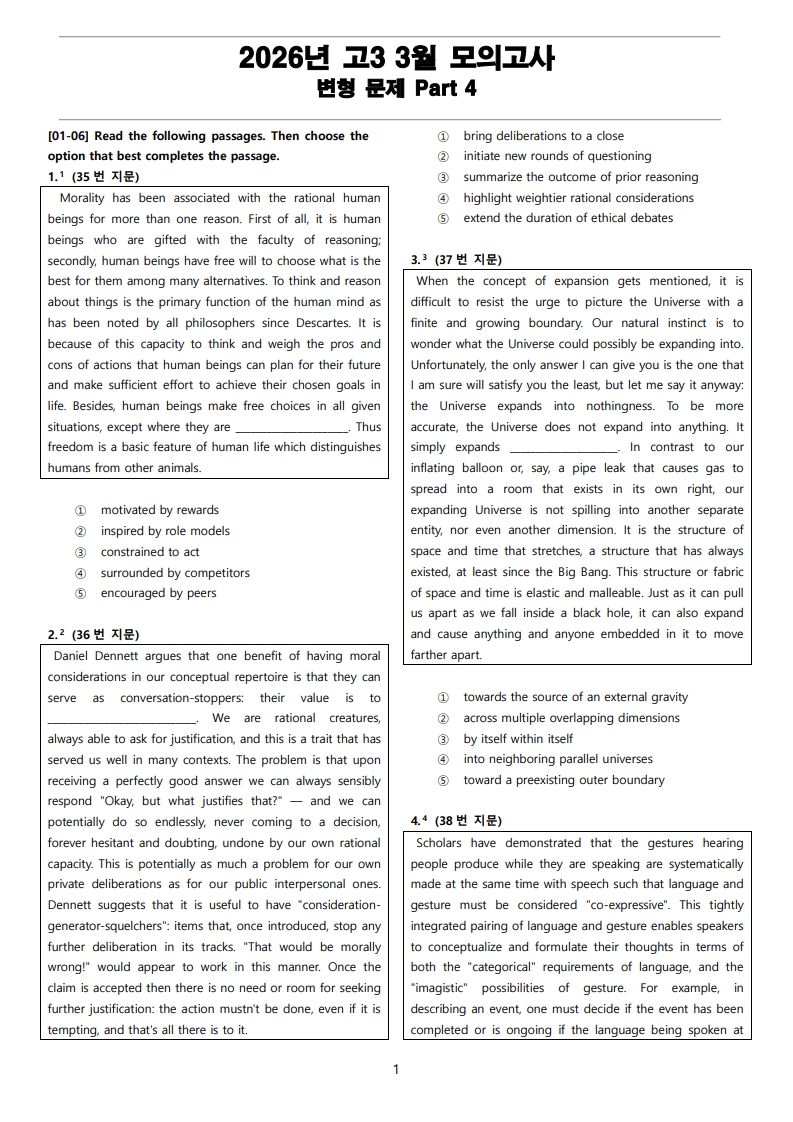
Morality has been associated with the rational human beings for more than one reason. First of all, it is human beings who are gifted with the faculty of reasoning; secondly, human beings have free will to choose what is the best for them among many alternatives. To think and reason about things is the primary function of the human mind as has been noted by all philosophers since Descartes. It is because of this capacity to think and weigh the pros and cons of actions that human beings can plan for their future and make sufficient effort to achieve their chosen goals in life. Besides, human beings make free choices in all given situations, except where they are constrained to act. Thus freedom is a basic feature of human life which distinguishes humans from other animals.
2번 지문(문항 번호 36번)
Daniel Dennett argues that one benefit of having moral considerations in our conceptual repertoire is that they can serve as conversation-stoppers: their value is to bring deliberations to a close. We are rational creatures, always able to ask for justification, and this is a trait that has served us well in many contexts. The problem is that upon receiving a perfectly good answer we can always sensibly respond "Okay, but what justifies that?" ─ and we can potentially do so endlessly, never coming to a decision, forever hesitant and doubting, undone by our own rational capacity. This is potentially as much a problem for our own private deliberations as for our public interpersonal ones. Dennett suggests that it is useful to have "consideration-generator-squelchers": items that, once introduced, stop any further deliberation in its tracks. "That would be morally wrong!" would appear to work in this manner. Once the claim is accepted then there is no need or room for seeking further justification: the action mustn't be done, even if it is tempting, and that's all there is to it.
3번 지문(문항 번호 37번)
When the concept of expansion gets mentioned, it is difficult to resist the urge to picture the Universe with a finite and growing boundary. Our natural instinct is to wonder what the Universe could possibly be expanding into. Unfortunately, the only answer I can give you is the one that I am sure will satisfy you the least, but let me say it anyway: the Universe expands into nothingness. To be more accurate, the Universe does not expand into anything. It simply expands by itself within itself. In contrast to our inflating balloon or, say, a pipe leak that causes gas to spread into a room that exists in its own right, our expanding Universe is not spilling into another separate entity, nor even another dimension. It is the structure of space and time that stretches, a structure that has always existed, at least since the Big Bang. This structure or fabric of space and time is elastic and malleable. Just as it can pull us apart as we fall inside a black hole, it can also expand and cause anything and anyone embedded in it to move farther apart.
4번 지문(문항 번호 38번)
Scholars have demonstrated that the gestures hearing people produce while they are speaking are systematically made at the same time with speech such that language and gesture must be considered "co-expressive". This tightly integrated pairing of language and gesture enables speakers to conceptualize and formulate their thoughts in terms of both the "categorical" requirements of language, and the "imagistic" possibilities of gesture. For example, in describing an event, one must decide if the event has been completed or is ongoing if the language being spoken at that moment has a verbal affix for each meaning and one or the other must be chosen. This kind of choice is characteristic of language as a semiotic system. According to McNeil and Duncan, gesture is different from language in that it does not present the speaker with such choices. Instead, it offers a kind of glue, which helps unite linguistic elements in a larger semiotic expression, which, as a whole, shares important characteristics with the represented objects. In this view, speech and gesture are not redundant nor is one a "translation" of the other. Rather, the minimal processing unit for the expression of thought is a combination of the two: it is "imagistic-categorial" in nature.
5번 지문(문항 번호 39번)
To acquire expert knowledge, one needs to become a member of the relevant group of knowledge bearers, for which I will use the term "epistemic communities." A newcomer learns from experts and is socialized into the common practices of the relevant epistemic community. Often there are admittance processes, combined with tests of a candidate's abilities. In the premodern era, epistemic communities were often kept secret, with strict tests of loyalty for new members, not least because of fears that specialized knowledge would fall into the "wrong hands." Some traces of these older practices may still be present today, but on the whole, the ideal has shifted to openness among the members of epistemic communities, and also, to some extent, toward outsiders. Nonetheless, for most outsiders even completely transparent practices do not lift the veil behind which such forms of knowledge are hidden ─ without the relevant training and acquisition of skills, which often take many years, one simply cannot make sense of the information that is being shared. Other, more active strategies are needed to make certain forms of knowledge as "accessible" as is realistically possible.
6번 지문(문항 번호 40번)
Carstensen's (1995) socioemotional selectivity theory looks at individuals' goals as a lifelong process that strengthens and matures with ageing. In relation to his motivational conceptual framework, Higgins (2014) proposes that motivation may even attain its highest levels in the later stages of life, subject to the balance and organisation of one's goals in relation to life priorities. Building on this foundation, more recent research looks deeply into additional factors influencing well-being in later adulthood, particularly emphasising the role of self-worthiness, and the overall positive impact of developing a well-rounded self-view in life course transitions. Together, these studies suggest that both goal alignment and a positive self-perception are crucial for enhancing motivation and overall well-being in later life. In fact, third-age learners exhibit a higher degree of selectivity when it comes to determining which goals to pursue and how to allocate their resources towards those specific priorities. Older adults demonstrate a stronger sense of life purpose and self-fulfilment. They do it their way, and their way is an accumulation of winning and personalized combinations in effectively relating motives all together at different degrees according to their life contexts.
'전국 연합 모의고사 변형 문제 > 고3 모의고사 변형 문제' 카테고리의 다른 글
| 2026년 고3 5월 전국 연합 모의고사 변형 문제 Part 1 (0) | 2026.05.10 |
|---|---|
| 2025년 고3 5월 전국 연합 모의고사 변형 문제 Part 4 (0) | 2026.04.18 |
| 2025년 고3 5월 전국 연합 모의고사 변형 문제 Part 3 (0) | 2026.04.14 |
| 2025년 고3 5월 전국 연합 모의고사 변형 문제 Part 2 (0) | 2026.04.13 |
| 2026년 고3 3월 전국 연합 모의고사 변형 문제 Part 3 (0) | 2026.04.12 |