
수능 실감 영어 독해 5문항 300제
Day 2 변형문제

전문항 확인 하러가기!
https://themakings.co.kr/421/?idx=1517
수능실감 영어 독해 5문항 모의고사 300제 DAY 2 변형문제(PDF)
수능실감 영어 독해 5문항 모의고사 300제 DAY 2 변형문제(PDF)은 원어민 선생님과 현직 강사가 제작한 수능 영어 변형문제. 실전 감각을 높이는 고퀄리티 문제로 내신·수능 완벽 대비.
themakings.co.kr
다음 지문을 읽고 글의 내용과 다른 문장을 고르세요.
Speaking is intrinsically social. Whether it comes from a person or a machine, speech activates a powerful and varied cognitive apparatus that is designed to express and recognize who a person is and what she or he is thinking and feeling. Although people have separate parts of the brain that are devoted to each social judgment and each aspect of speech production and understanding, people do not have separate parts of the brain for human speech and technology-generated speech. Even when voice interfaces exhibit all of the limitations associated with machines ─ including odd pronunciations, emotional ignorance, and chronic inconsistencies ─ they are not exempted from the social expectations that are activated by talking and listening. When technologies, regardless of quality, fail to conform to social norms, users experience confusion, frustration, and cognitive exhaustion and question the competence, utility, and enjoyability of the system. Socially inept interfaces suffer the same fate as socially inept individuals: they are ineffective, criticized, and shunned.
① Speech activates a cognitive apparatus designed to express and recognize a person's identity and inner states.
② The human brain has dedicated areas for social judgment and for speech production and comprehension.
③ People possess distinct brain regions that separately process human speech and machine-generated speech.
④ Voice interfaces are still subject to social expectations even when they display the typical limitations of machines.
⑤ Interfaces that lack social competence are treated the same way as individuals who are socially inept.
지문 해석
말하기는 본질적으로 사회적이다. 사람에게서 나오든 기계에서 나오든, 말은 한 사람이 누구이며 무엇을 생각하고 느끼는지를 표현하고 인식하도록 설계된 강력하고 다양한 인지 장치를 활성화시킨다. 사람들은 각각의 사회적 판단과 언어 생산 및 이해의 각 측면에 전담하는 별도의 뇌 영역을 가지고 있지만, 인간의 말과 기술이 생성한 말을 위한 별도의 뇌 영역은 가지고 있지 않다. 음성 인터페이스가 이상한 발음, 감정적 무지, 만성적 불일치 등 기계에 수반되는 모든 한계를 보여줄 때조차, 말하고 듣는 행위에 의해 활성화되는 사회적 기대에서 면제되지 않는다. 품질에 관계없이 기술이 사회적 규범에 부합하지 못하면, 사용자는 혼란, 좌절, 인지적 피로를 경험하며 시스템의 능력, 유용성, 즐거움에 의문을 제기한다. 사회적으로 서투른 인터페이스는 사회적으로 서투른 개인과 같은 운명을 겪는다: 비효과적이고, 비판받고, 기피된다.
풀이 흐름
이 지문의 핵심 논리는 "뇌는 인간의 말과 기계의 말을 구분하여 처리하지 않는다"는 것이다. 이것이 기계 음성에도 사회적 기대가 적용되는 근본적 이유이다. 지문은 뇌의 구조에 대해 두 가지 대조적 진술을 한다.
첫째, 사회적 판단과 언어 처리에는 별도의 뇌 영역이 "있다(have)".
둘째, 인간의 말과 기계의 말을 위한 별도의 뇌 영역은 "없다(do not have)". 이 "있다/없다"의 대비를 정확히 읽는 것이 핵심이다.
따라서 사람들이 인간의 말과 기계의 말을 별도로 처리하는 "구별된 뇌 영역을 가지고 있다(possess distinct brain regions)"고 서술하는 선지가 있다면, 이는 지문과 정면으로 모순된다.
전체 선지 분석
|
선지
|
판정
|
근거
|
|
① Speech activates a cognitive apparatus designed to express and recognize a person's identity and inner states.
|
✅ 일치
|
지문의 "speech activates a powerful and varied cognitive apparatus that is designed to express and recognize who a person is and what she or he is thinking and feeling"과 직접 대응. identity and inner states = who a person is and what they are thinking and feeling.
|
|
② The human brain has dedicated areas for social judgment and for speech production and comprehension.
|
✅ 일치
|
지문의 "people have separate parts of the brain that are devoted to each social judgment and each aspect of speech production and understanding"과 정확히 대응. dedicated areas = separate parts devoted to.
|
|
③ People possess distinct brain regions that separately process human speech and machine-generated speech.
|
❌ 불일치
|
지문은 "people do not have separate parts of the brain for human speech and technology-generated speech"라고 명시. possess distinct brain regions ↔ do not have separate parts로 정반대.
|
|
④ Voice interfaces are still subject to social expectations even when they display the typical limitations of machines.
|
✅ 일치
|
지문의 "Even when voice interfaces exhibit all of the limitations associated with machines... they are not exempted from the social expectations"와 일치. still subject to = not exempted from.
|
|
⑤ Interfaces that lack social competence are treated the same way as individuals who are socially inept.
|
✅ 일치
|
지문의 "Socially inept interfaces suffer the same fate as socially inept individuals"와 직접 대응. lack social competence = socially inept.
|
핵심 문장 정리
"Although people have separate parts of the brain that are devoted to each social judgment and each aspect of speech production and understanding, people do not have separate parts of the brain for human speech and technology-generated speech."
이 문장이 ③번 선지의 오류를 판별하는 결정적 근거다. 지문은 인간의 말과 기계의 말을 위한 별도의 뇌 영역이 "없다(do not have)"고 명시하는 반면, ③번은 이를 별도로 처리하는 구별된 뇌 영역을 "가지고 있다(possess)"고 정반대로 서술했다. 특히 이 문장은 "Although"로 시작하는 양보절과 주절의 대비 구조를 정확히 파악해야 하는데, ②번이 양보절(있다)의 내용이고 ③번이 주절(없다)의 내용을 뒤집은 것이다.
한 줄 정리
사람들은 인간의 말과 기계의 말을 별도로 처리하는 "구별된 뇌 영역을 가지고 있는" 것이 아니라, 두 종류의 말을 위한 별도의 뇌 영역이 "없다."
The Makings의 DAY 2 변형문제는 총 11개의 유형으로 구성되어 있습니다.
1. 빈칸 채우기(객관식)
2. 글의 내용 일치/불일치(객관식/한글 선택지)
3. 글의 내용 일치/불일치(객관식/영어 선택지)
4. 글 끼어 넣기(객관식)
5. 어법(서술형)
6. 어휘(서술형)
7. 주제문(객관식/영어 선택지)
8. 어휘 빈칸 채우기(서술형)
9. 영작(서술형)
10. 요약문 완성하기(서술형)
11. 문단 재배열 하기(객관식)
더메이킹스(The Makings)가 제작한
수능실감 영어 독해 5문항 모의고사 300제
DAY 2(55문항) 변형문제의 지문입니다.
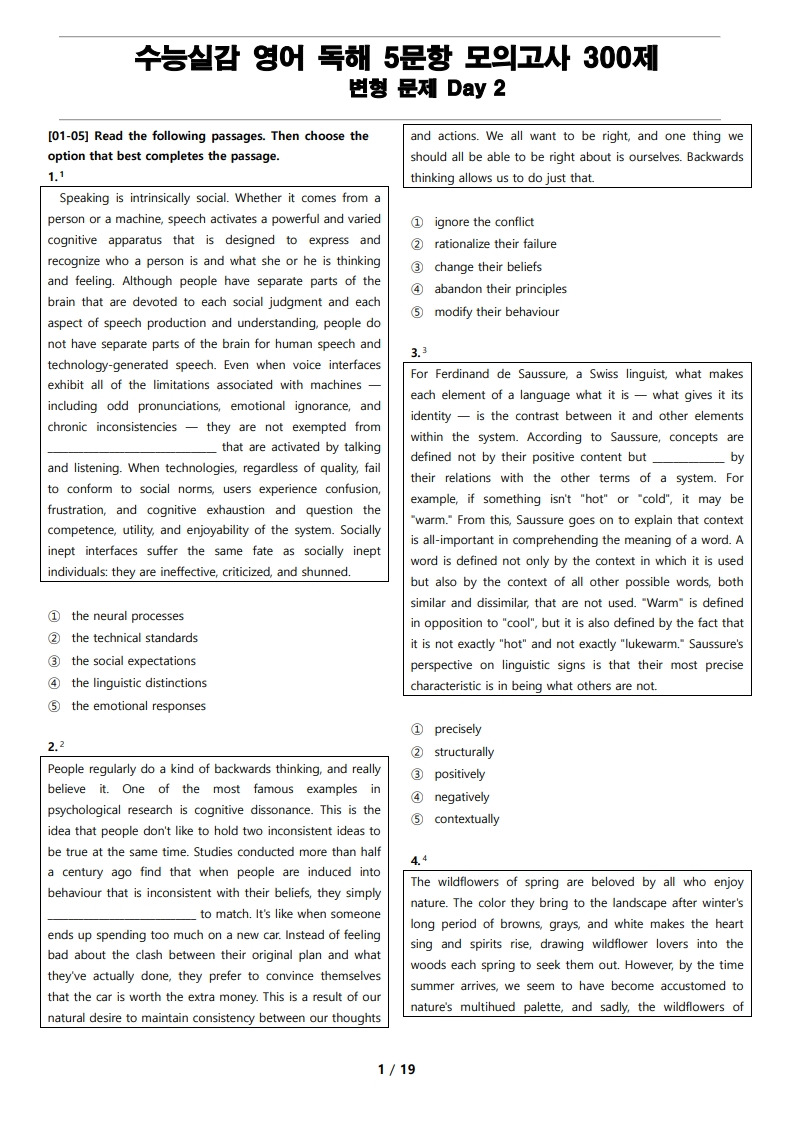
1번 지문
Speaking is intrinsically social. Whether it comes from a person or a machine, speech activates a powerful and varied cognitive apparatus that is designed to express and recognize who a person is and what she or he is thinking and feeling. Although people have separate parts of the brain that are devoted to each social judgment and each aspect of speech production and understanding, people do not have separate parts of the brain for human speech and technology-generated speech. Even when voice interfaces exhibit all of the limitations associated with machines ─ including odd pronunciations, emotional ignorance, and chronic inconsistencies ─ they are not exempted from the social expectations that are activated by talking and listening. When technologies, regardless of quality, fail to conform to social norms, users experience confusion, frustration, and cognitive exhaustion and question the competence, utility, and enjoyability of the system. Socially inept interfaces suffer the same fate as socially inept individuals: they are ineffective, criticized, and shunned.
2번 지문
People regularly do a kind of backwards thinking, and really believe it. One of the most famous examples in psychological research is cognitive dissonance. This is the idea that people don't like to hold two inconsistent ideas to be true at the same time. Studies conducted more than half a century ago find that when people are induced into behaviour that is inconsistent with their beliefs, they simply change their beliefs to match. It's like when someone ends up spending too much on a new car. Instead of feeling bad about the clash between their original plan and what they've actually done, they prefer to convince themselves that the car is worth the extra money. This is a result of our natural desire to maintain consistency between our thoughts and actions. We all want to be right, and one thing we should all be able to be right about is ourselves. Backwards thinking allows us to do just that.
3번 지문
For Ferdinand de Saussure, a Swiss linguist, what makes each element of a language what it is ─ what gives it its identity ─ is the contrast between it and other elements within the system. According to Saussure, concepts are defined not by their positive content but negatively by their relations with the other terms of a system. For example, if something isn't "hot" or "cold", it may be "warm." From this, Saussure goes on to explain that context is all-important in comprehending the meaning of a word. A word is defined not only by the context in which it is used but also by the context of all other possible words, both similar and dissimilar, that are not used. "Warm" is defined in opposition to "cool", but it is also defined by the fact that it is not exactly "hot" and not exactly "lukewarm." Saussure's perspective on linguistic signs is that their most precise characteristic is in being what others are not.
4번 지문
The wildflowers of spring are beloved by all who enjoy nature. The color they bring to the landscape after winter's long period of browns, grays, and white makes the heart sing and spirits rise, drawing wildflower lovers into the woods each spring to seek them out. However, by the time summer arrives, we seem to have become accustomed to nature's multihued palette, and sadly, the wildflowers of summer tend to get less of our attention. Yet the natural history of summer-blooming flowers is every bit as interesting as that of spring wildflowers, and in some cases more so because of the greater diversity of insects present during the summer months. That is, the interrelationships between flowers, the insects that visit them, and the predators and parasites of those insects can be even more extensive than those involving spring wildflowers.
5번 지문
In the less hierarchical and less bounded networked environment ─ where special knowledge is more in dispute than in the past and where relationships are less stable ─ there is more uncertainty about whom and what information sources to trust. The explosion of information and information sources has had the paradoxical impact of pushing people on the path of greater reliance on their networks. It might seem that the abundance of information that organizations provide on the Internet would prompt people to rely less on their friends and colleagues for facts and advice. Yet it turns out that the increasing amount of information pouring into people's lives leads them to turn to their social networks to make sense of it. The result is that as people gather information to help them make choices, they cycle back and forth between Internet searches and discussion with the members of their social networks, using in-person conversations, phone chats, and e-mails to exchange opinions and weigh options.
'문제집 변형문제 > 수능 실감 영어 독해 5문항 300제' 카테고리의 다른 글
| 수능 실감 영어 독해 5문항 300제 Day 6 변형문제 (0) | 2026.09.04 |
|---|---|
| 수능 실감 영어 독해 5문항 300제 Day 5 변형문제 (1) | 2026.09.03 |
| 수능 실감 영어 독해 5문항 300제 Day 4 변형문제 (1) | 2026.09.02 |
| 수능 실감 영어 독해 5문항 300제 Day 3 변형문제 (0) | 2026.09.01 |
| 수능 실감 영어 독해 5문항 300제 Day 1 변형문제 (0) | 2026.08.27 |