
N기출 영어영역 고난도 독해 Level 1
Part 1. - 3 어휘 변형문제
다음 지문을 읽고 글의 내용과 다른 문장을 고르세요.
“You are what you eat.” That phrase is often used to show the relationship between the foods you eat and your physical health. But do you really know what you are eating when you buy processed foods, canned foods, and packaged goods? Many of the manufactured products made today contain so many chemicals and artificial ingredients that it is sometimes difficult to know exactly what is inside them. Fortunately, now there are food labels. Food labels are a good way to find the information about the foods you eat. Labels on food are like the table of contents found in books. The main purpose of food labels is to inform you what is inside the food you are purchasing.
① The phrase “You are what you eat” illustrates the connection between diet and physical well-being.
② Food labels serve a similar function to a table of contents in books.
③ Many processed and packaged foods today include numerous chemicals and artificial additives.
④ Fortunately, food labels have made it easier for consumers to understand what they eat.
⑤ It is always straightforward to determine the exact contents of manufactured food products.
지문 해석
"당신이 먹는 것이 곧 당신이다(You are what you eat)." 이 문구는 당신이 먹는 음식과 신체 건강 사이의 관계를 보여주기 위해 자주 사용된다. 하지만 가공식품, 통조림, 포장 식품을 살 때 자신이 먹는 것이 무엇인지 정말 알고 있는가? 오늘날 제조되는 많은 제품에는 화학물질과 인공 성분이 너무 많이 들어 있어서 그 안에 정확히 무엇이 들어 있는지 아는 것이 때때로 어렵다. 다행히, 이제 식품 라벨이 있다. 식품 라벨은 당신이 먹는 음식에 대한 정보를 찾을 수 있는 좋은 방법이다. 식품 라벨은 책에서 볼 수 있는 목차와 같다. 식품 라벨의 주된 목적은 구매하는 식품 안에 무엇이 들어 있는지 알려주는 것이다.
풀이 흐름
이 지문의 논리 구조는 문제 제기 → 해결책 제시이다. 먼저 가공식품의 내용물을 파악하기 어렵다는 문제를 제시하고, 그 해결책으로 식품 라벨을 소개한다.
특히 주목해야 할 표현은 "it is sometimes difficult to know exactly what is inside them"이다. 지문은 제조 식품의 정확한 내용물을 파악하는 것이 "때때로 어렵다(sometimes difficult)"고 서술한다. 바로 이 어려움이 식품 라벨의 존재 이유이기도 하다.
따라서 제조 식품의 정확한 내용물을 파악하는 것이 "항상 간단하다(always straightforward)"고 서술하는 선지가 있다면, 이는 지문의 핵심 문제 인식과 정면으로 모순된다.
전체 선지 분석
|
선지
|
판정
|
근거
|
|
① The phrase "You are what you eat" illustrates the connection between diet and physical well-being.
|
✅ 일치
|
지문의 "often used to show the relationship between the foods you eat and your physical health"와 직접 대응. illustrates = show, well-being = health.
|
|
② Food labels serve a similar function to a table of contents in books.
|
✅ 일치
|
지문의 "Labels on food are like the table of contents found in books"와 정확히 대응. serve a similar function = are like.
|
|
③ Many processed and packaged foods today include numerous chemicals and artificial additives.
|
✅ 일치
|
지문의 "Many of the manufactured products made today contain so many chemicals and artificial ingredients"와 일치. additives = ingredients, numerous = so many.
|
|
④ Fortunately, food labels have made it easier for consumers to understand what they eat.
|
✅ 일치
|
지문의 "Fortunately, now there are food labels. Food labels are a good way to find the information about the foods you eat"과 대응.
|
|
⑤ It is always straightforward to determine the exact contents of manufactured food products.
|
❌ 불일치
|
지문은 **"it is sometimes difficult to know exactly what is inside them"**이라고 명시. always straightforward ↔ sometimes difficult로 정반대.
|
핵심 문장 정리
"Many of the manufactured products made today contain so many chemicals and artificial ingredients that it is sometimes difficult to know exactly what is inside them."
이 문장이 ⑤번 선지의 오류를 판별하는 결정적 근거다. 지문은 제조 식품의 내용물을 정확히 파악하는 것이 "때때로 어렵다(sometimes difficult)"고 서술하는 반면, ⑤번은 "항상 간단하다(always straightforward)"고 빈도와 난이도 모두 정반대로 서술했다.
한 줄 정리
제조 식품의 정확한 내용물을 파악하는 것은 "항상 간단한" 것이 아니라 화학물질과 인공 성분이 많아 "때때로 어려운" 일이다.
The Makings의 Part 1 - 3. 어휘 변형문제는
총 11개의 유형으로 구성되어 있습니다.
1. 빈칸 채우기(객관식)
2. 글의 내용 일치/불일치(객관식/한글 선택지)
3. 글의 내용 일치/불일치(객관식/영어 선택지)
4. 글 끼어 넣기(객관식)
5. 어법(서술형)
6. 어휘(서술형)
7. 주제문(객관식/영어 선택지)
8. 어휘 빈칸 채우기(서술형)
9. 영작(서술형)
10. 요약문 완성하기(서술형)
11. 문단 재배열 하기(객관식)
더메이킹스(The Makings)가 제작한 최상위 수능 기출문제집
N기출 영어영역 고난도 독해 Level 1
Part 1 - 3. 어휘(55문항) 변형문제의 지문입니다.
1번 지문
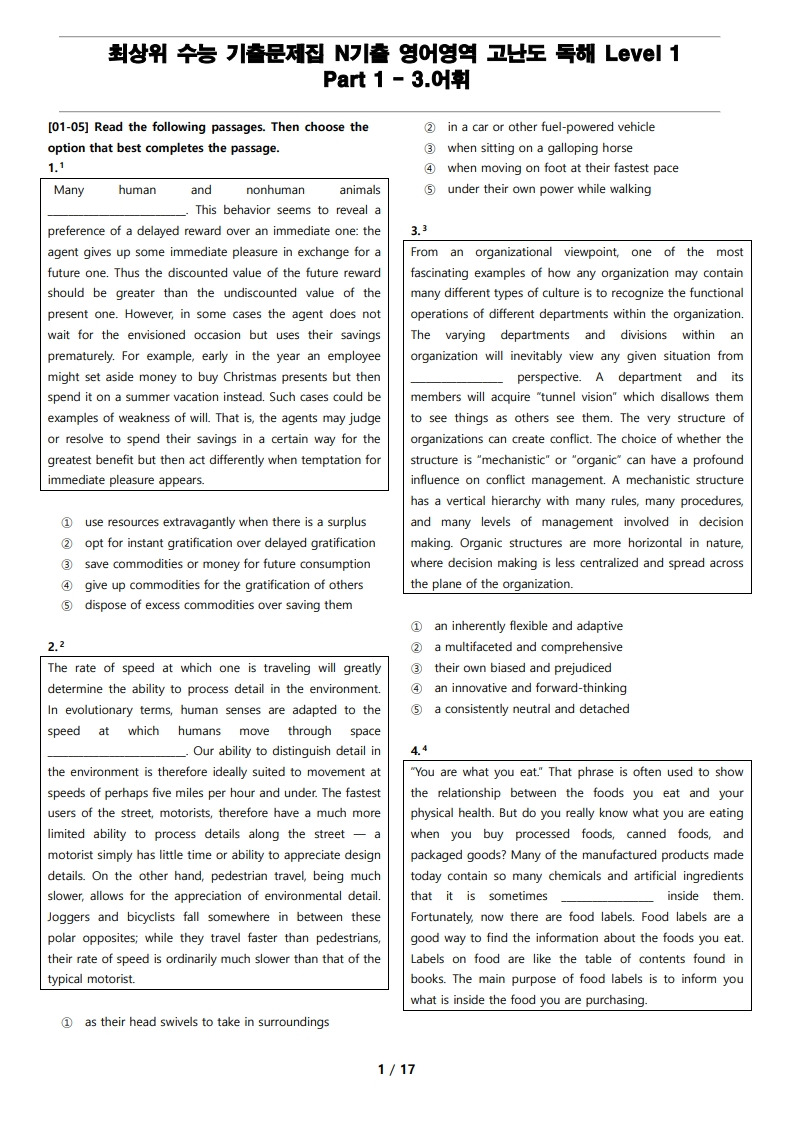
Many human and nonhuman animals save commodities or money for future consumption. This behavior seems to reveal a preference of a delayed reward over an immediate one: the agent gives up some immediate pleasure in exchange for a future one. Thus the discounted value of the future reward should be greater than the undiscounted value of the present one. However, in some cases the agent does not wait for the envisioned occasion but uses their savings prematurely. For example, early in the year an employee might set aside money to buy Christmas presents but then spend it on a summer vacation instead. Such cases could be examples of weakness of will. That is, the agents may judge or resolve to spend their savings in a certain way for the greatest benefit but then act differently when temptation for immediate pleasure appears.
2번 지문
The rate of speed at which one is traveling will greatly determine the ability to process detail in the environment. In evolutionary terms, human senses are adapted to the speed at which humans move through space under their own power while walking. Our ability to distinguish detail in the environment is therefore ideally suited to movement at speeds of perhaps five miles per hour and under. The fastest users of the street, motorists, therefore have a much more limited ability to process details along the street ― a motorist simply has little time or ability to appreciate design details. On the other hand, pedestrian travel, being much slower, allows for the appreciation of environmental detail. Joggers and bicyclists fall somewhere in between these polar opposites; while they travel faster than pedestrians, their rate of speed is ordinarily much slower than that of the typical motorist.
3번 지문
From an organizational viewpoint, one of the most fascinating examples of how any organization may contain many different types of culture is to recognize the functional operations of different departments within the organization. The varying departments and divisions within an organization will inevitably view any given situation from their own biased and prejudiced perspective. A department and its members will acquire “tunnel vision” which disallows them to see things as others see them. The very structure of organizations can create conflict. The choice of whether the structure is “mechanistic” or “organic” can have a profound influence on conflict management. A mechanistic structure has a vertical hierarchy with many rules, many procedures, and many levels of management involved in decision making. Organic structures are more horizontal in nature, where decision making is less centralized and spread across the plane of the organization.
4번 지문
“You are what you eat.” That phrase is often used to show the relationship between the foods you eat and your physical health. But do you really know what you are eating when you buy processed foods, canned foods, and packaged goods? Many of the manufactured products made today contain so many chemicals and artificial ingredients that it is sometimes difficult to know exactly what is inside them. Fortunately, now there are food labels. Food labels are a good way to find the information about the foods you eat. Labels on food are like the table of contents found in books. The main purpose of food labels is to inform you what is inside the food you are purchasing.
5번 지문
At every moment we are faced with a new situation. Actually, the truth is much more complicated than that. The truth is that, at every moment, we are simultaneously faced with an indefinite number of overlapping and intermingling situations. In the airport, we are surrounded by strangers whom we casually observe. Some seem interesting to us, but others less so. We see ads everywhere. We think vaguely about the cities whose names come blaring out through loudspeakers, yet at the same time we are absorbed in our private thoughts. We wonder if there’s time enough to go get a frozen yogurt, we worry about the health problems of an old friend, we are puzzled as to how the little birds flying around and scavenging for food survive in such a weird environment, and so on. In short, far from being faced with one situation, we are faced with a seething multitude of ill-defined situations, none of which comes with a sharp frame delineating it, either spatially or temporally. Our poor besieged brain is constantly struggling with this unpredictable chaos, always trying to make sense of what surrounds it and swarms into it randomly.
'문제집 변형문제 > N기출 영어영역 고난도 독해 Level 1' 카테고리의 다른 글
| N기출 영어영역 고난도 독해 Level 1 Part 1.-6 문장 삽입 변형 문제 (0) | 2026.08.20 |
|---|---|
| N기출 영어영역 고난도 독해 Level 1 Part 1 - 5.글의 순서 (0) | 2026.08.19 |
| N기출 영어영역 고난도 독해 Level 1 Part 1 - 4.빈칸 추론 (0) | 2026.08.18 |
| N기출 고난도 독해 Level 1 Part 1 - 2. 어법 (0) | 2026.08.16 |
| N기출 영어영역 고난도 독해 Level 1 Part 1. 1 함축 의미 추론 변형문제 (1) | 2026.08.03 |