
2026년 고1 3월 전국 연합 모의고사
변형 문제 Part 4
일반 워크북 형태의 문제에서 벗어나 The Makings가 만든
2026년 고1 3월 전국 연합 모의고사 변형 문제 Part 4
출판사에서 오랫동안 영어 번역과 교정을 하셨던 원어민 선생님과
현직에서 강사를 하고 있는 연구진들이 학생들을 위한
최상의 2026년 고1 3월 전국 연합 모의고사 변형 문제 Part 4를 선보입니다.
사고력과 이해력을 요구하는 문제들로 내신 대비 뿐만이 아니라
수능도 한꺼번에 공부하실 수 있는 자료입니다.
중간고사&기말고사 전에 더메이킹스(The Makings)에서
제작한 2026년 고1 3월 전국 연합 모의고사 변형 문제로 마무리 하세요.
정답 확인 하러가기!
https://themakings.co.kr/231/?idx=1211
2026년 고1 3월 전국 연합 모의고사 변형 문제 Part 4 (66문항) (PDF)
2026년 고1 3월 전국 연합 모의고사 변형 문제, 내신대비, 영어내신자료,고등영어자료, 모의고사 변형문제,전국 연합모의고사 변형자료, 모의고사 영어 서술형 대비, 대치동 고등 영어자료, 대치
themakings.co.kr
The Makings의 2026년 고1 3월 전국 연합 모의고사 변형 문제는
총 11개의 유형으로 구성되어 있습니다.
1. 빈칸 채우기(객관식)
2. 글의 내용 일치/불일치(객관식/한글 선택지)
3. 글의 내용 일치/불일치(객관식/영어 선택지)
4. 글 끼어 넣기(객관식)
5. 어법(서술형)
6. 어휘(서술형)
7. 주제문(객관식/영어 선택지)
8. 어휘 빈칸 채우기(서술형)
9. 영작(서술형)
10. 요약문 완성하기(서술형)
11. 문단 재배열 하기(객관식)
더메이킹스(The Makings)가 제작한
2026년 고1 3월 전국 연합 모의고사 변형 문제 Part 4의 지문입니다.
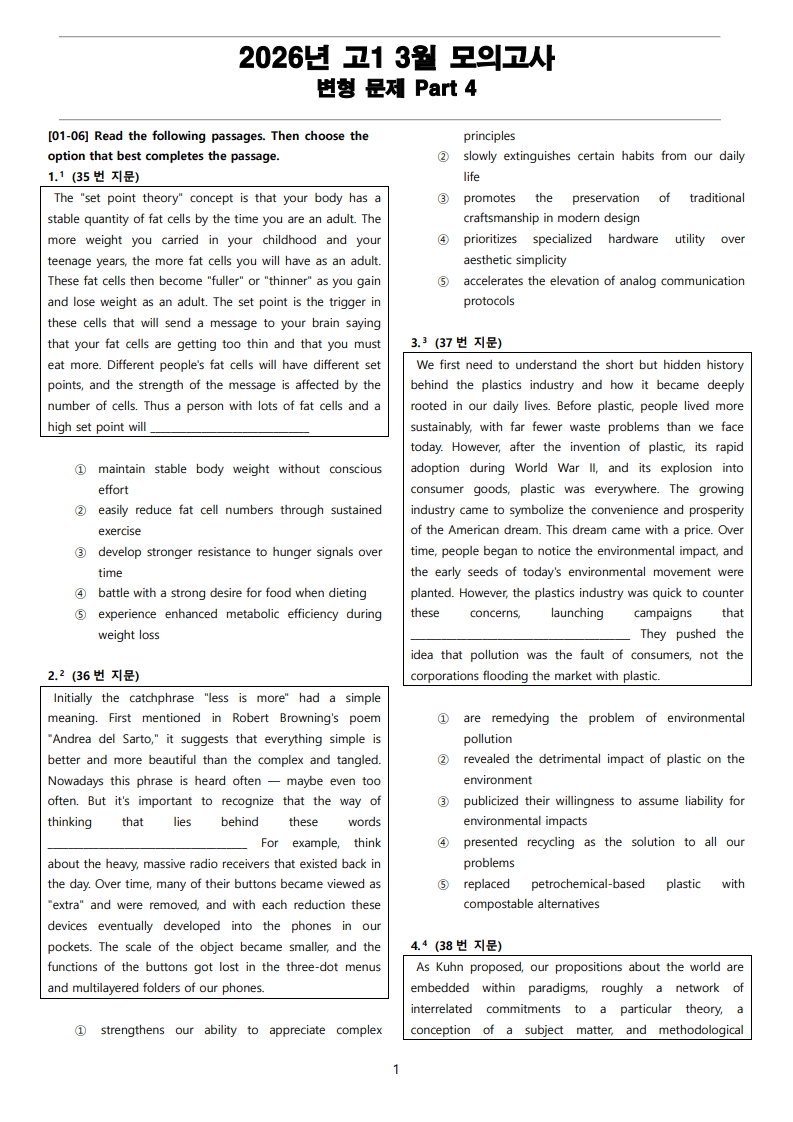
1번 지문(문항 번호 35번)
The "set point theory" concept is that your body has a stable quantity of fat cells by the time you are an adult. The more weight you carried in your childhood and your teenage years, the more fat cells you will have as an adult. These fat cells then become "fuller" or "thinner" as you gain and lose weight as an adult. The set point is the trigger in these cells that will send a message to your brain saying that your fat cells are getting too thin and that you must eat more. Different people's fat cells will have different set points, and the strength of the message is affected by the number of cells. Thus a person with lots of fat cells and a high set point will battle with a strong desire for food when dieting.
2번 지문(문항 번호 36번)
Initially the catchphrase "less is more" had a simple meaning. First mentioned in Robert Browning's poem "Andrea del Sarto," it suggests that everything simple is better and more beautiful than the complex and tangled. Nowadays this phrase is heard often ─ maybe even too often. But it's important to recognize that the way of thinking that lies behind these words slowly extinguishes certain habits from our daily life. For example, think about the heavy, massive radio receivers that existed back in the day. Over time, many of their buttons became viewed as "extra" and were removed, and with each reduction these devices eventually developed into the phones in our pockets. The scale of the object became smaller, and the functions of the buttons got lost in the three-dot menus and multilayered folders of our phones.
3번 지문(문항 번호 37번)
We first need to understand the short but hidden history behind the plastics industry and how it became deeply rooted in our daily lives. Before plastic, people lived more sustainably, with far fewer waste problems than we face today. However, after the invention of plastic, its rapid adoption during World War II, and its explosion into consumer goods, plastic was everywhere. The growing industry came to symbolize the convenience and prosperity of the American dream. This dream came with a price. Over time, people began to notice the environmental impact, and the early seeds of today's environmental movement were planted. However, the plastics industry was quick to counter these concerns, launching campaigns that presented recycling as the solution to all our problems. They pushed the idea that pollution was the fault of consumers, not the corporations flooding the market with plastic.
4번 지문(문항 번호 38번)
As Kuhn proposed, our propositions about the world are embedded within paradigms, roughly a network of interrelated commitments to a particular theory, a conception of a subject matter, and methodological practices. Thus, when scientists undertake research, they do so from within a specific paradigm. Even the most exacting measurements are only sensible from within that paradigm. For example, a look into a microscope tells you nothing unless you are already informed about the nature of the instrument and what you are supposed to be looking at. Thus, what we call major progress in science is not a movement from a less to a more accurate paradigm. Rather, it is a horizontal shift from one 'way of seeing the world' to another. For Kuhn, 'the scientist with a new paradigm sees differently from the way he had seen before.'
5번 지문(문항 번호 39번)
Making two visits to one of our cold greenhouses ─ one at dawn after a below-zero night, and the other a few hours later ─ provides a striking introduction to the winter harvest. During the dawn visit all the crops are frozen solid. Raising the inner covers, which is difficult because they too are frozen, reveals a sight of hard, frost-coated leaves bleak enough to convince anyone that this idea is foolish. Yet a few hours later, after the sun has warmed the greenhouses above freezing, the second visit presents a miraculous contrast. Under the inner covers are closely spaced rows of vigorous, healthy leaves that stretch the length of the greenhouse. The leaf colors in different shades of greens, reds, maroons, and yellows stand bright against the dark soil. It looks like a never-ending spring.
6번 지문(문항 번호 40번)
Parenting experts say children need to learn independence and resilience. But cities and suburbs don't offer safe walk and bike routes to school, malls kick teenagers out on the weekends, and free time disappears under a spreadsheet of activities. All of those "musts" take more of the parents' time or money to navigate, because the child can't do it on their own. As Darby Saxbe, a clinical psychologist, recently wrote in the New York Times, "underparenting requires structural change." Unlike most political experts, she's not just talking about economic policies like family leave and government-supported childcare. She's talking about actual physical structures, and the cultural change required to populate them. We need to "build back our tolerance for children in public spaces," she writes, "and create safe environments where lightly supervised kids can move around freely."
'전국 연합 모의고사 변형 문제 > 고1 모의고사 변형 문제' 카테고리의 다른 글
| 2026년 고1 3월 전국 연합 모의고사 변형 문제 Part 3 (0) | 2026.03.27 |
|---|---|
| 2026년 고1 3월 전국 연합 모의고사 변형 문제 Part 1 (44문항) (0) | 2026.03.26 |
| 2025년 고1 10월 전국 연합 모의고사 변형 문제 Part 4 (0) | 2025.12.02 |
| 2025년 고1 10월 전국 연합 모의고사 변형 문제 Part 3 (0) | 2025.11.28 |
| 2025년 고1 10월 전국 연합 모의고사 변형 문제 Part 2 (0) | 2025.11.26 |