
2026년 고1 3월 전국 연합 모의고사
변형 문제 Part 2
일반 워크북 형태의 문제에서 벗어나 The Makings가 만든
2026년 고1 3월 전국 연합 모의고사 변형 문제 Part 2
출판사에서 오랫동안 영어 번역과 교정을 하셨던 원어민 선생님과
현직에서 강사를 하고 있는 연구진들이 학생들을 위한 최상의
2026년 고1 3월 전국 연합 모의고사 변형 문제 Part 2 를 선보입니다.
사고력과 이해력을 요구하는 문제들로 내신 대비 뿐만이 아니라
수능도 한꺼번에 공부하실 수 있는 자료입니다.
중간고사&기말고사 전에 더메이킹스(The Makings)에서 제작한
2026년 고1 3월 전국 연합 모의고사 변형 문제로 마무리 하세요.
정답 확인 하러가기!
https://themakings.co.kr/231/?idx=1207
2026년 고1 3월 전국 연합 모의고사 변형 문제 Part 2 (44문항) (PDF)
2026년 고1 3월 전국 연합 모의고사 변형 문제, 내신대비, 영어내신자료,고등영어자료, 모의고사 변형문제,전국 연합모의고사 변형자료, 모의고사 영어 서술형 대비, 대치동 고등 영어자료, 대치
themakings.co.kr
The Makings의 2026년 고1 3월 전국 연합 모의고사 변형 문제는
총 11개의 유형으로 구성되어 있습니다.
1. 빈칸 채우기(객관식)
2. 글의 내용 일치/불일치(객관식/한글 선택지)
3. 글의 내용 일치/불일치(객관식/영어 선택지)
4. 글 끼어 넣기(객관식)
5. 어법(서술형)
6. 어휘(서술형)
7. 주제문(객관식/영어 선택지)
8. 어휘 빈칸 채우기(서술형)
9. 영작(서술형)
10. 요약문 완성하기(서술형)
11. 문단 재배열 하기(객관식)
더메이킹스(The Makings)가 제작한
2026년 고1 3월 전국 연합 모의고사 변형 문제 Part 2의 지문입니다.
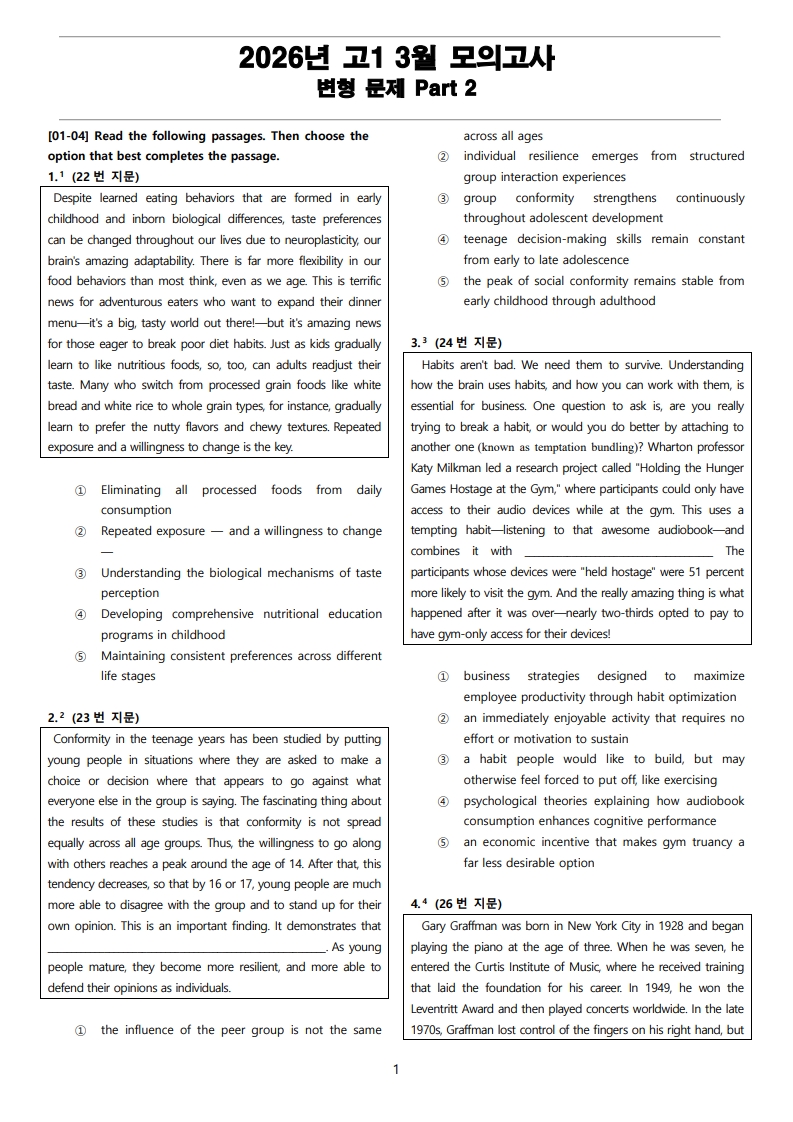
1번 지문(문항 번호 22번)
Despite learned eating behaviors that are formed in early childhood and inborn biological differences, taste preferences can be changed throughout our lives due to neuroplasticity, our brain's amazing adaptability. There is far more flexibility in our food behaviors than most think, even as we age. This is terrific news for adventurous eaters who want to expand their dinner menu—it's a big, tasty world out there!—but it's amazing news for those eager to break poor diet habits. Just as kids gradually learn to like nutritious foods, so, too, can adults readjust their taste. Many who switch from processed grain foods like white bread and white rice to whole grain types, for instance, gradually learn to prefer the nutty flavors and chewy textures. Repeated exposure and a willingness to change is the key.
2번 지문(문항 번호 23번)
Conformity in the teenage years has been studied by putting young people in situations where they are asked to make a choice or decision where that appears to go against what everyone else in the group is saying. The fascinating thing about the results of these studies is that conformity is not spread equally across all age groups. Thus, the willingness to go along with others reaches a peak around the age of 14. After that, this tendency decreases, so that by 16 or 17, young people are much more able to disagree with the group and to stand up for their own opinion. This is an important finding. It demonstrates that the influence of the peer group is not the same across all ages. As young people mature, they become more resilient, and more able to defend their opinions as individuals.
3번 지문(문항 번호 24번)
Habits aren't bad. We need them to survive. Understanding how the brain uses habits, and how you can work with them, is essential for business. One question to ask is, are you really trying to break a habit, or would you do better by attaching to another one (known as temptation bundling)? Wharton professor Katy Milkman led a research project called "Holding the Hunger Games Hostage at the Gym," where participants could only have access to their audio devices while at the gym. This uses a tempting habit—listening to that awesome audiobook—and combines it with a habit people would like to build, but may otherwise feel forced to put off, like exercising. The participants whose devices were "held hostage" were 51 percent more likely to visit the gym. And the really amazing thing is what happened after it was over—nearly two-thirds opted to pay to have gym-only access for their devices!
4번 지문(문항 번호 26번)
Gary Graffman was born in New York City in 1928 and began playing the piano at the age of three. When he was seven, he entered the Curtis Institute of Music, where he received training that laid the foundation for his career. In 1949, he won the Leventritt Award and then played concerts worldwide. In the late 1970s, Graffman lost control of the fingers on his right hand, but he never gave up playing the piano. Reconsidering the traditional piano performance convention of using both hands, he focused on works for the left hand alone, such as Ravel's Piano Concerto for the Left Hand. Graffman returned to the Curtis Institute of Music in 1980 as a member of the piano faculty. There he taught many outstanding young musicians, including Lang Lang, and his lifelong commitment to music continues to inspire people today.