문제집 변형문제/수능 실감 영어 독해 10문항 500제

수능실감 영어 독해 10문항 모의고사 500제 7회 변형문제

더메이킹스 2026. 9. 26. 12:00

수능실감 영어 독해 10문항 모의고사 500제 7회 변형문제

수능실감 영어 독해 10문항 모의고사 500제 7회 변형문제


전문항 확인 하러가기!

https://themakings.co.kr/422/?idx=1579


수능실감 영어 독해 10문항 모의고사 500제 7회(PDF)

수능실감 영어 독해 10문항 모의고사 500제 7회(PDF)은 원어민 선생님과 현직 강사가 제작한 수능 영어 변형문제. 실전 감각을 높이는 고퀄리티 문제로 내신·수능 완벽 대비.

themakings.co.kr


다음 지문을 읽고 글의 내용과 다른 문장을 고르세요.


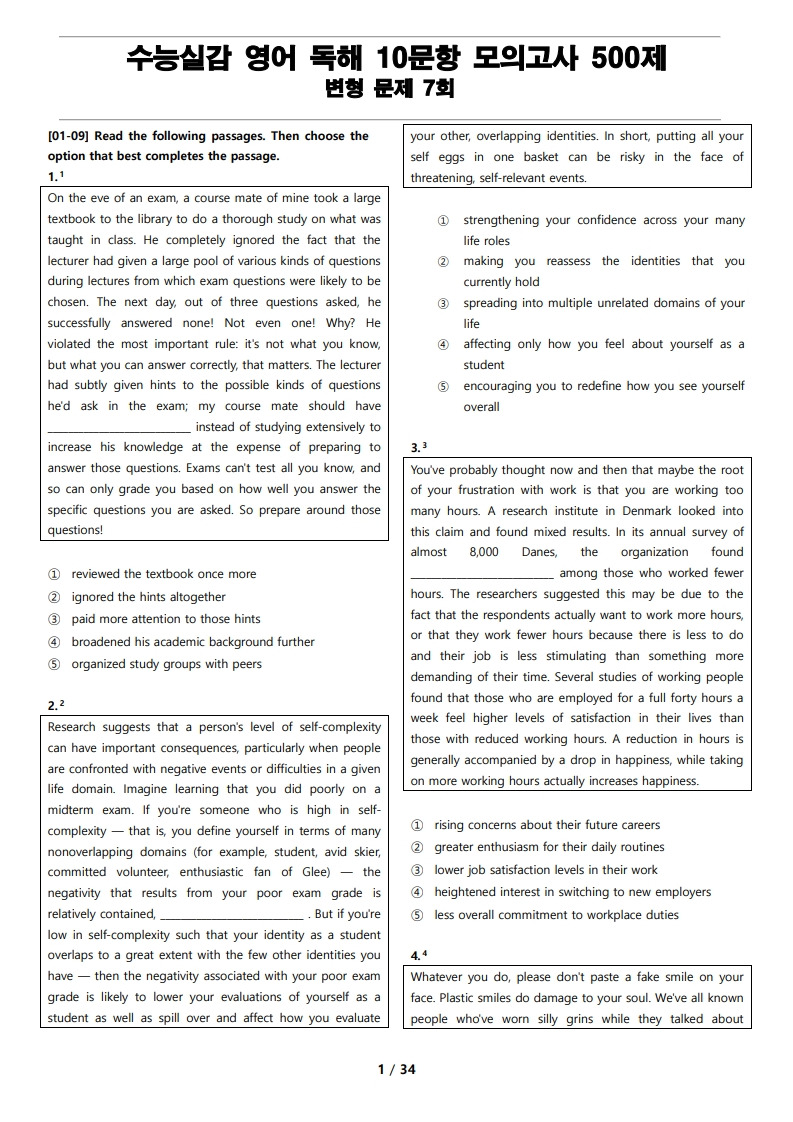
On the eve of an exam, a course mate of mine took a large textbook to the library to do a thorough study on what was taught in class. He completely ignored the fact that the lecturer had given a large pool of various kinds of questions during lectures from which exam questions were likely to be chosen. The next day, out of three questions asked, he successfully answered none! Not even one! Why? He violated the most important rule: it's not what you know, but what you can answer correctly, that matters. The lecturer had subtly given hints to the possible kinds of questions he'd ask in the exam; my course mate should have paid more attention to those hints instead of studying extensively to increase his knowledge at the expense of preparing to answer those questions. Exams can't test all you know, and so can only grade you based on how well you answer the specific questions you are asked. So prepare around those questions!


① The writer's course mate brought a large textbook to the library the night before the exam to study the class material thoroughly.

② The lecturer had provided a wide range of question types during lectures that were likely to appear on the exam.

③ Out of three questions on the exam, the course mate was unable to answer any of them correctly.

④ According to the writer, the fundamental principle of exam success is that broad knowledge matters more than the ability to respond to specific questions.

⑤ The writer concludes that students should focus their preparation on the kinds of questions they expect to encounter on the exam.


지문 해석

시험 전날 밤, 내 수업 동료는 수업에서 가르친 내용을 철저히 공부하기 위해 큰 교과서를 도서관에 가져갔다. 그는 강사가 수업 중에 시험 문제가 출제될 가능성이 높은 다양한 유형의 질문들로 이루어진 큰 문제 풀을 제공했다는 사실을 완전히 무시했다. 다음 날, 출제된 세 문제 중 그는 단 하나도 성공적으로 답하지 못했다! 하나도! 왜? 그는 가장 중요한 규칙을 위반했다: 중요한 것은 당신이 아는 것이 아니라 정확하게 답할 수 있는 것이다. 강사는 시험에서 어떤 종류의 질문을 할지에 대한 힌트를 넌지시 주었다. 내 수업 동료는 그 질문들에 답할 준비를 하는 것을 희생하면서 지식을 늘리기 위해 광범위하게 공부하는 대신 그 힌트들에 더 주의를 기울였어야 했다. 시험은 당신이 아는 모든 것을 테스트할 수 없으므로, 물어보는 특정 질문에 얼마나 잘 답하느냐에 따라서만 평가할 수 있다. 그러니 그 질문들을 중심으로 준비하라!


풀이 흐름

이 지문의 핵심 주장은 "중요한 것은 넓은 지식이 아니라 특정 질문에 정확히 답하는 능력이다"라는 것이다. 이 메시지는 지문 전체를 관통하며, 수업 동료의 실패 사례가 이를 뒷받침하는 역할을 한다.

지문은 "it's not what you know, but what you can answer correctly, that matters"라고 명시한다. 즉, 넓은 지식(what you know)보다 특정 질문에 정확히 답하는 능력(what you can answer correctly)이 더 중요하다는 것이다.

따라서 시험 성공의 근본 원칙이 "넓은 지식이 특정 질문에 답하는 능력보다 더 중요하다(broad knowledge matters more than the ability to respond to specific questions)"고 서술하는 선지가 있다면, 이는 지문의 핵심 주장과 정면으로 모순된다.


전체 선지 분석

 
선지
판정
근거
① The writer's course mate brought a large textbook to the library the night before the exam to study the class material thoroughly.
✅ 일치
지문의 "On the eve of an exam, a course mate of mine took a large textbook to the library to do a thorough study"와 직접 대응.
② The lecturer had provided a wide range of question types during lectures that were likely to appear on the exam.
✅ 일치
지문의 "the lecturer had given a large pool of various kinds of questions during lectures from which exam questions were likely to be chosen"과 정확히 대응. wide range = large pool of various kinds.
③ Out of three questions on the exam, the course mate was unable to answer any of them correctly.
✅ 일치
지문의 "out of three questions asked, he successfully answered none! Not even one!"과 직접 대응.
④ According to the writer, the fundamental principle of exam success is that broad knowledge matters more than the ability to respond to specific questions.
❌ 불일치
지문은 "it's not what you know, but what you can answer correctly, that matters"라고 명시. broad knowledge matters more ↔ it's not what you know... that matters로 정반대. 넓은 지식이 아니라 특정 질문에 답하는 능력이 중요하다.
⑤ The writer concludes that students should focus their preparation on the kinds of questions they expect to encounter on the exam.
✅ 일치
지문의 "So prepare around those questions!"과 직접 대응. focus their preparation = prepare around.


핵심 문장 정리

"It's not what you know, but what you can answer correctly, that matters."


이 문장이 ④번 선지의 오류를 판별하는 결정적 근거다. 지문은 시험 성공의 근본 원칙이 "아는 것이 아니라 정확하게 답할 수 있는 것(not what you know, but what you can answer correctly)"이라고 서술하는 반면, ④번은 "넓은 지식이 특정 질문에 답하는 능력보다 더 중요하다(broad knowledge matters more)"고 우선순위를 정반대로 서술했다.


한 줄 정리

시험 성공의 근본 원칙은 "넓은 지식이 더 중요하다"는 것이 아니라 "아는 것이 아니라 정확하게 답할 수 있는 것이 중요하다"는 것이다.


The Makings의 수능실감 영어 독해 10문항 모의고사 500제 7회

변형문제는 총 11개의 유형으로 구성되어 있습니다.


1. 빈칸 채우기(객관식)

2. 글의 내용 일치/불일치(객관식/한글 선택지)

3. 글의 내용 일치/불일치(객관식/영어 선택지)

4. 글 끼어 넣기(객관식)

5. 어법(서술형)

6. 어휘(서술형)

7. 주제문(객관식/영어 선택지)

8. 어휘 빈칸 채우기(서술형)

9. 영작(서술형)

10. 요약문 완성하기(서술형)

11. 문단 재배열 하기(객관식)


더메이킹스(The Makings)가 제작한

수능실감 영어 독해 10문항 모의고사 500제의

7회(99문항) 변형문제의 지문입니다.


1번 지문

On the eve of an exam, a course mate of mine took a large textbook to the library to do a thorough study on what was taught in class. He completely ignored the fact that the lecturer had given a large pool of various kinds of questions during lectures from which exam questions were likely to be chosen. The next day, out of three questions asked, he successfully answered none! Not even one! Why? He violated the most important rule: it's not what you know, but what you can answer correctly, that matters. The lecturer had subtly given hints to the possible kinds of questions he'd ask in the exam; my course mate should have paid more attention to those hints instead of studying extensively to increase his knowledge at the expense of preparing to answer those questions. Exams can't test all you know, and so can only grade you based on how well you answer the specific questions you are asked. So prepare around those questions!


2번 지문

Research suggests that a person's level of self-complexity can have important consequences, particularly when people are confronted with negative events or difficulties in a given life domain. Imagine learning that you did poorly on a midterm exam. If you're someone who is high in self-complexity ─ that is, you define yourself in terms of many nonoverlapping domains (for example, student, avid skier, committed volunteer, enthusiastic fan of Glee) ─ the negativity that results from your poor exam grade is relatively contained, affecting only how you feel about yourself as a student. But if you're low in self-complexity such that your identity as a student overlaps to a great extent with the few other identities you have ─ then the negativity associated with your poor exam grade is likely to lower your evaluations of yourself as a student as well as spill over and affect how you evaluate your other, overlapping identities. In short, putting all your self eggs in one basket can be risky in the face of threatening, self-relevant events.


3번 지문

You've probably thought now and then that maybe the root of your frustration with work is that you are working too many hours. A research institute in Denmark looked into this claim and found mixed results. In its annual survey of almost 8,000 Danes, the organization found lower job satisfaction levels among those who worked fewer hours. The researchers suggested this may be due to the fact that the respondents actually want to work more hours, or that they work fewer hours because there is less to do and their job is less stimulating than something more demanding of their time. Several studies of working people found that those who are employed for a full forty hours a week feel higher levels of satisfaction in their lives than those with reduced working hours. A reduction in hours is generally accompanied by a drop in happiness, while taking on more working hours actually increases happiness.


4번 지문

Whatever you do, please don't paste a fake smile on your face. Plastic smiles do damage to your soul. We've all known people who've worn silly grins while they talked about something sad. This tendency to smile even when you don't feel like it developed in childhood, when our parents persuaded us into smiling for the camera or for other people even though we didn't feel like it. Making kids smile when they aren't up to it sends a message that it's not OK to be authentic. Even in front of the camera it's better to capture genuine irritable faces than false stares. The most fascinating snapshots are truthful, those that catch people being real. Fake people plaster on smiles when they'd rather be crying, or they smile when they're angry or sad. Slowly they lose touch with their souls.


5번 지문

A human being is the kind of machine that wears out from lack of use. There are physical limits, of course, and we do need healthful rest and relaxation, but for the most part we gain energy by using it. Often, the best remedy for physical weariness is thirty minutes of aerobic exercise. In the same way, mental and spiritual indifference is often cured by decisive action or the clear intention to act. We learn in high school physics that kinetic energy is measured in terms of motion. The same thing is true of human energy: it comes into existence through use. You can't stockpile it. As Frederich S. Perls, founder of Gestalt therapy, used to say, "I don't want to be saved, I want to be spent." It might well be that all of us possess enormous stores of potential energy, more than we could ever hope to use.


6번 지문

If someone is actually vain or arrogant enough to go through life totally believing that they will succeed at every important goal they set, sooner or later they will get a big shock, because everybody, no matter how talented and driven they are, will fail at times. Fortunately, you do not have to believe completely that you'll win the contract in order to put in your proposal. You do not have to believe completely that the answer will be yes in order to ask someone out on a date. You do not have to believe completely that you will win the competition in order to enter. All you need to do is to acknowledge there's a possibility. And once you've acknowledged it's possible, you can play by this rule: Don't obsess about the outcome; get passionate about the process.


7번 지문

Sleep, rather than rest, and 'unconsciousness' (when the term can be used), are certainly to be found in insects. For example, at night the bee sleeps for about 6-8 hours, when it will often have 'droopy' antennae, and be fairly unresponsive to other bees bumping into it. Although most insects have very good eyes, there are no eyelids, and so we cannot tell from their eyes whether they are asleep. However, as antennae are just as important as eyes, and probably more so, droopy antennae certainly indicate that the animal is not in contact with reality and is not just resting. Bees, for example, can easily be deprived of sleep by keeping them in continuously moving jars, so that the insects have to fly about all the time. When the jar stops moving they settle down and are even less responsive than normal to further, gentle shaking of the jar. It is as if their sleep has become deeper in compensation for its loss.


8번 지문

Approximately 7,000 residents live in Copenhagen's city center. On an ordinary weekday evening in the winter season a person walking through the city can enjoy the lights from about 7,000 windows. The proximity to housing and residents plays a key role in the feeling of safety. It is common practice for city planners to mix functions and housing as a crime prevention strategy and thus increase the feeling of safety along the most important streets used by pedestrians and bicyclists. The strategy works well in Copenhagen, where the city center has buildings between five and six stories high, and there is good visual contact between residences and street space. However, it does not work as well in Sydney, Australia, despite the 15,000 people living in its heart. Here residences are generally from 10 to 50 stories above street level, and no one who lives high up can see what is happening down on the street.


9번 지문

If your client is trying to decide between a jacket and a sweater, she might not purchase either if she can't make up her mind. How can you help her decide what she really wants? Recent research shows that decision making is simplified when a consumer considers a third, less attractive option. Akshay Rao, a marketing professor, conducted research that shows that, when a less desirable sweater is considered in the situation above, the shopper could solve her conundrum by choosing the more attractive sweater. Akshay Rao says, "The less appealing sweater plays the role of a decoy that makes the other sweater appear more pleasing than before. In some ways, it is quite straightforward. When a consumer is faced with a choice, the presence of a relatively unattractive option improves the choice share of the most similar, better item." In fact, subjects had their brains scanned while they made their choices, and the presence of the extra possibility systematically increased preference for the better options. The brain scans showed that when making a choice between only two equally preferred options, subjects tended to display irritation because of the difficulty of the choice process. The presence of the third option made the choice process easier. When considering three options, buyers displayed a decrease in activation of the amygdala, an area of the brain associated with negative emotions. There are several implications of this research. Alternatives are routinely encountered in a variety of settings, including Web-based travel markets, and cell-phone plans. In these markets, the addition of irrelevant options is a strategy that reduces negative emotion.