N기출 영어영역 고난도 독해 Level 1 Part 1.- 7 요약문 완성 변형 문제
N기출 영어영역 고난도 독해 Level 1
Part 1.- 7 요약문 완성
변형 문제
전문항 확인 하러가기!
https://themakings.co.kr/407/?idx=1483
최상위 수능 기출문제집 N기출 영어영역 고난도 독해 Level 1 Part 1 - 7. 요약문 완성(PDF)
최상위 수능 기출문제집 N기출 영어영역 고난도 독해 Level 1 Part 1 - 7. 요약문 완성(PDF)은 원어민 선생님과 현직 강사가 제작한 수능 영어 변형문제. 실전 감각을 높이는 고퀄리티 문제로 내신·수
themakings.co.kr
지문 해석
두려운 것을 회피하면 역설(paradox)이 발생하는데, 그 두려움이 오히려 커지기 때문이다. 이는 직관에 반하는데, 두려운 것을 단기간 회피하면 두려움이 실제로 줄어들기 때문이다. 그러나 장기적으로 회피는 불안이 번성하도록 허용한다. 예를 들어, 낯선 사람과 대화하는 것이 두려워 저녁 파티에 가는 것에 불안감을 느낀다고 하자. 잠시 동안 그 저녁 모임을 피하면 불안이 줄어든다. 그러나 다음 파티 초대, 그다음, 또 그다음을 계속 피하면 문제가 생긴다. 저녁 파티를 회피한 결과, 낯선 사람과의 대화에 대한 불안이 처음보다 더 심해진 것이다. 비록 기분이 나아지는 것처럼 보이지만, 회피에 맞서야 한다. 나는 이것을 역설에 도전하기(challenging the paradox)라고 부른다. 역설에 도전하는 것은 회피를 제거하고 이를 노출(exposure)로 대체하는 것을 포함한다. 노출이란 불안하게 만드는 것에 맞서는 것이다. 불안하게 만드는 상황에 계속 맞서면 시간이 지남에 따라 불안이 줄어들 것이다.
풀이 흐름
이 지문의 핵심 논지는 "회피는 단기적 해결책일 뿐, 장기적으로는 불안을 악화시킨다"는 역설이다. 그리고 이 역설을 극복하는 방법으로 "회피를 제거하고 노출로 대체하라"고 제시한다.
지문은 "challenging the paradox"를 "getting rid of avoidance and replacing it with exposure"라고 명확히 정의한다. 즉, 회피를 제거(getting rid of)하는 것이지 수용(accepting)하는 것이 아니다.
따라서 역설에 도전하는 것이 "회피를 장기적 대처 전략으로 수용하는 것(accepting avoidance as a necessary long-term coping strategy)"이라고 서술하는 선지가 있다면, 이는 지문의 핵심 해결책과 정면으로 모순된다.
전체 선지 분석
|
선지
|
판정
|
근거
|
|
① When you avoid what you fear, a paradox occurs in which your fear ultimately grows stronger.
|
✅ 일치
|
지문의 "A paradox occurs when you avoid what you fear, because your fear then grows"와 직접 대응. ultimately grows stronger = fear then grows.
|
|
② Short-term avoidance of a feared situation can temporarily reduce your level of anxiety.
|
✅ 일치
|
지문의 "when you avoid what you fear for a short time, your fear does decrease"와 정확히 대응. temporarily reduce = does decrease for a short time.
|
|
③ Repeatedly declining dinner party invitations worsened the anxiety about talking to strangers.
|
✅ 일치
|
지문의 "if you avoid the next dinner party invitation, and then the next and the next... you have made your anxiety about talking to strangers worse"와 일치. repeatedly declining = the next and the next.
|
|
④ Challenging the paradox involves accepting avoidance as a necessary long-term coping strategy.
|
❌ 불일치
|
지문은 "Challenging the paradox involves getting rid of avoidance and replacing it with exposure"라고 명시. accepting avoidance ↔ getting rid of avoidance로 정반대. 회피를 수용하는 것이 아니라 제거하는 것이다.
|
|
⑤ Continuously facing situations that cause anxiety can help reduce that anxiety over time.
|
✅ 일치
|
지문의 "When you keep facing situations that make you anxious, you will lessen the anxiety over time"과 직접 대응. continuously = keep, reduce = lessen.
|
핵심 문장 정리
"Challenging the paradox involves getting rid of avoidance and replacing it with exposure."
이 문장이 ④번 선지의 오류를 판별하는 결정적 근거다. 지문은 역설에 도전하는 것이 회피를 "제거하고(getting rid of)" 노출로 "대체하는(replacing)" 것이라고 서술하는 반면, ④번은 회피를 장기적 대처 전략으로 "수용하는(accepting)" 것이라고 정반대로 서술했다.
한 줄 정리
역설에 도전하는 것은 회피를 장기적 대처 전략으로 "수용하는" 것이 아니라 회피를 "제거하고" 노출로 "대체하는" 것이다.
The Makings의 Part 1 - 7. 요약문 완성 변형문제는
총 11개의 유형으로 구성되어 있습니다.
1. 빈칸 채우기(객관식)
2. 글의 내용 일치/불일치(객관식/한글 선택지)
3. 글의 내용 일치/불일치(객관식/영어 선택지)
4. 글 끼어 넣기(객관식)
5. 어법(서술형)
6. 어휘(서술형)
7. 주제문(객관식/영어 선택지)
8. 어휘 빈칸 채우기(서술형)
9. 영작(서술형)
10. 요약문 완성하기(서술형)
11. 문단 재배열 하기(객관식)
더메이킹스(The Makings)가 제작한
최상위 수능 기출문제집 N기출 영어영역 고난도 독해 Level 1
Part 1 - 7. 요약문 완성(55문항) 변형문제의 지문입니다.
1번 지문
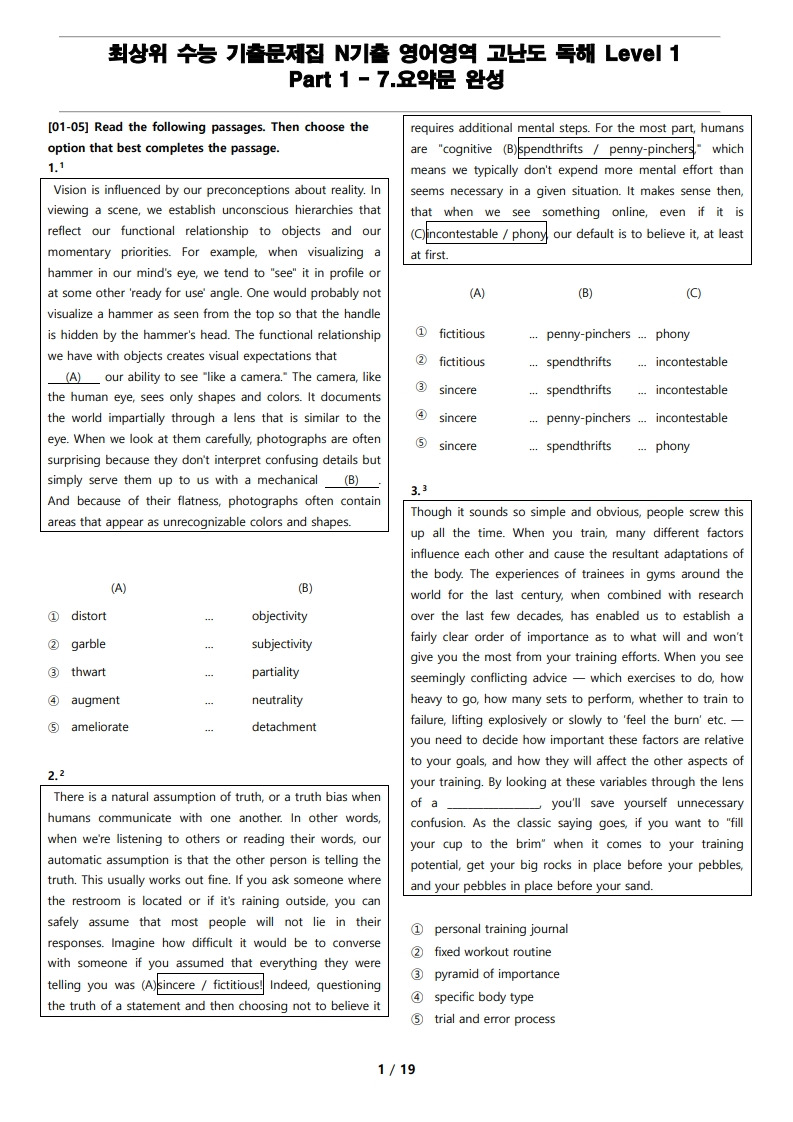
Vision is influenced by our preconceptions about reality. In viewing a scene, we establish unconscious hierarchies that reflect our functional relationship to objects and our momentary priorities. For example, when visualizing a hammer in our mind's eye, we tend to "see" it in profile or at some other 'ready for use' angle. One would probably not visualize a hammer as seen from the top so that the handle is hidden by the hammer's head. The functional relationship we have with objects creates visual expectations that interfere with our ability to see "like a camera." The camera, like the human eye, sees only shapes and colors. It documents the world impartially through a lens that is similar to the eye. When we look at them carefully, photographs are often surprising because they don't interpret confusing details but simply serve them up to us with a mechanical indifference. And because of their flatness, photographs often contain areas that appear as unrecognizable colors and shapes.
2번 지문
There is a natural assumption of truth, or a truth bias when humans communicate with one another. In other words, when we're listening to others or reading their words, our automatic assumption is that the other person is telling the truth. This usually works out fine. If you ask someone where the restroom is located or if it's raining outside, you can safely assume that most people will not lie in their responses. Imagine how difficult it would be to converse with someone if you assumed that everything they were telling you was false! Indeed, questioning the truth of a statement and then choosing not to believe it requires additional mental steps. For the most part, humans are "cognitive misers," which means we typically don't expend more mental effort than seems necessary in a given situation. It makes sense then, that when we see something online, even if it is fake, our default is to believe it, at least at first.
3번 지문
Though it sounds so simple and obvious, people screw this up all the time. When you train, many different factors influence each other and cause the resultant adaptations of the body. The experiences of trainees in gyms around the world for the last century, when combined with research over the last few decades, has enabled us to establish a fairly clear order of importance as to what will and won't give you the most from your training efforts. When you see seemingly conflicting advice ― which exercises to do, how heavy to go, how many sets to perform, whether to train to failure, lifting explosively or slowly to 'feel the burn' etc. ― you need to decide how important these factors are relative to your goals, and how they will affect the other aspects of your training. By looking at these variables through the lens of a pyramid of importance, you'll save yourself unnecessary confusion. As the classic saying goes, if you want to "fill your cup to the brim" when it comes to your training potential, get your big rocks in place before your pebbles, and your pebbles in place before your sand.
4번 지문
Clothes have always been carriers of meaning and key resources for identity work, but their role as resources for identity work varies across age lines. Whereas the older women typically make fewer excursions to the shops and have in mind aims and objectives when they do and do not enjoy being distracted, younger women are more likely to view shopping as a leisure-time pursuit, more likely to visit a shop with no specific purchase in mind. The clothing purchases of older women are more likely to be linked to specific needs (professional and social) or to their household budgets. For these women, identity will be further removed, than for younger women, from how they look and its significance. It will be linked to matters such as professional standing, children, social roles and obligations. By contrast, younger women purchase things that help them expand their self-perceived identities and images. Entities far more complex than clothes are being tried on in the changing rooms, where a dress becomes something that 'fits' or may be 'grown into' in a symbolic as well as a physical sense.
5번 지문
A paradox occurs when you avoid what you fear, because your fear then grows. This is counterintuitive, because when you avoid what you fear for a short time, your fear does decrease. Over a longer period, however, avoidance allows the anxiety to flourish. For example, let's say that you are anxious about going to a dinner party because you fear talking to strangers. For a brief time, avoiding the evening enables your anxiety to lessen. However, if you avoid the next dinner party invitation, and then the next and the next, you have created a problem. Because of your avoidance of those dinner parties, you have made your anxiety about talking to strangers worse than it was at the start. You have to try to work against avoidance, even though it seems to make you feel better. I call this challenging the paradox. Challenging the paradox involves getting rid of avoidance and replacing it with exposure. Exposure means facing what makes you feel anxious. When you keep facing situations that make you anxious, you will lessen the anxiety over time.