2026년 6월 고1 영어 모의고사 변형 문제 지문 [29, 30, 31, 32, 33 ,34]
2026년 6월 고1 영어 모의고사
변형 문제 지문 [29, 30, 31, 32, 33 ,34]
전문항 보러 가기!
https://themakings.co.kr/236/?idx=1319
2026년 고1 6월 전국 연합 모의고사 변형 문제 Part 3 (66문항) (PDF)
2026년 고1 6월 전국 연합 모의고사 변형 문제, 내신대비, 영어내신자료,고등영어자료, 모의고사 변형문제,전국 연합모의고사 변형자료, 모의고사 영어 서술형 대비, 대치동 고등 영어자료, 대치
themakings.co.kr
오늘의 문제
29번 — 글의 내용과 다른 것 고르기
지문 주제: 문학의 본질과 지속적인 힘 — 인간 창의성과 공감의 예술
지문 핵심 파악부터
이 글은 문학의 가치와 역할을 설명하는 지문이다. 특별한 사건이나 인물이 없는 대신, 문학이 무엇을 할 수 있는가에 대한 주장이 연속해서 나온다. 각 주장을 정확히 파악하는 것이 핵심이다.
① 문학의 본질적 정의
문학은 인간 창의성과 표현의 지속적인 힘을 보여주는 증거다. 시간과 공간을 초월해 모든 계층의 사람들, 수 세기와 문화를 넘어 우리를 연결한다.
② 새로운 기술에도 흔들리지 않는 문학
새로운 기술과 미디어 환경의 변화에도 불구하고 문학은 시대를 초월한 예술 형식으로서 그 가치를 유지하고 있다.
③ 문학이 지속적인 힘을 갖는 이유
인간 경험의 복잡성을 포착하고 전달하는 능력 때문이다. 작가들은 인간 감정의 깊이, 관계의 미묘함, 인간 정신의 도전과 승리를 탐구할 수 있다.
④ 문학이 독자에게 주는 것
책 속에서 자신을 발견하고, 자신과 다른 인물에게 공감하며, 인간 조건에 대한 더 깊은 이해를 얻게 해준다.
선지별 O/X 분석
① 문학은 우리 자신과 매우 유사한 인물만 보여줌으로써 우리의 시각을 제한한다.
→ ❌ (불일치) → 정답
지문을 보자.
"Literature allows us to ~ empathize with characters different from ourselves, and to gain a deeper understanding of the human condition."
지문은 문학이 우리와 다른 인물에게 공감하게 해준다고 했다. 그런데 ①은 "우리와 비슷한 인물만 보여줘서 시각을 제한한다" 고 완전히 반대로 서술했다. 내용도 틀리고 방향도 틀렸다.
② 문학은 인간 창의성과 표현의 지속적인 힘을 보여주는 증거로 묘사된다.
→ O (일치)
"Literature, in its essence, is a testament to the enduring power of human creativity and expression." 지문 첫 문장과 정확히 일치한다.
③ 작가들은 감정의 깊이와 관계의 미묘함을 탐구하는 고유한 능력을 갖고 있다.
→ O (일치)
"authors have the unique ability to explore the depths of human emotion, the nuances of relationships." 지문과 그대로 일치한다.
④ 문학은 시간과 공간을 초월해 수 세기와 다양한 문화를 넘어 사람들을 연결한다.
→ O (일치)
"It transcends time and space, connecting us with the thoughts and emotions of people from all walks of life, across centuries and cultures." 지문과 정확히 일치한다.
⑤ 문학이 지속적인 힘을 갖는 한 가지 이유는 인간 경험의 복잡성을 포착하는 능력이다.
→ O (일치)
"One reason for literature's enduring power is its ability to capture and convey the complexities of the human experience." 지문과 그대로 일치한다.
이 문제의 핵심 함정
이번 문제의 함정 유형은 이것이다.
핵심 주장을 정반대로 뒤집기
지문이 말하는 문학의 가장 중요한 역할 중 하나가 바로 "우리와 다른 사람에 대한 공감" 이다. 그런데 ①은 이것을 "우리와 비슷한 사람만 보여줘서 시각을 제한한다" 고 두 가지를 동시에 뒤집었다.
내용 뒤집기 + 방향 뒤집기가 동시에 일어난 경우로, 얼핏 읽으면 그럴싸하게 들릴 수 있지만 지문과는 완전히 반대다.
추상적 주제 지문 불일치 문제 풀이 전략
1단계 — 지문의 핵심 주장을 문장 단위로 파악
2단계 — 선지가 지문의 어느 문장에 대응하는지 찾기
3단계 — 긍정 ↔ 부정, 확장 ↔ 제한, 포용 ↔ 배제 방향 체크
4단계 — 지문에 없는 새로운 주장이 들어간 선지를 의심
이처럼 더메이킹스의 문제는 단순 암기보다는
실제 지문 이해력을 테스트 하는 문제들로 구성되어 있습니다.
The Makings의 2026년 고1 6월 전국 연합 모의고사 변형 문제는
총 11개의 유형으로 구성되어 있습니다.
1. 빈칸 채우기(객관식)
2. 글의 내용 일치/불일치(객관식/한글 선택지)
3. 글의 내용 일치/불일치(객관식/영어 선택지)
4. 글 끼어 넣기(객관식)
5. 어법(서술형)
6. 어휘(서술형)
7. 주제문(객관식/영어 선택지)
8. 어휘 빈칸 채우기(서술형)
9. 영작(서술형)
10. 요약문 완성하기(서술형)
11. 문단 재배열 하기(객관식)
더메이킹스(The Makings)가 제작한
2026년 고1 6월 전국 연합 모의고사 변형 문제 Part 3의 지문입니다.
1번 지문(문항 번호 29번)
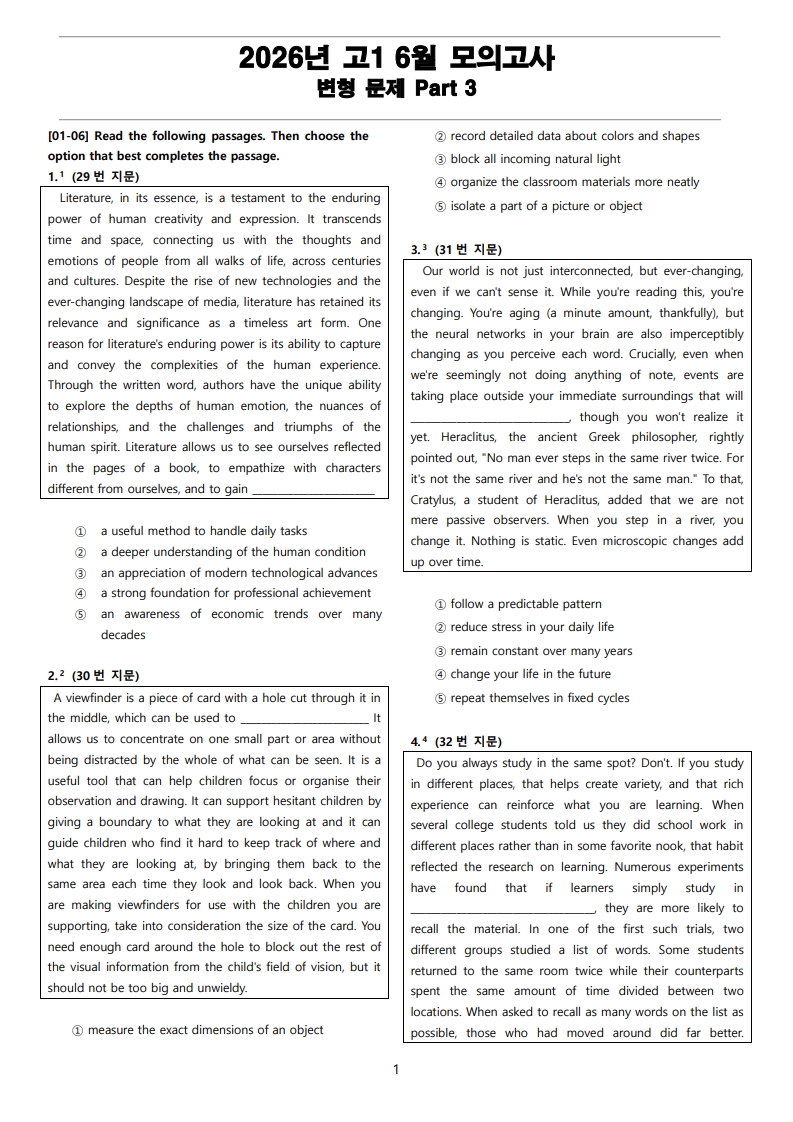
Literature, in its essence, is a testament to the enduring power of human creativity and expression. It transcends time and space, connecting us with the thoughts and emotions of people from all walks of life, across centuries and cultures. Despite the rise of new technologies and the ever-changing landscape of media, literature has retained its relevance and significance as a timeless art form. One reason for literature's enduring power is its ability to capture and convey the complexities of the human experience. Through the written word, authors have the unique ability to explore the depths of human emotion, the nuances of relationships, and the challenges and triumphs of the human spirit. Literature allows us to see ourselves reflected in the pages of a book, to empathize with characters different from ourselves, and to gain a deeper understanding of the human condition.
2번 지문(문항 번호 30번)
A viewfinder is a piece of card with a hole cut through it in the middle, which can be used to isolate a part of a picture or object. It allows us to concentrate on one small part or area without being distracted by the whole of what can be seen. It is a useful tool that can help children focus or organise their observation and drawing. It can support hesitant children by giving a boundary to what they are looking at and it can guide children who find it hard to keep track of where and what they are looking at, by bringing them back to the same area each time they look and look back. When you are making viewfinders for use with the children you are supporting, take into consideration the size of the card. You need enough card around the hole to block out the rest of the visual information from the child's field of vision, but it should not be too big and unwieldy.
3번 지문(문항 번호 31번)
Our world is not just interconnected, but ever-changing, even if we can't sense it. While you're reading this, you're changing. You're aging (a minute amount, thankfully), but the neural networks in your brain are also imperceptibly changing as you perceive each word. Crucially, even when we're seemingly not doing anything of note, events are taking place outside your immediate surroundings that will change your life in the future, though you won't realize it yet. Heraclitus, the ancient Greek philosopher, rightly pointed out, "No man ever steps in the same river twice. For it's not the same river and he's not the same man." To that, Cratylus, a student of Heraclitus, added that we are not mere passive observers. When you step in a river, you change it. Nothing is static. Even microscopic changes add up over time.
4번 지문(문항 번호 32번)
Do you always study in the same spot? Don't. If you study in different places, that helps create variety, and that rich experience can reinforce what you are learning. When several college students told us they did school work in different places rather than in some favorite nook, that habit reflected the research on learning. Numerous experiments have found that if learners simply study in at least two different places, they are more likely to recall the material. In one of the first such trials, two different groups studied a list of words. Some students returned to the same room twice while their counterparts spent the same amount of time divided between two locations. When asked to recall as many words on the list as possible, those who had moved around did far better. Variety creates rich association, even when those connections form in the background, totally outside of what we are consciously thinking.
5번 지문(문항 번호 33번)
Talking about what something smells like is the most basic way of talking about our olfactory experience, and even this most basic way of talking about smells is challenging. There are no words in the English language to describe smells in the same way in which "blue" or "green" describe colors. Instead, to talk about how something smells, we talk about the source of the odor. Things smell "flowery," "fruity," or "fishy." Furthermore, even the most familiar odors are difficult to identify when they are not experienced in their usual context. In one experiment the majority of participants was unable to name very common odors like beer, urine, roses, or motor oil. Obviously, even those who couldn't name any of these odors would drink the beer but not the urine or the motor oil. This is how evolution has shaped our brain: We respond to odors correctly in many different ways, but we are not well-equipped to talk about them.
6번 지문(문항 번호 34번)
A particularly powerful way in which human beings adapt and adjust to their circumstances is by changing behaviors in light of the consequences that they yield. For instance, a child who gets praised by her teacher for doing an exercise correctly is likely to continue doing the exercise in that way. A dancer who feels that a particular conditioning exercise is not giving any results is likely to give that exercise up in favor of another one that seems more promising. In general, we tend to do things that bring us some kind of benefit or act in ways that help us avoid some kind of problem, discomfort, or disadvantage. We also tend to do fewer things (or stop doing things) that lead to problems, discomfort, or disadvantages, and we tend to avoid acting in ways that do not bring any benefit or reward.