2025년 고1 10월 전국 연합 모의고사 변형 문제 Part 3
2025년 고1 10월 전국 연합 모의고사
변형 문제 Part 3
일반 워크북 형태의 문제에서 벗어나 The Makings가 만든
2025년 고1 10월 전국 연합 모의고사 변형 문제 Part 3
출판사에서 오랫동안 영어 번역과 교정을 하셨던 원어민 선생님과
현직에서 강사를 하고 있는 연구진들이 학생들을 위한 최상의
2025년 고1 10월 전국 연합 모의고사 변형 문제 Part 3을 선보입니다.
사고력과 이해력을 요구하는 문제들로 내신 대비 뿐만이 아니라
수능도 한꺼번에 공부하실 수 있는 자료입니다.
중간고사&기말고사 전에 더메이킹스(The Makings)에서 제작한
2025년 고1 10월 전국 연합 모의고사 변형 문제로 마무리 하세요.
정답 확인 하러가기!
https://themakings.co.kr/226/?idx=1193
2025년 고1 10월 전국 연합 모의고사 변형 문제 Part 3
2025년 고1 10월 전국 연합 모의고사 변형 문제, 내신대비, 영어내신자료,고등영어자료, 모의고사 변형문제,전국 연합모의고사 변형자료, 모의고사 영어 서술형 대비, 대치동 고등 영어자료, 대치
themakings.co.kr
The Makings의 2025년 고1 10월 전국 연합 모의고사 변형 문제 Part 3는
총 11개의 유형으로 구성되어 있습니다.
1. 빈칸 채우기(객관식)
2. 글의 내용 일치/불일치(객관식/한글 선택지)
3. 글의 내용 일치/불일치(객관식/영어 선택지)
4. 글 끼어 넣기(객관식)
5. 어법(서술형)
6. 어휘(서술형)
7. 주제문(객관식/영어 선택지)
8. 어휘 빈칸 채우기(서술형)
9. 영작(서술형)
10. 요약문 완성하기(서술형)
11. 문단 재배열 하기(객관식)
더메이킹스(The Makings)가 제작한
2025년 고1 10월 전국 연합 모의고사 변형 문제 Part 3의 지문입니다.
1번 지문(문항 번호 29번)
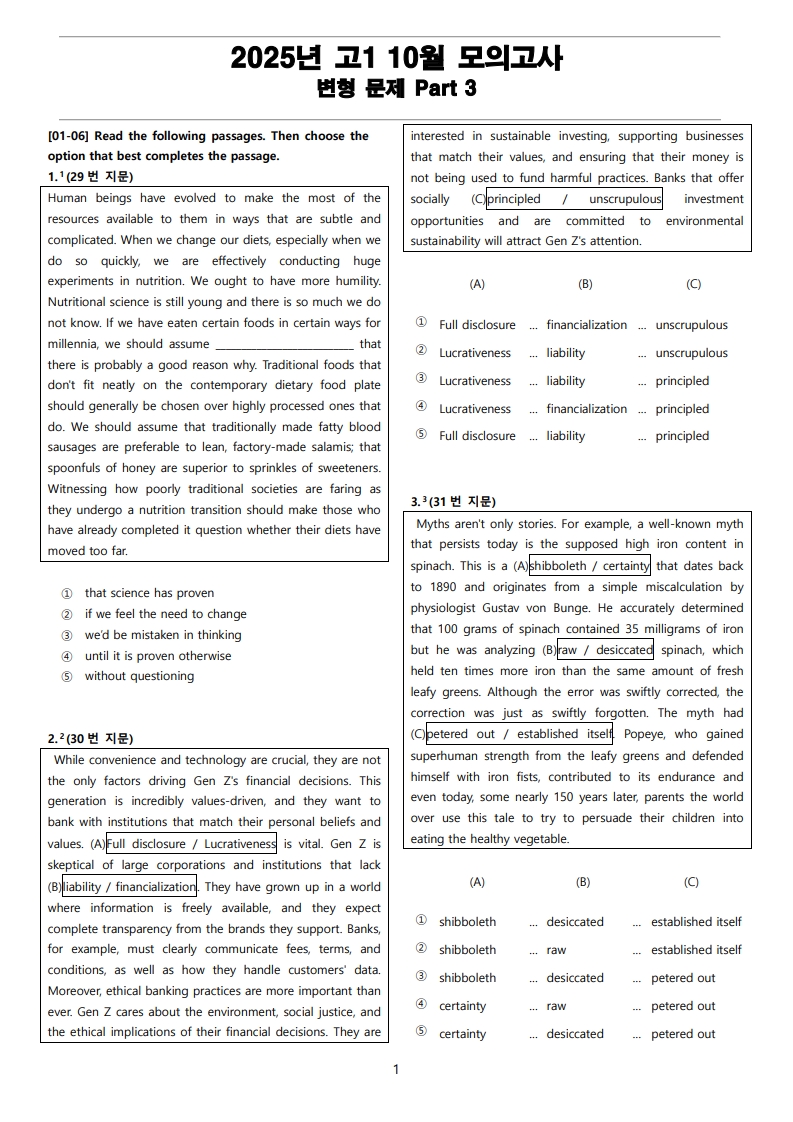
Human beings have evolved to make the most of the resources available to them in ways that are subtle and complicated. When we change our diets, especially when we do so quickly, we are effectively conducting huge experiments in nutrition. We ought to have more humility. Nutritional science is still young and there is so much we do not know. If we have eaten certain foods in certain ways for millennia, we should assume until it is proven otherwise that there is probably a good reason why. Traditional foods that don't fit neatly on the contemporary dietary food plate should generally be chosen over highly processed ones that do. We should assume that traditionally made fatty blood sausages are preferable to lean, factory-made salamis; that spoonfuls of honey are superior to sprinkles of sweeteners. Witnessing how poorly traditional societies are faring as they undergo a nutrition transition should make those who have already completed it question whether their diets have moved too far.
2번 지문(문항 번호 30번)
While convenience and technology are crucial, they are not the only factors driving Gen Z's financial decisions. This generation is incredibly values-driven, and they want to bank with institutions that match their personal beliefs and values. Transparency is vital. Gen Z is skeptical of large corporations and institutions that lack accountability. They have grown up in a world where information is freely available, and they expect complete transparency from the brands they support. Banks, for example, must clearly communicate fees, terms, and conditions, as well as how they handle customers' data. Moreover, ethical banking practices are more important than ever. Gen Z cares about the environment, social justice, and the ethical implications of their financial decisions. They are interested in sustainable investing, supporting businesses that match their values, and ensuring that their money is not being used to fund harmful practices. Banks that offer socially responsible investment opportunities and are committed to environmental sustainability will attract Gen Z's attention.
3번 지문(문항 번호 31번)
Myths aren't only stories. For example, a well-known myth that persists today is the supposed high iron content in spinach. This is a legend that dates back to 1890 and originates from a simple miscalculation by physiologist Gustav von Bunge. He accurately determined that 100 grams of spinach contained 35 milligrams of iron but he was analyzing dried spinach, which held ten times more iron than the same amount of fresh leafy greens. Although the error was swiftly corrected, the correction was just as swiftly forgotten. The myth had taken hold. Popeye, who gained superhuman strength from the leafy greens and defended himself with iron fists, contributed to its endurance and even today, some nearly 150 years later, parents the world over use this tale to try to persuade their children into eating the healthy vegetable.
4번 지문(문항 번호 32번)
The technical term often used to describe animals' judgement of numbers is the approximate number system. What it does not provide is precision. It shows ― and this is the same in every species tested ― a characteristic pattern of errors, with discrimination becoming less accurate as the quantities get bigger. Rhesus monkeys can tell one from two, two from three, three from four, four from five ... but start to fail from five upwards. Rats that learned to press a lever a given number of times, from four up to twenty-four, became markedly less and less precise in their responses as the number increased: by the top end of the range they would merely produce a spread of numbers around the target. It is a common observation that when testing the accuracy of animals' number sense, the size of the numbers matters.
5번 지문(문항 번호 33번)
Despite the cultural trope depicting emotions as the opposite of rational thought, cognition ― what we commonly refer to as thinking ― is actually a key building block of emotion. How we think about our circumstances shapes the emotions we experience; then those emotions echo back to influence how we think. For instance, if you walk into a test thinking you are bad at taking tests, your anxiety will be increased. Then you don't feel good about your performance on the test, and that becomes evidence for continuing to think that you're bad at test taking. In this way there's simply no pulling emotion and cognition apart. This bi-directionality of cognition and emotion allows us to adjust difficult emotions by changing the way we think. By thinking differently ― I get nervous sometimes, but I'm still a good test taker, or that nervous feeling is just excitement and anticipation, it means I'm ready ― you can work those pathways to your advantage.
6번 지문(문항 번호 34번)
What is the Capabilities Approach (CA), and why would lawyers passionate about animal justice care about it? It is easy to say what it is not. The CA does not rank animals by likeness to humans or seek special privileges for those considered most "like us," as do some other popular theoretical approaches. The CA has concern for the finch and the pig as much as the whale and the elephant. And it argues that the human form of life is simply irrelevant when we think about what each type of animal needs and deserves. What is relevant is their own forms of life. Just as humans seek to be able to enjoy the characteristic goods of a human life, so a finch seeks a finch's life and the whale a whale's life. We should extend ourselves and learn, not lazily picture animals as lesser humans, seeking a life sort of like our own. According to the CA, each sentient creature should have the opportunity to flourish in the form of life characteristic for that creature.